
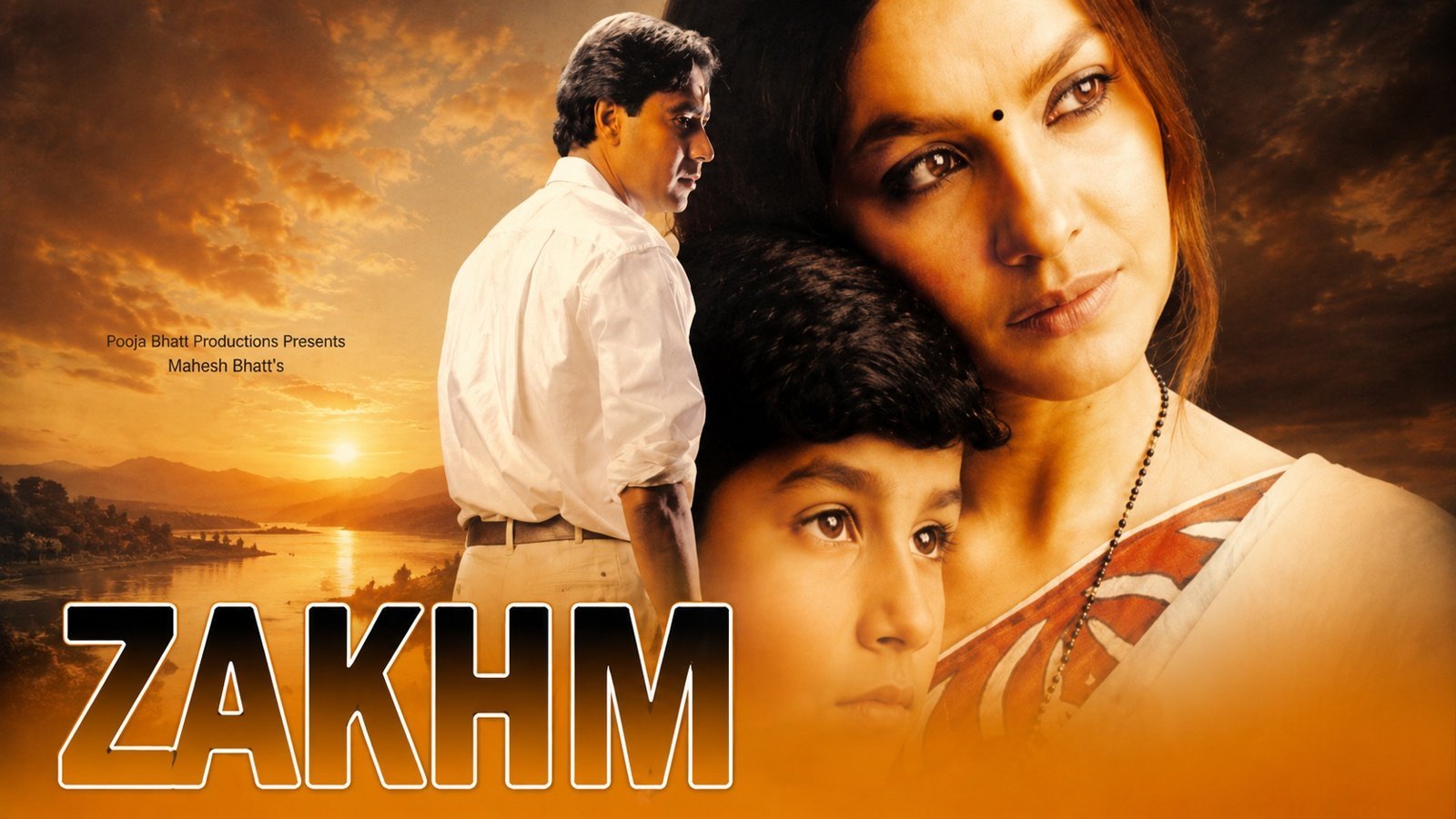
Zakhm (1998)
Starring: Ajay Devgun, Pooja Bhatt, Sonali Bendre
Director: Mahesh Bhatt
Synopsis: a sensitive and superior effort - a fitting signing off by director Mahersh Bhatt
Reviewed by: Faiz Khan
Not to be confused with the odious Chunky Pandey starrer of the late eighties, Zakhm marked Mahesh Bhatt's farewell as a director and, by any standard, it is a fitting conclusion to one of Bollywood's most fascinatingly inconsistent careers.
Bhatt has always been something of an enigma. At his best, he is capable of making deeply personal, thoughtful and emotionally resonant cinema. At his worst, he has churned out some truly dreadful commercial fare that barely hints at the talent behind it.
Zakhm reminds us exactly what Mahesh Bhatt was capable of when working from the heart.
It may not quite be a masterpiece, but it is an intelligent, compassionate and beautifully acted film.
The story opens during the Bombay riots of the early 1990s. Ajay (Ajay Devgn), now a successful music director, finds himself struggling with both writer's block and growing tension at home. His wife (Sonali Bendre) wants them to leave India and return to England before the birth of their child, escaping the violence engulfing the city. Ajay refuses.
Then comes the news that his mother has disappeared.
His search leads him to a hospital, where he discovers that an elderly woman has been set ablaze during the riots. It is his mother.
As he waits beside her hospital bed, a journalist asks why the badly burnt woman kept calling out "Allah" when Ajay himself is a Hindu.
From that moment, the story moves backwards.
We discover that Ajay's mother (Pooja Bhatt) was a Muslim woman involved in a long and ultimately tragic relationship with a Hindu man (Nagarjuna). His deeply orthodox mother refuses to accept the marriage and threatens suicide should her son marry outside the faith. Forced into another marriage, he nevertheless continues to support Pooja and their children until his untimely death.
Following his death, Pooja raises both sons as Hindus while concealing her own religion from almost everyone around her.
Returning to the present, Bhatt exposes the ultimate irony.
The woman murdered by a Muslim mob, believing her to be Hindu, was in fact a Muslim herself.
It is a powerful observation on the absurdity of communal hatred.
Religion throughout Zakhm is presented not as the problem itself but as something manipulated by politicians and extremists for their own ends. Bhatt never demonises one community at the expense of another. Instead, he presents intolerance as a tragedy that transcends religious identity.
One of the film's most convincing aspects is the pressure placed upon Nagarjuna by his orthodox family. At first it seems almost melodramatic, but one gradually realises how deeply rooted such attitudes were—and, sadly, often still are. One suspects the reaction would have been little different had the religions been reversed.
Bhatt handles this potentially explosive material with remarkable sensitivity.
There are no simplistic villains, no easy answers and very little preaching. Instead, Zakhm quietly builds towards an ending of enormous emotional power.
The performances are outstanding throughout.
Ajay Devgn gives what was, at the time, unquestionably the finest performance of his career. Quiet, restrained and deeply internalised, he conveys enormous pain without resorting to theatricality. It was the performance that firmly established him as an actor of genuine substance.
Pooja Bhatt, who also produced the film, is excellent in a role that leaves a lasting impression despite relatively limited screen time.
The film is almost stolen, however, by young Kunal Khemu, whose wonderfully natural performance as the young Ajay gives the emotional heart of the story much of its power.
Sonali Bendre has comparatively little to do but performs her role with sincerity.
The soundtrack deserves special mention. One of M. M. Kreem's finest scores, the songs are beautifully composed and perfectly integrated into the narrative, adding considerably to the film's melancholy atmosphere.
Zakhm is not simply a film about communal violence.
It is a film about identity, tolerance, family and unconditional love.
Mahesh Bhatt closes his directing career with one of his most personal and moving works—a film that refuses to sensationalise tragedy and instead finds humanity amidst hatred.
A genuine heartbreaker.
I doubt there will be a dry eye in the house by the time the final credits roll.

0 Comments
Leave a Comment