
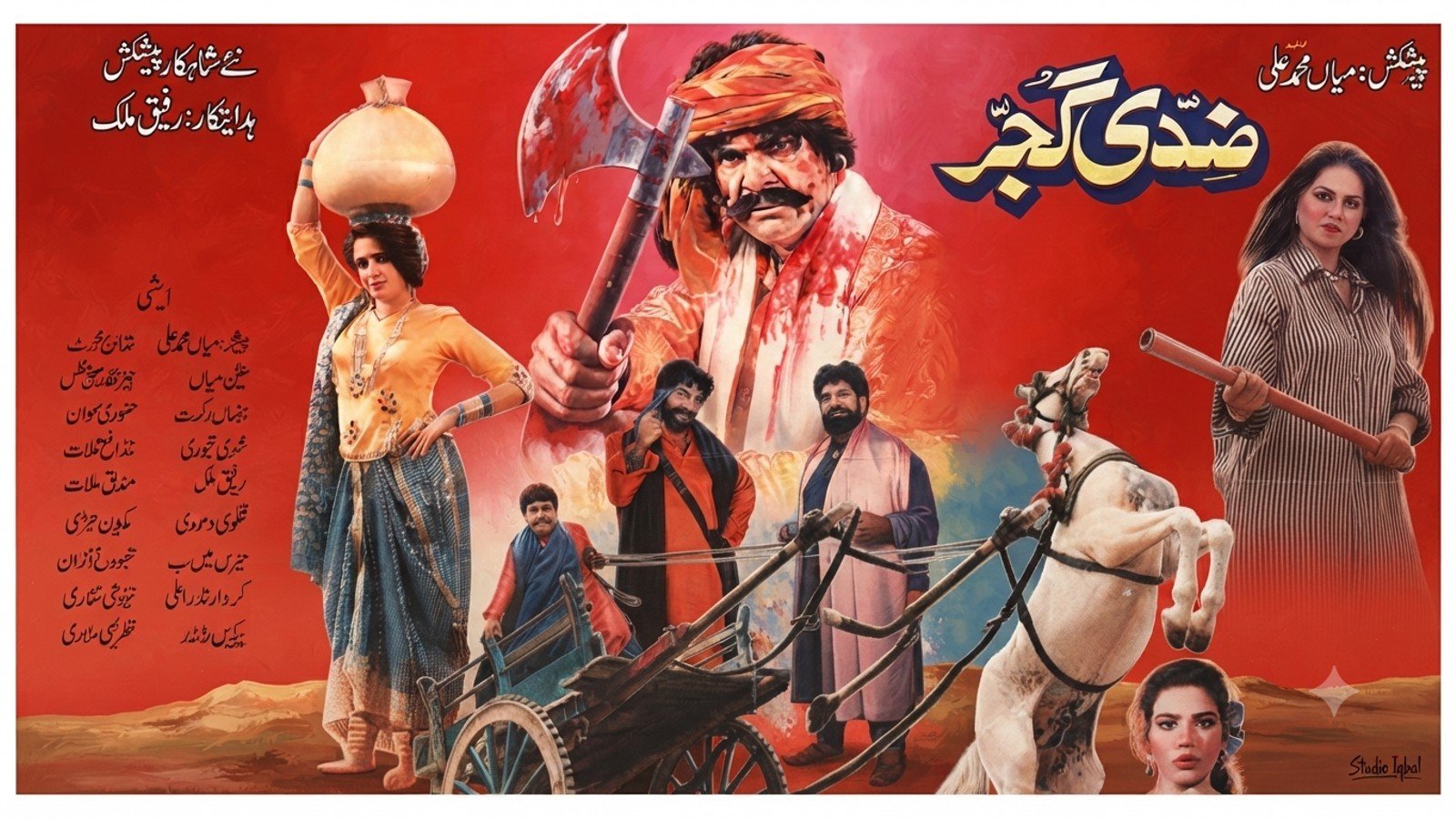
Ziddi Gujjar (1994)
Cast: Sultan Rahi, Gori, Neeli, Mustafa Qureshi, Sabiha Khanam, Asad Bokhari, Albela
Director: Younus Malik
Synopsis: Yet another vendetta-based farce with garish costumes, loud confrontations, dubious sexual double entendre, and weaves that would make Roxxxy Andrews turn green with envy.
Reviewed by: Omar Khan
The action kicks off with a man in a pink silk shalwar (who said men dressed drably in Pakistan?), calling out for help as two of his buffaloes have decided to have a violent clash, which is threatening to spill into bloodshed rather than the milk that he farms for as a living. Soon enough, Makhna (Butterfingers?), played by Sultan
Rahi, appears in a signature Polka Dot shalwar with stunningly contrasting singlet muffler thingy, a quite breathtaking attire and all in the finest shiny silk. Makhna proceeds to thrash the buffalos into submission and separates them, but then a saucy Billo (Neeli), slinks forward, carrying her “Matka” of milk about which Makhna has some concerns. The double entendre fly about “checking out her milk”, and suddenly, a toad leaps out from the container causing her significant embarrassment. Still, she takes it well in her stride, and has a jibe to answer all his innuendos with and let’s fly with a stinger before sashaying away in style. He allows her to have a lashing with his whip, typical for the ghastly machismo permeating the culture. Beating, whipping, and thrashing women are all in a day’s work, and just the norm in these parts, and those who flinch or show any shock are inexperienced in the depiction of Punjabi culture as it has been and continues to be, alas.
Rahi has some fixing to do and heads to Evernew Studios in Lahore, as one of his uncles is complaining that the hero of his movie refuses to give him dates, and the film is thus stuck. He fears his classic will be incomplete and not the money-spinning hit he hoped for. So, Makhna heads for the studios and promptly bashes some heads together. That problem is quickly solved, but not before we are treated to some special appearance inserts of Javed Sheikh, walking along a corridor for about three seconds and Anjuman for almost a fraction of a second, just to lend star power to the production. Also indicative of how law enforcement is viewed at large (rightly or wrongly), Rahi thrashes a dozen cops to a pulp and makes them stand with their heads between their legs, holding their ears; an ordinary village idiot punishment. They turn out to be actors, not real cops, so they are let off!
The public and cinema viewers look upon the police force as being utterly pathetic parasites, who only exist to exploit the public in any given situation in a society saturated with corruption. Comical but sadly not far from the truth.
Corruption is how the wheel turns in Pakistan, and though shown through absurd situations, it’s a telling portrayal. It is the same with politicians who are always depicted as leeches of the lowest form of humanity, which reflects what most of them are: parasites.
The scene then shifts to the city where a feisty babe takes on a bunch of local hoods, led by another feisty number claiming to be from the Sanghar clan, and they strut around like Sultan Rahi clones, bellowing threats at each other and dropping names like bombshells. The hoods led by Gori claim to be a top draw, “Ghundi Run” (Baddest Bitch), who has come to evict many school children and their teachers or relatives who are desperate to cling on to their abode. Still, all the
Ziddi Gujjar defiance is deflated once Gori announces she has connections to the Gujjar clan.
Moments later, we discover that the Sanghars and the Gujjars have a peace pact and have sworn by the Quran to maintain peace at all costs; thus, that particular confrontation is a non-starter while the Pact is in place.
It soon transpires that Gori is a professional con artist, who accumulates properties by posing as belonging to whichever clan suits the situation. Still, her luck is about to run out when she is sold a property by Albela, who is out to expose her fraudulent ways.
Soon enough, when she tries to muscle in on the property she supposedly bought from Albela, she is confronted by Makhna, who thrashes her bunch of hockey stick-carrying hoods to a pulp. At the same time, his nephew pees on one of them to add insult to injury.
Gori falls for Makhna during this humiliation as nothing works for a feisty Punjabi lass than being humiliated and degraded. Instantly, she bursts into a rain-drenched song to highlight her impressive bust. She quits her job as a property tycoon, as Makhna has “woken up the women within her.” Thus, she will now live only for her new love and all personal aspirations crushed for the better good.
Meanwhile, two buffoons, Jaggoo and Bagggoo (Asad Bukhari and Mustafa Qureshi), emerge from Prison wearing the finest pastel silk suits and behaving as the norm in Pakistan. In this culture, being a criminal is the most sought-after acclaim, and these two are glowing with pride as they stride out from jail, shouting imbecilic couplets as they emerge. The criminals are greeted with a full gunfire salute by a businessman from Karachi who has a grievance about how politicians have destroyed his business and ruined him. So they set off to Karachi and beat the living daylights of the said politicians and are rewarded with a flight back to Lahore in the businessman’s quite astonishing private jet. A wide-bodied aircraft containing a room where two chubby women perform a spectacular mujra with a chandelier dangling above them.
The plane, which hurtles along at the speed of light, dwarfs the Dreamliner, making it look like a speck of dust with its glorious 50ft wide body, maybe something to do with its phenomenal performance is that some windows show the plane is travelling forward. In contrast, others show it to be heading backwards.
These planes are made in Evernew Studios by the most brilliant minds. Magnificent state-of-the-art technology illustrates why the nation exports technology years ahead of the rest. All this talk about being a banana republic and a failed state is the liberal prattle of armchair Greta Thunberg wannabes. Boeing and Airbus would be drooling over this incredible slice of technology: the envy of the entire world.
Upon reaching Lahore, Baggoo and Jaggoo are displeased to find a pact between the Gujjar and Sanghar clans. They are soon scheming to end it and entertain themselves by bringing their bedding into the middle of the city, and handing out justice to a couple of men they accuse of stealing arms and giving them to our enemy across the border. A crime for which they are set alight in broad daylight while their fans cheer them on. Justice Pakistani style.
Elsewhere, the fraudulent property tycoon, Gori, shimmies in the rain for her new beau, Makhna, an ageing 60-year-old with a bulging body in all the wrong places.
The Quranic Pact is increasingly under strain as the two psychopaths, Jaggoo and Baggoo, seemingly have no jobs other than beating up people and dressing up for the catwalk on RuPaul’s Drag Race. Another fashion-forward woman is being held ransom by men with an astounding wig collection. Soon Makhna arrives and beats the living daylights out of them, saving the day as he seems to do regularly. This is before Billo tries to seduce him by wriggling and twitching around,
Ziddi Gujjar and heaving her bosom quite violently as a fish leapt into her bra from a nearby puddle. Sadly, her tactics don’t achieve what she had hoped.
At the 50-minute mark, the film has now laid down the framework for a lot of violence, amidst a spectacular display of men wearing fabulous pastel suits. Many "healthy" Uncles with loud voices walking like Macho-Men, who need desperately to show that they are “He-Men” who have enjoyed a few too many curries as their muscles are all concentrated in their guts.
So far, scintillating stuff indeed, and it is no surprise that the film has nearly hit 500,000 views on YouTube and in no time. As they say in local parlance, a Supper Hit film through and through.
Soon enough, Jaggoo and Baggoo’s blockade of the main Lahore road has Makhna riding along. When he comes across the obstacle, the Quranic Pact is stressed to breaking point, just as the two wanted. Sure enough, mayhem unleashes itself in typically gruesome and comical Lollywood style.
With the Pact broken, bloodshed, mayhem, and loud posturing get turned to unprecedented levels. But the trigger for the bloodbath is the first jumped-up Bad Bitch, who, despite being thrashed brutally by Gori, maintains her makeup and poise and swears to take the resurrected feud to a new level altogether.
At the same time, Makhna’s mother (Bahar, who else?) locks her son up in a room for being naughty and swears that he will not take any further revenge against those who broke the Quranic peace pact. And thus, the stage is set for extensive fight scenes, which resemble a deranged pantomime show for an audience with a high tolerance for juvenile idiocy of the lowest level. Despite the brilliant, decapitated head in the Biryani scene, and just when you thought you had reached the giddiest of heights, a second Sultan Rahi saves the day. With an hour and a half of fights interspersed by the occasional saucy Madame Noor Jehan number, the film is as predictable as 99.9% of Punjabi
Lollywood films are. This means neither Billo nor Gori will need to jump before a bullet or intercept a bludgeoning dagger soon.
When you thought you had seen it all, the film steps up for a jawdropping finale of such breathtaking brilliance that all that has come before is suddenly dwarfed into insignificance. The showdown between Gujjar and Sanghar features double-reanimated beheaded heads, exchanging winks and jibes and taunting their executioner, only to be blown to smithereens. The last word in Sultan Rahi endings, yet the film failed to fire at the box office again, showing how fickle the audience can be.
The movie is gaudy, loud, violent, ugly, belligerent, and fashionforward, with fat elderly men posturing in a demented manner and bulbous women (excluding the relatively svelte Neeli), to add a little spice. This formula has been repeated in hundreds of films starring Sultan Rahi and has been on repeat remix mode for decades. Some of these cinematic wonders click at the box office; others don’t, but everything is on auto mode, and it’s a pretty brain-numbing experience. If you scratch below the surface, the depiction of women indicates vile misogyny that most Pakistanis take as usual, indeed virtuous. It’s nauseating on many levels, but if you dumb yourself down to the story of a rather brainless 5-year-old or are inebriated enough, it has a particular perverse fun factor for sheer bold ridiculousness.
Sultan Rahi is on auto mode, and has been in the same manner for decades, but once a reasonably fit and wise man, he is 60 plus and bulbously overweight, and to have pretty young women throwing themselves at him is a little stomach-churning.
Neeli appears only as eye candy while Gori, Anjuman’s real sister, steps into her sister’s shoes once the latter has decided to tie the knot and head for England for a “normal life”, but sadly that didn’t work out. She had to return to Lollywood, where she was laughed at offscreen for being too old. There are no such problems for men, though, and Sultan Rahi, had he not been murdered in 1996, would probably
Ziddi Gujjar still be acting as a male romantic action hero with women 50 years younger than him. Ziddi Gujjar is appalling, laughable, and embarrassing but fascinating as a reflection of Pakistani cinema and society.
Undoubtedly, the highlight being the mujra performed at 30,000 feet within an aircraft must be the envy of the entire world.


0 Comments
Leave a Comment