
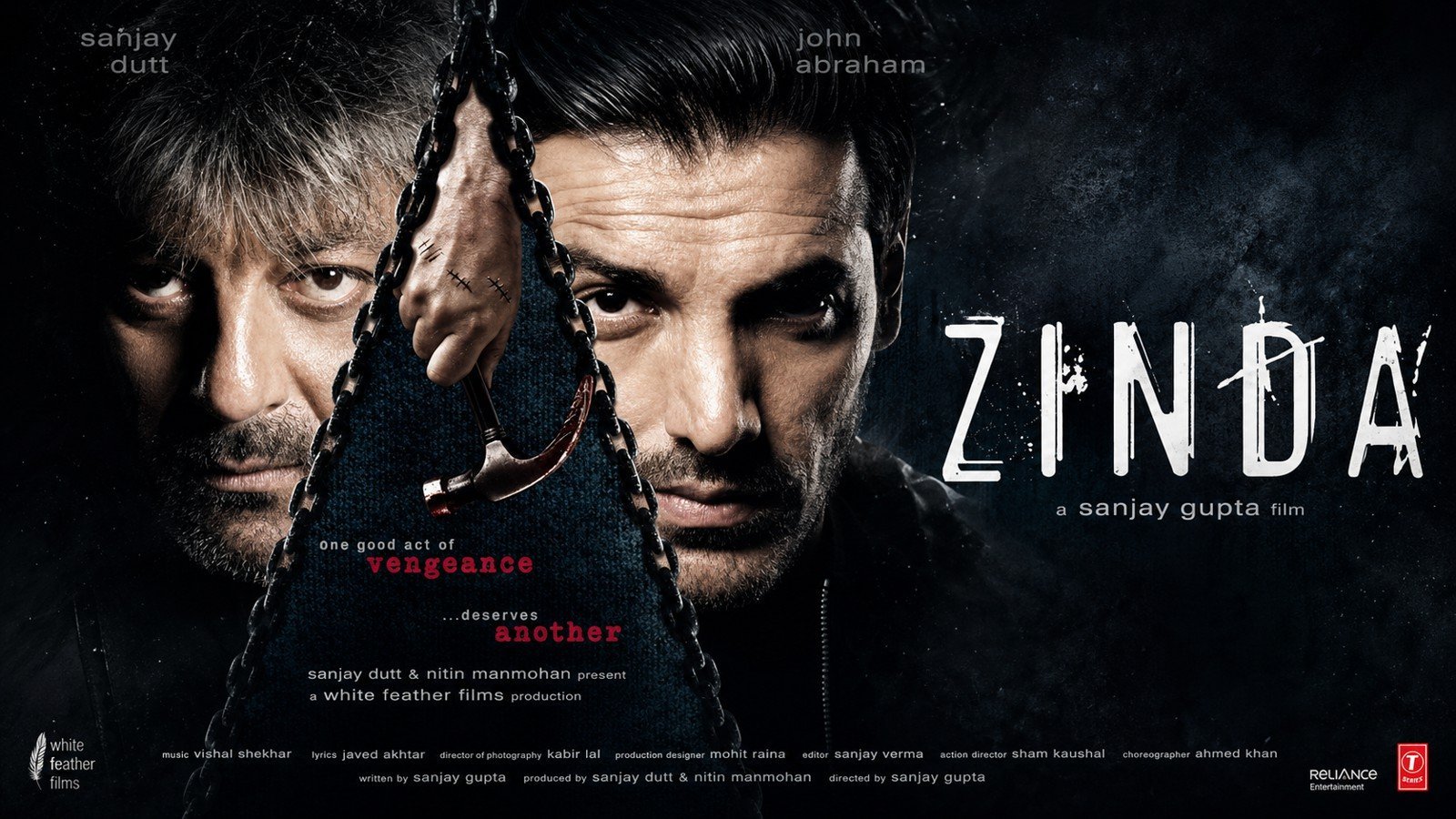
Zinda (2006)
Cast: Dutt John Abraham Lara Dutta Mahesh Manjrekar
Director: Sanjay Gupta
Music Director: Vishal Shekhar, Strings-
Synopsis: Excessively violent but stylish copy of Korean Film Oldboy
Reviewed by: Faiz Khan
The film opens with the camera gliding through the streets of Bangkok before settling upon a dishevelled, bloodied man stumbling into view. A voice-over carries us into the past.
Three friends—Balajit Roy (Sanjay Dutt), his wife Nisha (Celina Jaitly) and a companion (Mahesh Manjrekar)—argue over where to eat. Moments later, Nisha discovers she is pregnant. Excited, she rushes to tell Balajit, who is painting at the end of a jetty.
He has vanished.
The next time we see him, Balajit is imprisoned inside a dark, windowless cell, begging to know why he has been locked away. His captors never answer.
Days become months, months become years. Time passes only through fleeting images on a television, showing world events unfolding while Balajit remains trapped in the same room. Every day he is fed nothing but fried wontons. Periodically, sleeping gas is pumped into the cell, allowing unseen captors to shave him, clean the room and maintain his imprisonment.
It is a nightmare without explanation.
Through television reports he eventually discovers that his wife has been murdered—and that he himself has been blamed for the crime.
Fourteen years later, without warning, Balajit is released.
He finds himself dressed in new clothes, carrying money and a mobile phone, but with no idea who imprisoned him or why. A mysterious phone call begins a deadly game of cat and mouse.
With the help of taxi driver Jenny Singh (Lara Dutta), Balajit travels across Bangkok, sampling wontons from restaurant after restaurant until he finally recognises the taste that sustained him throughout his captivity.
From there begins his search for the truth, a journey that ultimately leads him to Rohit Chopra (John Abraham), the man responsible for his imprisonment.
Violence, revenge and increasingly outrageous revelations follow before the film races towards an astonishingly over-the-top finale.
Unfortunately, none of this really belongs to Sanjay Gupta.
Gupta claimed that Zinda was one of the most difficult films he had ever made. In truth, it must have been among the easiest, because he simply lifted almost every significant scene from Park Chan-wook's Korean masterpiece Oldboy while presenting the result as an original work.
This goes far beyond the usual Bollywood "inspiration".
It is not an adaptation.
It is not even a loose remake.
It is scene-for-scene plagiarism.
Watching the film, I initially found myself admiring the superb visual style, the striking colour palette and the technical polish. That admiration evaporated the moment it became apparent just how faithfully Gupta had copied the original. Scene after scene, image after image, even entire visual compositions are reproduced almost exactly.
Changing a chef into a taxi driver or altering a few superficial details does not transform theft into originality.
As far as I understand, the principal difference between the two films is the removal of the incest storyline from the Korean original.
Everything else remains depressingly familiar.
Sanjay Dutt throws himself into the role of Balajit Roy with complete commitment and makes the character as believable as the screenplay allows. The difficulty is that the story itself is so extreme that many Indian audiences were always likely to reject it.
The film is also exceptionally violent by mainstream Bollywood standards. Teeth are extracted with a hammer, brutal torture is depicted graphically and acts of self-mutilation make this one of the most unpleasant Hindi films of its time.
Lara Dutta has very little to do beyond accompanying the hero through much of the investigation.
John Abraham, however, continues to develop an increasingly commanding screen presence. He brings an icy menace to his role, although even much of his characterisation owes an obvious debt to the Korean original.
Ironically, the film's one truly original highlight is its superb title track by Strings, which remains haunting long after the film has ended.
As an exercise in technical filmmaking, Zinda is undeniably accomplished.
As an original piece of cinema, it is almost non-existent.
And as an overall viewing experience, it is neither pleasant nor particularly rewarding.

0 Comments
Leave a Comment