
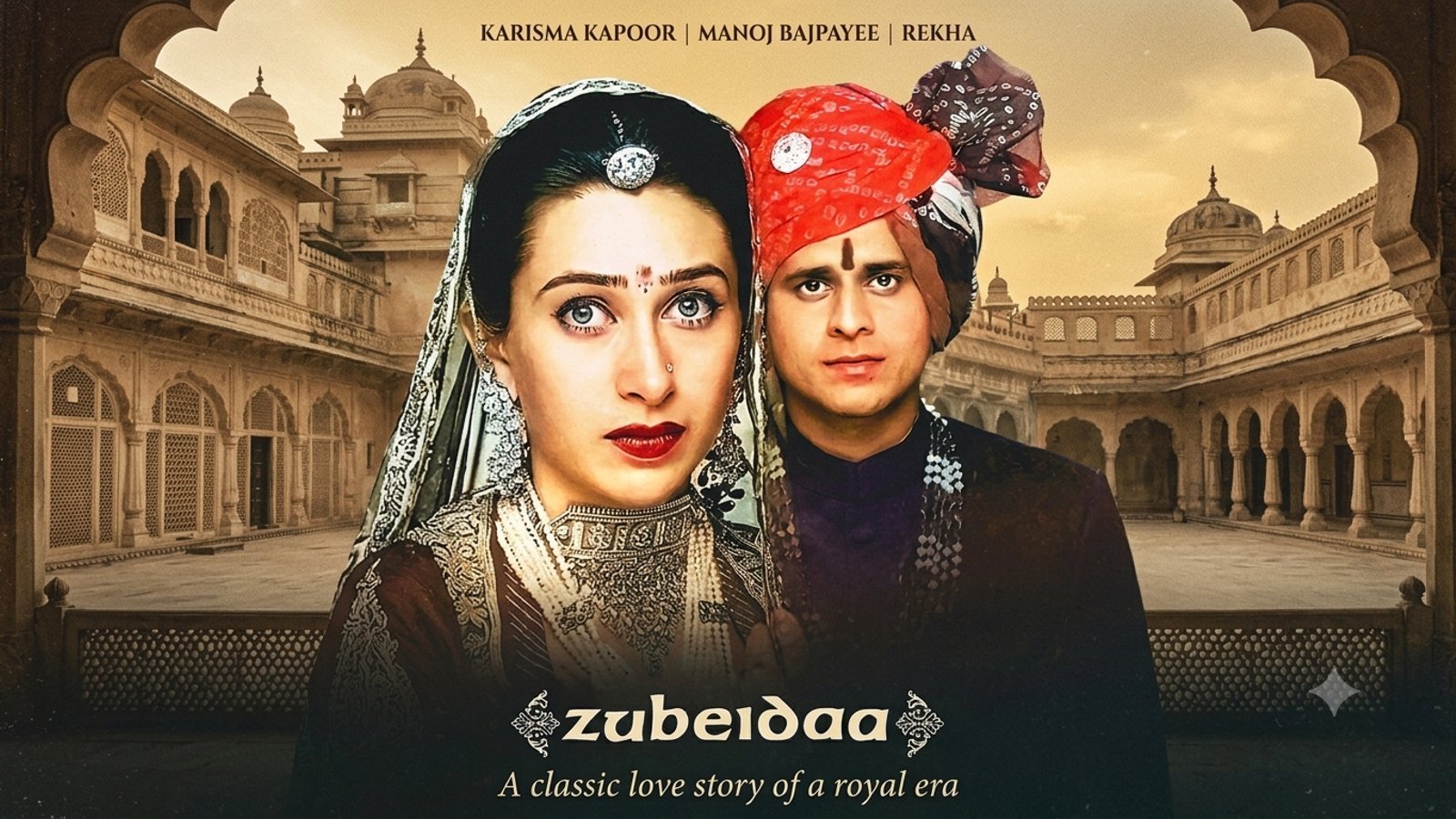
Zubeidaa (2001)
Cast: Rekha, Karishma Kapoor, Manoj Bajpai
Director: Shyam Benegal
Music Director: A.R.Rahman
Synopsis: Benegal flirts with the mainstream but does so with immense style and class
Reviewed by: Faiz & Sara Khan
An orange dupatta flutters against a sky-coloured backdrop, dancing before the camera, blown by a force beyond its control. Suddenly we descend into a quiet glade where a young boy stands beside a grave, oblivious, his tiny hands filled with rose petals. The dupatta settles upon the grave and the boy gently covers it with petals. His grandmother tells him that someone very dear to her has died. Later, when a schoolmate taunts him by saying that his mother is dead and the woman raising him is merely his grandmother, he can make little sense of his world. His ayah, also draped in an orange dupatta, sings him a story about his second mother, and the exhausted child slowly falls asleep.
Shyam Benegal has set a tragic stage from which the story quietly unfolds.
The scene shifts twenty-eight years forward to 1980. Riyaz Masud (Rajit Kapur), affectionately known as Rizzu, is now a journalist determined to uncover the truth about his mother, Zubeidaa.
His search first takes him to an abandoned film studio in pursuit of a reel containing a gypsy dance sequence—the only film appearance his mother ever made during the late 1940s. There he encounters Hiralalji, an ageing dance master from an era when, as he fondly recalls, "cinema people had character," and dancing consisted of more than "groups of youngsters in skimpy outfits doing P.T."
His bloodshot eyes immediately light up at the mention of "Zubeidaa Baby" (Karisma Kapoor). He remembers her talent, her spirit and how her domineering father, Suleiman Seth (Amrish Puri), forbade her from performing.
When Rizzu returns home, his grandmother Fayuzi Begum is appalled that he has begun searching for the past, yet cannot conceal her own curiosity. Following her initial outburst, she quietly asks whether he found anything at all.
The story begins to reveal itself.
We discover Zubeidaa's unhappy arranged marriage, forced upon her by a father who dismisses romance with the immortal question: "What has love got to do with marriage?" His own marriage is hardly an example to follow, as he finds greater companionship in the fading but still charming former film star, Miss Rose Davenport.
Whatever Rose's moral failings may be, she alone truly understands Zubeidaa's unhappiness. Following the collapse of Zubeidaa's marriage, she is left with an infant son and no prospect of a meaningful future. Rose, herself living a lonely existence surrounded by cats and dogs, perhaps sees in Zubeidaa the family she never had.
She arranges for Zubeidaa to meet the dashing polo-playing Rajkumar Victor of Fatehpur.
Their romance blossoms in secret.
Eventually, Zubeidaa's mother reluctantly permits her to travel to Fatehpur—but only on the heartbreaking condition that she leaves her young son behind.
Victor marries her.
Up until this point the narrative has relied upon memories and second-hand recollections, but Fayuzi Begum finally hands Rizzu his mother's diaries. Through them he learns of Zubeidaa's happiness, her growing disillusionment and her encounters with Victor's first wife, Mandira Devi (Rekha).
Driven by these revelations, Rizzu journeys to Fatehpur himself, now transformed into a heritage hotel. He discovers that his mother, the forgotten Choti Rani, has been erased from the official family history. Yet his meeting with the Rajmata reveals that someone there had genuinely cared for her.
The second half follows Zubeidaa's struggle against convention and royal protocol. She escaped the constraints of her father's house only to become imprisoned within an even more elaborate system of etiquette and duty.
The cage may be gilded, but it remains a cage.
Victor can never belong entirely to her. He continues to share a close bond with his first wife, whom he married as a child, while his political responsibilities increasingly occupy his attention during the turbulent years of newly independent India.
Loneliness gradually consumes Zubeidaa.
Like the dupatta carried helplessly upon the wind in the opening scene, she too is swept along by forces beyond her control, spiralling into insecurity, frustration and despair.
At its heart, Zubeidaa is about a woman searching for happiness.
Running parallel to this is Rizzu's own emotional journey. He is not seeking someone to blame; he simply wants to understand. Holding her infant son, Zubeidaa asks through tears, "Will he ever forgive me?"
It seems that perhaps he finally can.
Fortunately, the film remains uncluttered by unnecessary violence or broad comedy. Benegal recreates the late 1940s with meticulous attention to costume, décor and atmosphere. One delightful moment occurs when the Rajmata observes Rizzu's jeans, denim jacket and trainers before remarking, "Why do you have to dress like that? I suppose it's the fashion," reflecting an era when even afternoon tea demanded formal attire.
The performances are uniformly excellent.
Manoj Bajpayee undoubtedly benefits from the effortless elegance of his character. Dressed impeccably in tailored jackets, cravats and riding attire, half his work is already done before he speaks. Amrish Puri has played authoritarian fathers many times before, yet brings sufficient restraint here to prevent the character becoming merely another tyrant. It is a pity the film gradually sidelines him.
The emotional weight, however, belongs overwhelmingly to its women.
Rekha is magnificent as the gracious Rajmata. She conveys more through silence than many actresses achieve through pages of dialogue. Despite relatively little screen time, she possesses extraordinary authority and grace. It is a joy to see an actress of her calibre given material worthy of her talents.
Surekha Sikri delivers a deeply convincing performance as Fayuzi Begum, a mother trying to do what she believes is right while trapped within circumstances beyond her control.
Rajit Kapur brings warmth and quiet sincerity to Rizzu's search for his mother.
Lilette Dubey nearly steals every scene she appears in as Rose Davenport, perfectly capturing the faded Anglo-Indian film personality whose warmth and generosity survive despite a life spent on the fringes of respectability.
Ultimately, though, the film belongs to Karisma Kapoor.
She fully inhabits the restless, impulsive and emotionally vulnerable Zubeidaa. Trapped by convention yet unable to suppress her free spirit, she creates a woman constantly searching for fulfilment but never quite finding it.
Karisma navigates a remarkable range of emotions. The divorce sequence is simply superb. She remains outwardly composed while the formalities are completed, only to collapse emotionally once the final words have been spoken. It is a devastating moment that captures the repeated disappointments suffered by this spirited woman.
One inevitably asks what Zubeidaa truly wanted from life.
Perhaps the answer lies within the wonderful "Banjaran Ladki" sequence:
"Main albeli, hoon main akeli, koi paheli hoon main... Pagli hawaayein mujhe jahan bhi le jaayein mujhe, unki saheli hoon main."
For those few fleeting moments she becomes exactly who she always longed to be.
Shyam Benegal, one of India's great filmmakers, tells this deceptively simple love story with intelligence, restraint and almost lyrical grace. An undercurrent of sadness flows through the entire film as Rizzu slowly pieces together the fragments of his mother's life.
One of the film's greatest strengths lies in the way multiple perspectives combine to create a richer portrait of one woman. Fayuzi Begum blames Rose for her family's tragedy, while Rose quietly argues that Fayuzi herself mishandled her husband. "The truth always hurts," she remarks.
Everyone possesses their own truth.
Benegal moves effortlessly between past and present without ever disrupting the emotional flow. The structure is elegant and beautifully judged.
A.R. Rahman's score is magnificent, the cinematography is sumptuous, and the editing seamlessly supports the film's shifting timelines.
This is probably Benegal's most accessible work for mainstream audiences. Some may argue that it does not quite belong alongside masterpieces such as Ankur, Nishant, Manthan, Bhumika or Mandi.
That hardly matters.
Zubeidaa remains an exquisitely crafted film—deeply moving, beautifully acted and another worthy addition to the remarkable body of work created by one of India's finest directors.

0 Comments
Leave a Comment