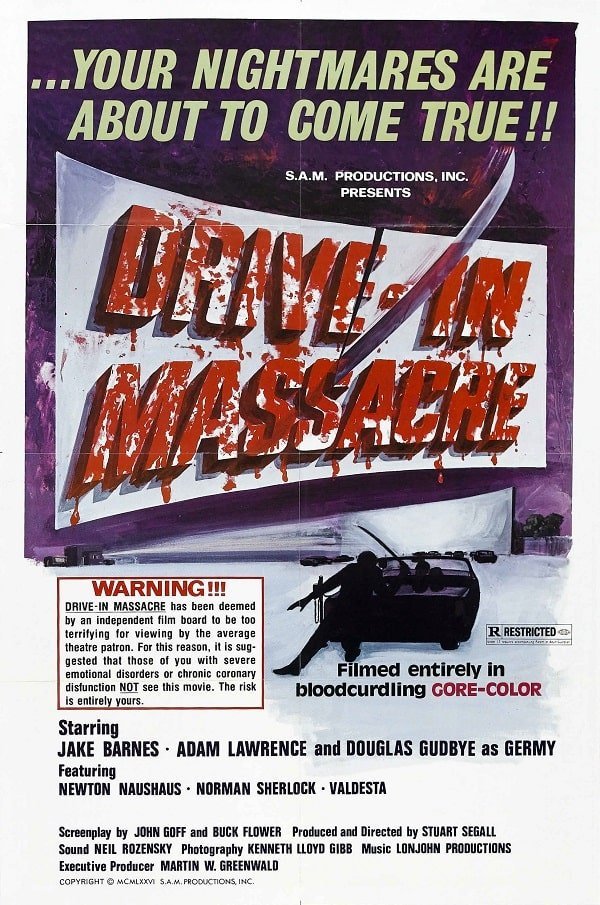
The Hot Spot Rating
Drive-in Massacre (1976)
Cast: Jake Barnes, Adam Lawrence, Douglas Gudbye
Director: Stu Segall
Synopsis: a movie that gives cheap a new meaning. A hideous piece of tripe!
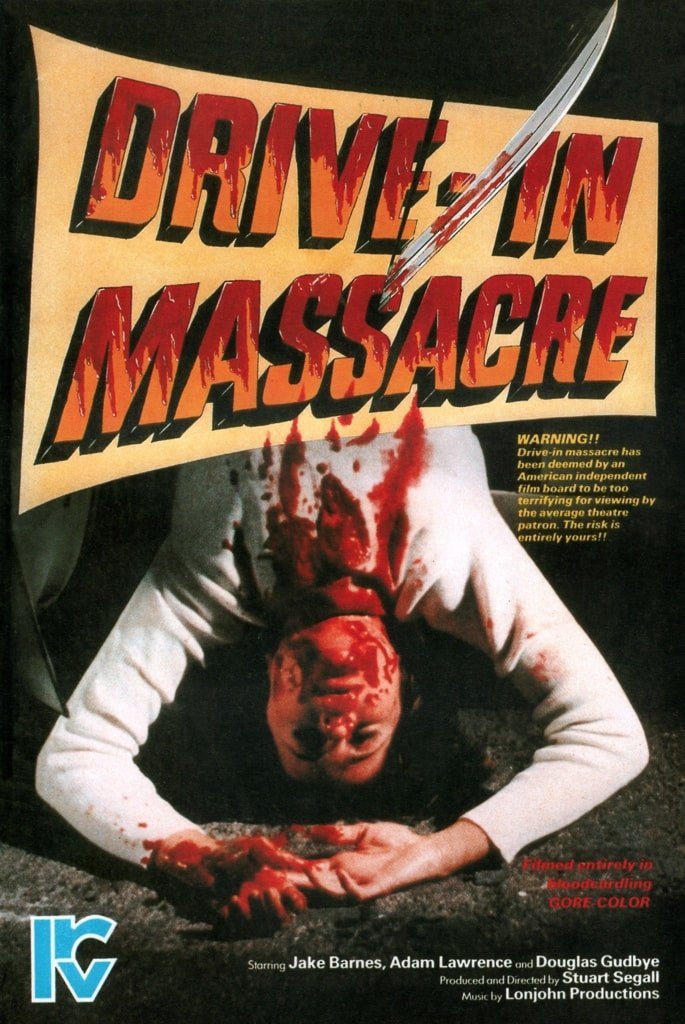
“We can’t even recommend that you see this at a drive-in” Creature Features.
“if you’re in the mood for a slasher film, you could do worse than this” Video Movie Guide
Drive-In Massacre opens with one of the most catastrophically awful title songs ever inflicted upon unsuspecting audiences.
The wretched ballad “Kissed by Yesterday” arrives shrieking over the opening credits like some dying lounge act trapped inside a collapsing karaoke machine, immediately signalling that unspeakable horrors lie ahead. In fact, astonishingly enough, this excruciating song may well represent the single most polished and accomplished aspect of the entire production.
Which tells you everything you need to know.
The setting is a sleepy, gloriously tacky American drive-in theatre where teenagers neck furiously in parked cars while a sword-wielding maniac prowls the grounds in search of fresh victims. Within minutes, a young man is decapitated in one of the most hysterically inept murder scenes imaginable before his girlfriend suffers a similar fate courtesy of a gleaming sword plunged directly through what appears very obviously to be a nylon stocking stuffed with cushions.
The resulting gore effects resemble a violent accident in a kitchenware department.
And thus the tone is firmly established.
From there onward, the film collapses into seventy minutes of near-uninterrupted incompetence as the director desperately attempts to manufacture suspense through a series of painfully obvious red herrings. Chief suspects include the nasty bald drive-in manager and the terminally dim usher Jeremy — both suspicious primarily because they used to swallow swords professionally.
Naturally.
One must admire the film’s confidence in presenting this revelation as sophisticated detective plotting.
Everything about Drive-In Massacre feels astonishingly cheap. The acting is catastrophically awful, the dialogue sounds improvised by people who may never previously have encountered human conversation, and the production values suggest the entire film was assembled using unpaid acquaintances, borrowed clothing, and whatever loose change happened to be found beneath the producer’s sofa cushions.
Yet despite all this, the film hovers tantalisingly close to achieving genuine cult-movie greatness.
Almost.
The problem is that unlike truly magnificent cinematic disasters, Drive-In Massacre possesses virtually no charm whatsoever. It lacks the manic energy, bizarre imagination, or accidental poetry that elevates many terrible films into beloved cult classics.
Instead, it simply lumbers onward with grim determination.
Particular mention must go to the soundtrack — if such a term can even be used here. The background “music” largely consists of what sounds like a malfunctioning Casio keyboard accompanied by repetitive clicking noises resembling an electric typewriter slowly dying from exhaustion.
The effect is less atmospheric than psychologically punishing.
One especially unforgettable murder scene involves a victim being impaled with a sword through what is unmistakably a stuffed pillow attempting heroically to masquerade as a human torso. The special effects throughout are so shamelessly inept that one almost begins admiring the sheer audacity involved.
And then, quite suddenly, the film simply ends.
Not concludes.
Ends.
One genuinely suspects the filmmakers ran out of film stock and collectively decided nobody involved deserved further suffering. Frankly, it was probably the wisest production decision made during the entire shoot.
Still, one undeniable blessing remains:
the running time.
At barely over sixty-eight minutes, Drive-In Massacre at least understands the importance of brevity. Even so, the experience feels considerably longer, with every minute dragging past like punishment for crimes one cannot quite remember committing.
To properly convey the staggering incompetence on display here, it is perhaps worth noting that the filmmakers could not even consistently spell the title of their own movie correctly in promotional materials.
That level of carelessness almost becomes admirable.
This may genuinely rank among the worst films ever made — which ordinarily would constitute the highest possible recommendation in the realm of cult cinema. Unfortunately, unlike true masterpieces of bad filmmaking, Drive-In Massacre remains almost entirely devoid of the accidental charm or lunatic sincerity necessary to render incompetence enjoyable.
It is not fascinatingly bad.
It is simply bad.
Painfully, relentlessly, soul-crushingly bad.
And yet somehow, perversely, still oddly compelling as an archaeological artefact of regional drive-in horror filmmaking collapsing under the weight of its own ineptitude.
The truly horrifying part is not the murders.
It is the horrifying realisation that some of us actually spent real money purchasing the laserdisc of this monstrosity voluntarily.
Which may ultimately make the audience the film’s greatest victims of all.