
The Hot Spot Rating
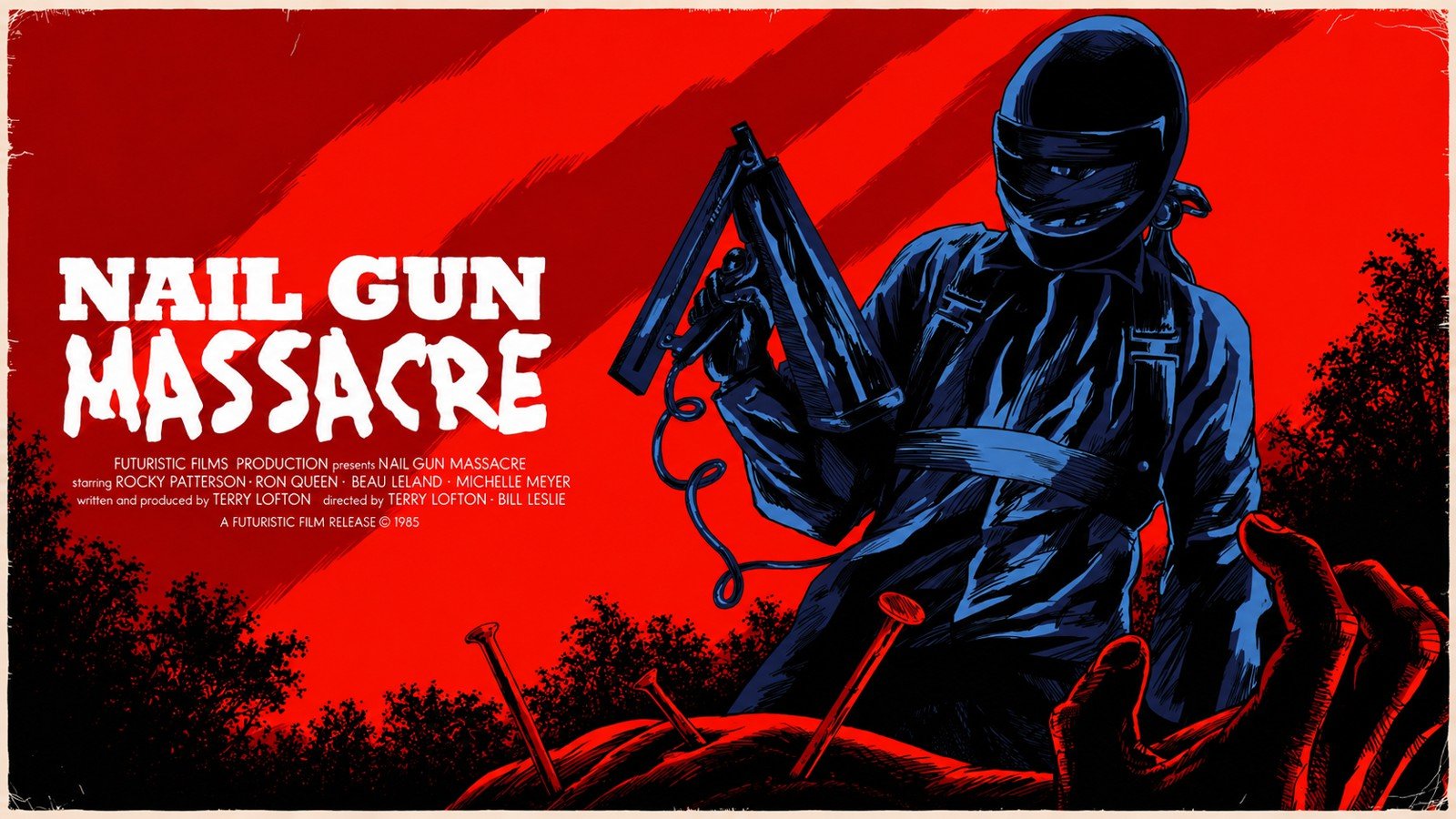
Nail Gun Massacre (1985)
Cast: Rocky Patterson, Ron Queen, Beau Leland, Michelle Meyer, Sebrina Lawless, Monica Lawless
Directors: Bill Leslie & Terry Lofton
Nutshell: The aftermath of a brutal gang rape leaves a small Texas community under siege as a nail gun-wielding maniac embarks upon a murderous campaign of revenge.
- “An amateurish horror feature… the premise proves to be funny; realistic blood effects are the pic’s raison d’être.” —Variety (video review, May 2, 1987)
- “A typically lame slasher flick… an inexcusable sexist tripe that will only appeal to indiscriminate splatterpunks.”— Scott Aaron Stine, The Gorehound’s Guide to Splatter Films of the 1980s
- “It’s not quite the Troll 2 of slasher movies, but I had more fun with Nail Gun Massacre… laughing and screaming at my TV… than any other movie I’ve watched in a very long time.”— Adam Tyner, DVD Talk
- “A sleazy slasher from the ‘anything goes’ VHS heyday… There are moments of unintentionally hilarious reprieve on display throughout the film.”— Paul Corupe, DVD Verdict
- ★☆☆☆ (1 out of 4 stars)
— TV Guide
There is dreadful, there is shocking, and then there is cinema so hopelessly inept that it somehow develops a perverse charm simply through the sheer scale of its incompetence. Nail Gun Massacre comes tantalisingly close to joining that select club, but never quite embraces its own madness enough to become genuinely entertaining.
Produced in Texas during the dying days of the slasher boom, it was clearly hoping to cash in on the success of The Texas Chain Saw Massacre, replacing Leatherface’s chainsaw with a pneumatic nail gun. On paper that sounds promising. In practice, not so much.
The film opens with an unpleasantly protracted gang rape in which a group of redneck louts take turns terrorising a young woman while their equally repellent accomplices wait patiently for their opportunity. Five months later the tables begin to turn when a mysterious figure, clad in motorcycle helmet, combat fatigues and what appears to be an oxygen cylinder, starts dispatching the culprits with a nail gun.
Our anonymous killer also delights in delivering dreadful one-liners after each murder, using an electronic voice changer decades before Scream made the gimmick fashionable. The effect is unintentionally hilarious, although probably not in the way the filmmakers intended.
Curiously, this may be one of the few slashers in which the killer seems to prefer broad daylight to the traditional cover of darkness. Victims are dispatched with such relentless frequency that the film barely pauses long enough to establish who anybody is before another unfortunate soul is pinned to a wall with industrial hardware.
Between murders, the filmmakers dutifully include lengthy love scenes for viewers who measure slashers by their nudity quota rather than their body count. There is no shortage of exposed flesh, including generous close-ups of female breasts, male buttocks and, rather unexpectedly, a rare full-frontal male shot thrown into the bargain.
Although the body count mounts impressively, the violence itself is surprisingly restrained. We seldom witness the killings directly; instead we’re shown corpses decorated with protruding nails and lavish quantities of fake blood after the event. Ironically, the extended love scenes are considerably more graphic than the murders themselves.
The acting is catastrophically wooden. Performances that would seem hopelessly amateurish in a local theatre production somehow made it onto film. By comparison, the cast of Don’t Go in the Woods look positively Shakespearean. Likewise, the camerawork and production values make early John Waters films resemble Gone with the Wind.
The filmmakers also attempt to inject a whodunit element into proceedings, but by this stage one is far more interested in wondering how many more nails remain in the gun than in discovering the killer’s identity.
Is there anything remotely redeeming here? Perhaps, if viewed in exactly the right frame of mind. There is certainly an undeniable fascination in watching a film fail on almost every conceivable level while continuing to press doggedly onward with complete sincerity. That kind of accidental entertainment has its own peculiar appeal.
Still, ninety minutes is a long time to spend in the company of such determined incompetence. By the end, one begins to sympathise with the victims and seriously consider reaching for a nail gun oneself—if only to put the film out of its misery.
Nail Gun Massacre isn’t so-bad-it’s-good. It’s mostly just bad.
“