
The Hot Spot Rating
Snorkel, The (1958)
Cast: Peter Van Eyck, Betta St. John, Mandy Miller
Director: Guy Green
Nutshell: A cold-blooded killer with an ingenious methodology must kill again as his dark secrets are in danger of being unravelled.

“A neat little thriller with a genuinely ingenious murder method.”— retrospective British film review
“One of the better Hitchcockian British thrillers of the late 1950s.”— film historian commentary
“Tense, stylish and admirably economical.”— classic British cinema appraisal
“The premise is macabre enough to hook the viewer immediately.”— contemporary review commentary
“A tightly wound suspenser that deserves rediscovery.”— cult thriller reassessment
“The famous underwater breathing gimmick remains unsettlingly effective.”— retrospective review
“A crisp and efficient thriller that sustains tension through atmosphere rather than spectacle.”— British noir commentary
The Snorkel emerged from a screenplay by legendary Jimmy Sangster and became one of the earlier thrillers produced during the transitional period when Hammer Film Productions was beginning its ascent toward horror immortality.
By 1957, Hammer had already struck gold with The Curse of Frankenstein, and the studio was rapidly reshaping itself into a powerhouse specialising in horror and suspense cinema. The Snorkel arrived during this formative stage, before the studio’s lavish Gothic colour productions completely came to dominate public memory.
Unlike many conventional murder mysteries, the film immediately reveals its killer to the audience from the opening sequence itself. There is no whodunit element here. Instead, the suspense derives from watching a cold, calculating murderer repeatedly outwit both the authorities and his increasingly suspicious young stepdaughter.
The killer has already perfected an ingenious murder method using a concealed breathing apparatus — the titular snorkel — which allows him to commit murder in sealed rooms while maintaining an apparently airtight alibi.
Having previously murdered his wife’s husband years earlier, he now eliminates his own wife as well, leaving only her orphaned thirteen-year-old daughter standing between him and complete freedom.
Unfortunately for him, the girl is absolutely convinced he murdered both her parents.
The police, however, have little reason to believe the increasingly hysterical accusations of a grieving adolescent, and before long the case is quietly shelved as unsolved.
The young girl nevertheless persists relentlessly, taunting her stepfather with strange little rhymes and cryptic accusations that seem childish on the surface but clearly strike nerves deep within him.
Gradually the pressure mounts until the killer decides there is only one permanent solution left:
he must kill again.
From there the film steadily builds toward its climax as the murderer meticulously prepares another “perfect crime,” only for fate to intervene in devastating fashion and turn the tables upon him.
One of the more intriguing aspects of the production is that Sangster originally conceived a much darker ending than the one ultimately used. Hammer reportedly considered his original conclusion too bleak and controversial for audiences of the period and opted instead for a softened alternative.
In hindsight, Sangster was probably correct when he later remarked that the darker ending would have given audiences something to talk about — and perhaps would have helped the film linger more powerfully in memory.
Visually, the film is beautifully photographed in black and white, though it lacks the rich stylistic flourish so strongly associated with Hammer’s later Gothic masterpieces. Much of the presentation feels oddly restrained and occasionally resembles early television drama more than a theatrical feature shot on atmospheric European locations.
One cannot help feeling that a little more visual flamboyance might have elevated the material considerably.
The performances themselves are difficult to criticise. Peter van Eyck makes a strong impression as the coldly calculating killer, while Mandy Miller is highly effective as the determined and increasingly desperate young girl attempting to expose him.
The opening murder sequence is especially intriguing and establishes genuine promise, though frustratingly the film rarely quite develops the level of tension or taut suspense it occasionally threatens to achieve.
This perhaps explains why The Snorkel became overshadowed so completely by Hammer’s far more famous Gothic horrors such as Dracula, The Mummy, and their many sequels.
Compared with those vividly coloured monster classics, The Snorkel faded quietly into obscurity and remained largely forgotten for decades.
Thankfully, the excellent people at Powerhouse Films eventually restored and released the film on Blu-ray as part of one of their superb Hammer box sets, finally giving this neglected little thriller the presentation it deserved.
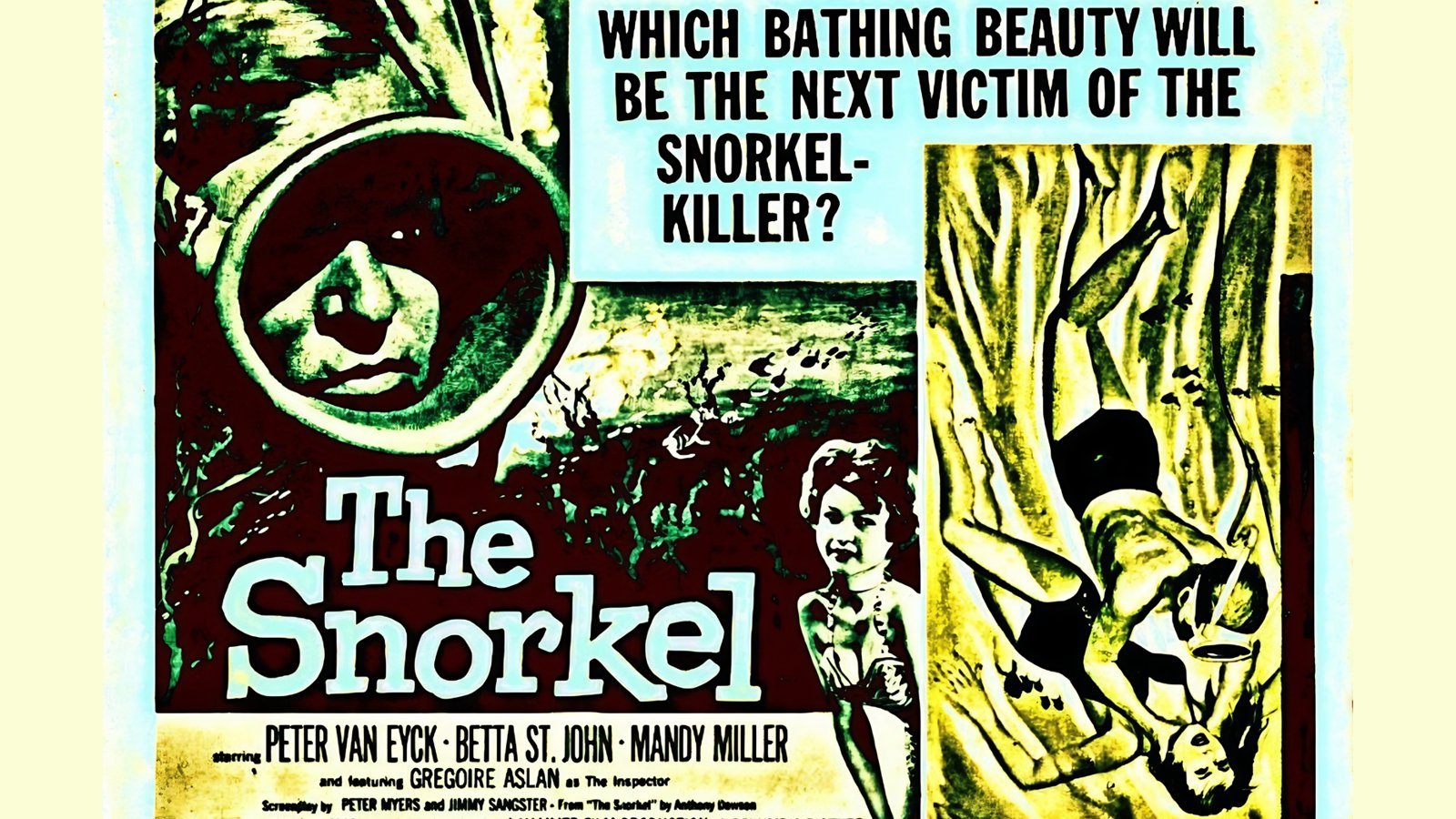
Ironically, the original poster artwork is perhaps more exciting than the film itself, misleadingly suggesting some sort of underwater stalk-and-slash thriller involving a killer pursuing victims beneath the sea.
The actual film is considerably more restrained.
Still, the Indicator release is beautifully assembled, featuring an excellent transfer, commentary tracks, and thoughtful supplementary material that make it essential viewing for anyone seriously interested in Hammer history or British genre cinema more broadly.
The Snorkel may not rank among Hammer’s greatest triumphs, nor among their most memorable productions, but it remains a perfectly capable and consistently engaging little thriller.
Had Hammer retained Sangster’s original ending, the film might well have carried considerably greater emotional weight and perhaps avoided slipping so quietly into obscurity over the decades.
As it stands, it survives as a fascinating minor Hammer curio — understated, forgotten, but certainly well worth rediscovering.