
The Hot Spot Rating
The Reptile (1966)
Cast: Noel Willman, Jennifer Daniel, Ray Barrett, Jacqueline Pearce, Marne Maitland
Director: John Gilling
Nutshell: Racist and Xenophobic shades enhance this sublime slice of vintage Hammer horror, where a spate of mysterious deaths points towards something extremely sinister.
“One of Hammer’s most stylish and eerie productions.” — classic horror retrospective
“Beautifully photographed and steeped in dread.” — cult horror review
“A haunting little nightmare.” — retrospective genre criticism
“Rich in gothic atmosphere and creeping menace.” — monster movie commentary
“An unusually poetic Hammer horror.” — film historian review
“The atmosphere is thick enough to cut with a knife.” — horror criticism
“One of Hammer’s hidden gems.” — modern cult review
“Elegant, strange and genuinely unsettling.” — classic film retrospective
“A superb exercise in slow-building terror.” — horror magazine review
“Hammer horror at its most dreamlike and sinister.” — genre commentary
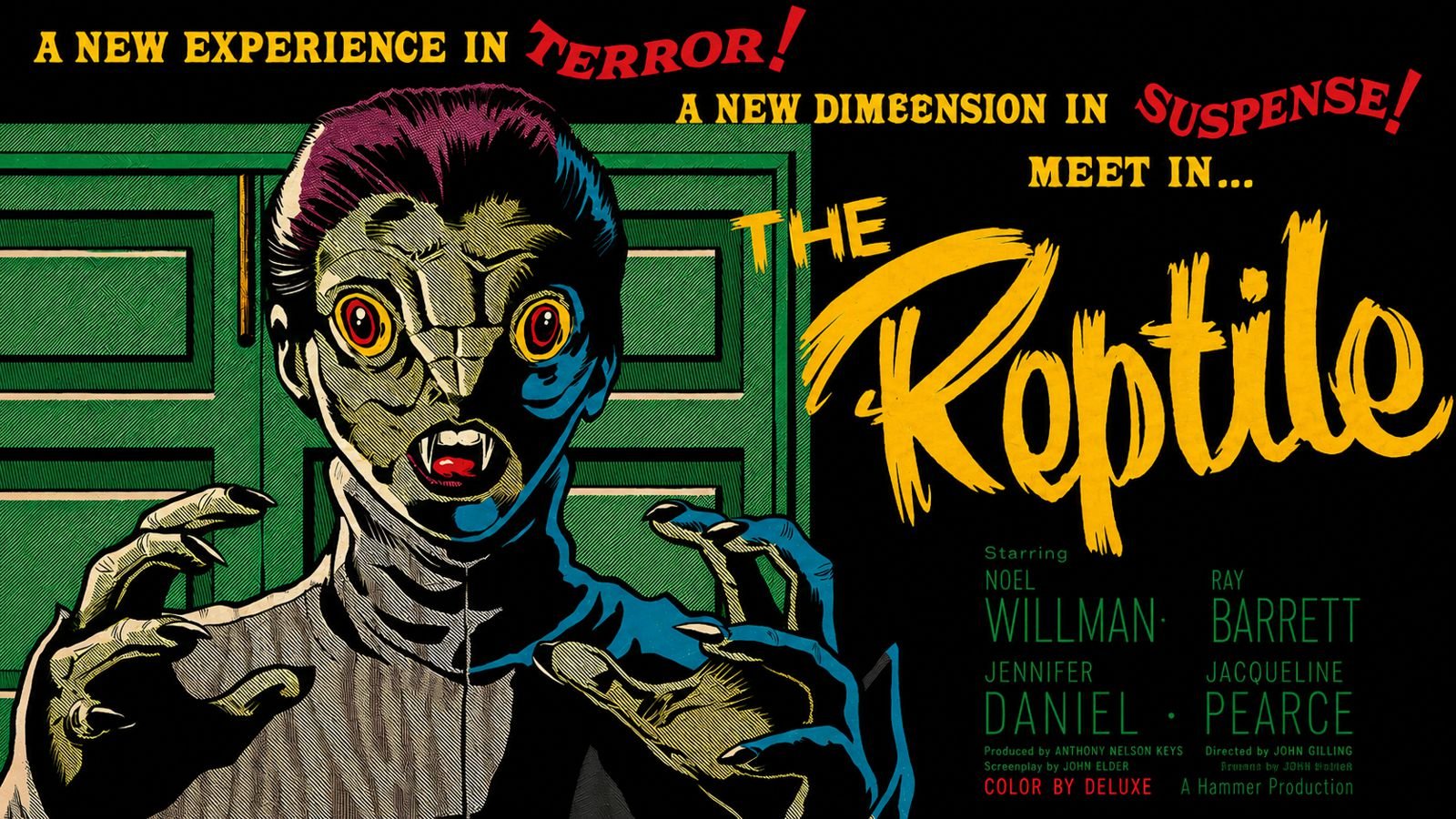
The Reptile is one of Hammer’s lesser-known films but, along with its “twin” production The Plague of the Zombies, remains something of a hidden gem. The film is loosely inspired by Bram Stoker’s The Lair of the White Worm and revolves around the sinister Dr. Franklyn.
We discover during the course of the movie that, years earlier, during an expedition to the exotic East, Franklyn managed to antagonise a cult of snake worshippers. While the doctor escaped unharmed, the cult retaliated by placing a terrible curse upon his daughter. What follows is a series of horrifying murders as a remote Cornish community falls prey to the mysterious “killer” lurking in its midst.
At the outset, a man enters a large house full of “Eastern” ornaments and is soon horribly beset by some unknown creature that fangs him in the neck, sending him reeling to his death, foaming at the mouth and turning an ashen shade of black in the process — not a pretty picture at all. His brother, living in London, inherits the deceased man’s country cottage and decides to move there with his wife while also investigating the strange death. Upon arrival, however, they are met with a cold shoulder from suspicious locals and are forced to rely on an amiable innkeeper for assistance.
Before long, they encounter the inhabitants of the large manor looming ominously over the nearby cottage — the distant Dr. Franklyn, his beautiful daughter Anna, and an exotic foreign assistant-cum-housekeeper who prowls around the area with very dubious intentions and speaks in an affected accent. He is, in fact, Malay, and clearly exerts a vice-like grip over both Dr. Franklyn and his daughter.
Slowly but surely, the mystery behind the deaths begins to unfold, building toward a thrilling climax that reveals the true horror gripping the community ever since the “foreigners” arrived in the village. Earlier, the couple had been warned by a particularly loopy villager that 15 or 20 years ago the area had been a blissful community, but “then they came… bringing their vileness with them” — all while strains of ominous “exotic” Indian music drift eerily through the background.
“Listen, damn you… can’t you hear it, woman? It means death!”
There is very clearly a recurring premise throughout the film that “vile foreigners” are arriving upon English shores and contaminating God’s good ways with strange and dangerous evil. The rhetoric sounds uncannily similar to the line that later helped propel Donald Trump to the American presidency and bears more than a passing resemblance to the themes underpinning Brexit-era paranoia in the United Kingdom.
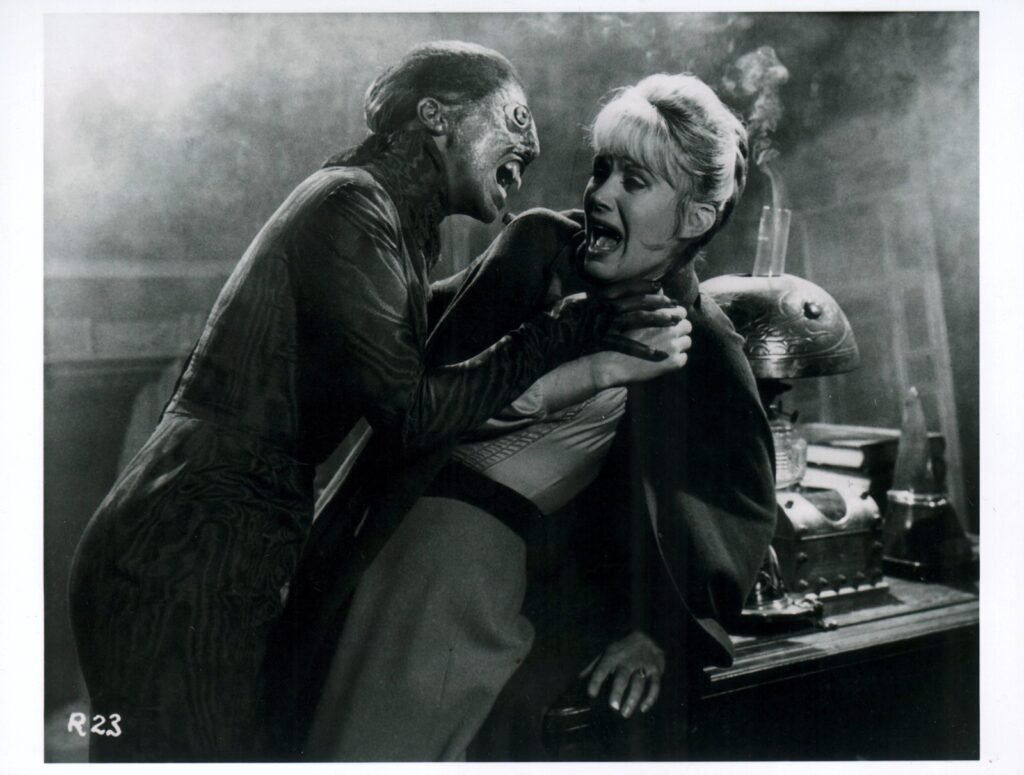
The Reptile possesses a surprisingly uneasy creepiness. Some of the deaths — particularly those involving victims foaming at the mouth while their skin blackens — are genuinely rather nasty. The film also features several genuinely frightening attack scenes.
Special mention must be made of Hammer’s legendary make-up expert Roy Ashton, who did a marvellous job creating the Reptile creature itself. Despite the film’s age, the make-up still holds up remarkably well and never descends into tacky absurdity, unlike Hammer’s later venture The Gorgon.
The Reptile creature itself remains one of Hammer’s more genuinely eerie creations. Brooding, atmospheric, and suspenseful, the film is tightly directed and consistently well acted throughout. Jacqueline Pearce is particularly alluring both as Anna and as her sinister alter ego. Another quality product from Hammer, this remains one of the better “snake genre” films I’ve encountered.
There are undeniably xenophobic shades running throughout the film, something not at all uncommon in British cinema during the 1960s. Had the film been made today, it would almost certainly be interpreted as somewhat racist — and with good reason. There is an inbuilt suspicion of foreigners and their supposedly strange and often evil ways, alongside the notion that their arrival upon the pristine shores of Cornwall has brought with it a creeping moral degeneration that is invasive, corrupting, and insidious.
The initial death sequence itself unfolds to the sound of “Eastern” music wafting through the air, and every time those musical cues return, they carry with them a sense of ominous unease.
One of the villagers accosts the newly arrived couple and warns them about the origins of the mysterious plague that has afflicted the region, with the husband’s brother becoming the latest victim. Each corpse bears bite marks upon the neck alongside the now familiar charred-black face and froth bubbling from the mouth and nose — supposedly the fate suffered by those bitten by an Indian King Cobra. But a cobra roaming around plush Cornwall?
The film has since been restored from its original negative and released on Blu-ray, looking better than it ever has before, with rich saturated colours and excellent detail. That said, the recent Hammer restorations issued by Indicator still appear even more impressive overall.
The Reptile, which reportedly came in under budget, remains one of the finest hidden gems within the Hammer catalogue. It may be less celebrated than some of the more famous Christopher Lee and Peter Cushing vehicles, but it is every bit as enjoyable and contains all the trademarks that helped earn Hammer the iconic reputation it continues to enjoy today.
A satisfying, enjoyable, and impressively crafted Hammer Horror film — among their finest.