
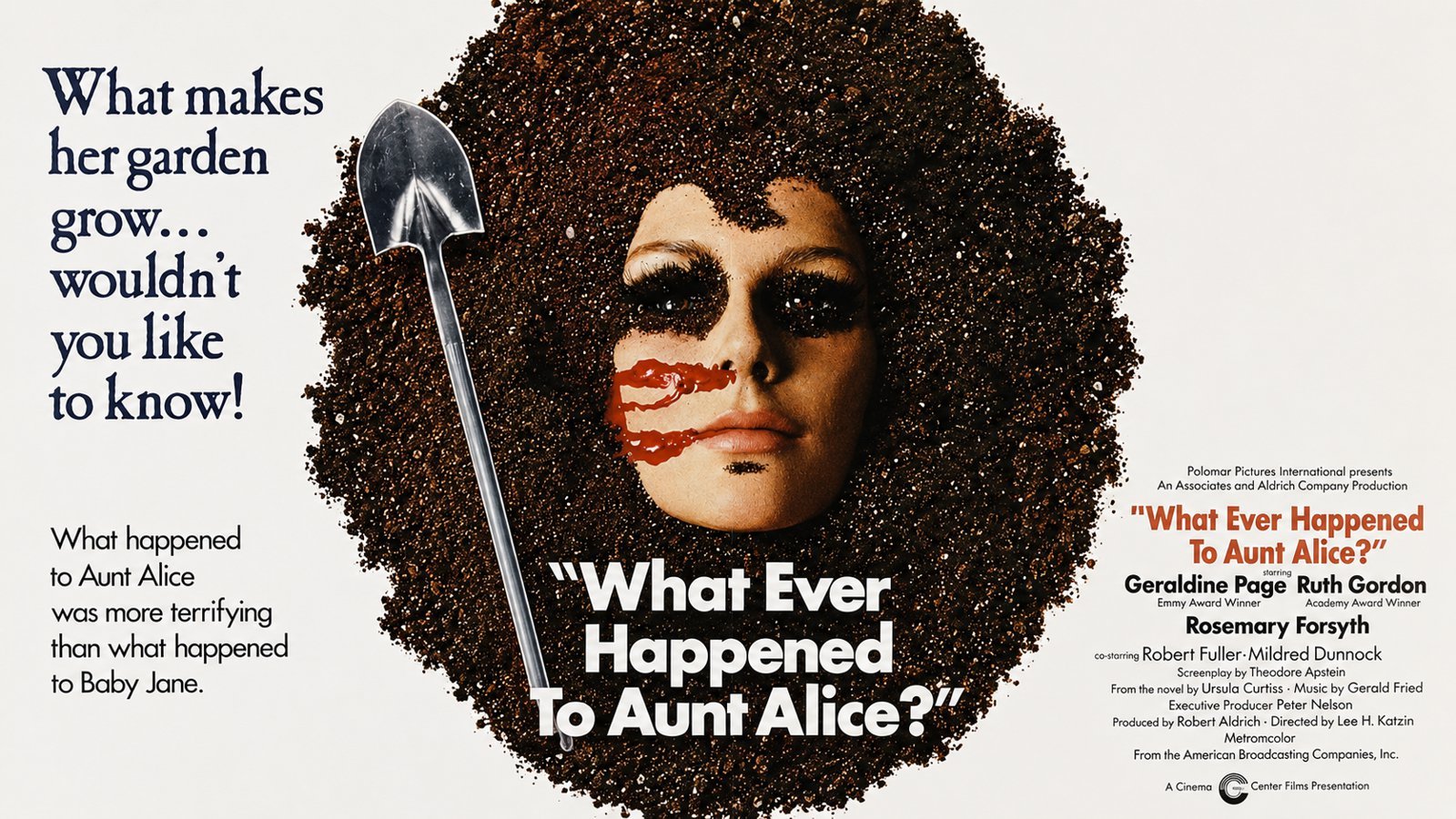
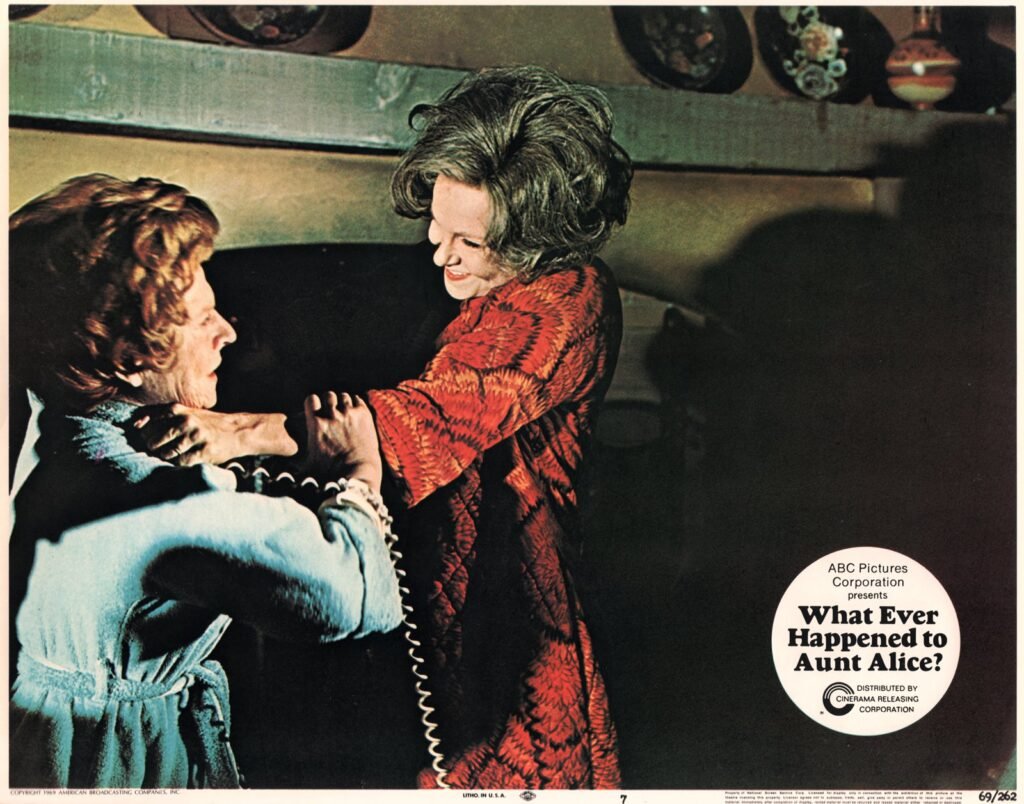
What Ever Happened to Aunt Alice? is a glorious product of the Hagsploitation era that spawned such delirious classics as What Ever Happened to Baby Jane?, Hush…Hush, Sweet Charlotte, Whoever Slew Auntie Roo?, Fanatic (better known as Die! Die! My Darling!), as well as William Castle’s wonderfully lurid Joan Crawford vehicles.
Aunt Alice is a superlative camp thriller, brilliantly acted by its principal cast. The magnificent Geraldine Page stars as a psychotic widow with a penchant for cultivating the sturdiest and most handsome pine trees imaginable — her secret, naturally, being human fertiliser in the form of a succession of butchered companions.
The deliciously deranged screenplay was adapted from Ursula Curtiss’ novel The Forbidden Garden. Eventually, suspicion begins to mount, and a friend of one of the deceased — now conveniently serving as pine-tree nourishment — starts catching on to Miss Marrable’s increasingly suspicious activities.
The film opens with a wonderfully macabre sequence of black comedy as Page demands that her dowdy companion perform the necessary gardening duties so a fresh batch of pine trees may be planted at the crack of dawn. Frumpy Miss Hull reluctantly agrees, only to have her skull cracked open with a rock before her blood is offered up as nourishment for the thirsty saplings.
It is a marvellous opening scene, accompanied by manic screeches and wildly unstable musical flourishes from Ronald Stein’s fabulously demented score.
In the scenes that follow, Mrs. Marrable is presented as a glamorous, wheelchair-bound vixen charming wealthy society friends with tales of her famous green thumb. She revels in her status as the belle of the social circuit, and apparently no gathering is complete without her gracious presence.
The unfortunate Rose Hull is swiftly replaced by Edna Tinsley who, despite her best efforts, soon finds herself falling foul of the stylish Mrs. Marrable for lacking sufficient “spark.”
Miss Tinsley tries desperately to please her employer, but to little avail. At one point she innocently plays one of Marrable’s favourite records after dinner, only to be immediately met with frosty contempt.“Will you turn that off, please?”
Edna protests:“But it’s one of your favourites…”
To which Marrable icily replies:“Is it indeed? I think we can do without music this evening.”
Mrs. Marrable has clearly had enough and is already contemplating the planting of yet more pine trees at the earliest opportunity. Miss Tinsley’s days are now obviously numbered.
Things worsen considerably when Tinsley dares ask how her investment portfolio is performing.“It was at your request, my dear Miss Tinsley, that you handed over your massive capital to Mr. Honolou… My broker has far more pressing concerns than worrying about your savings.”
Then she adds “However I shall call him in the morning and request him to sell all your savings at a loss!”
The final straw arrives when Tinsley pours her employer a cordial, only for Marrable to recoil in horror at her uncouth pronunciation.“When referring to a cordial, one uses the French pronunciation — LEE-QUAIRRR!”
Clearly, Miss Marrable has entirely run out of patience with Miss Tinsley, who now urgently needs converting into fertiliser.
Later that evening, Tinsley is smashed over the head with a spade while Marrable cackles away in triumphant delight.
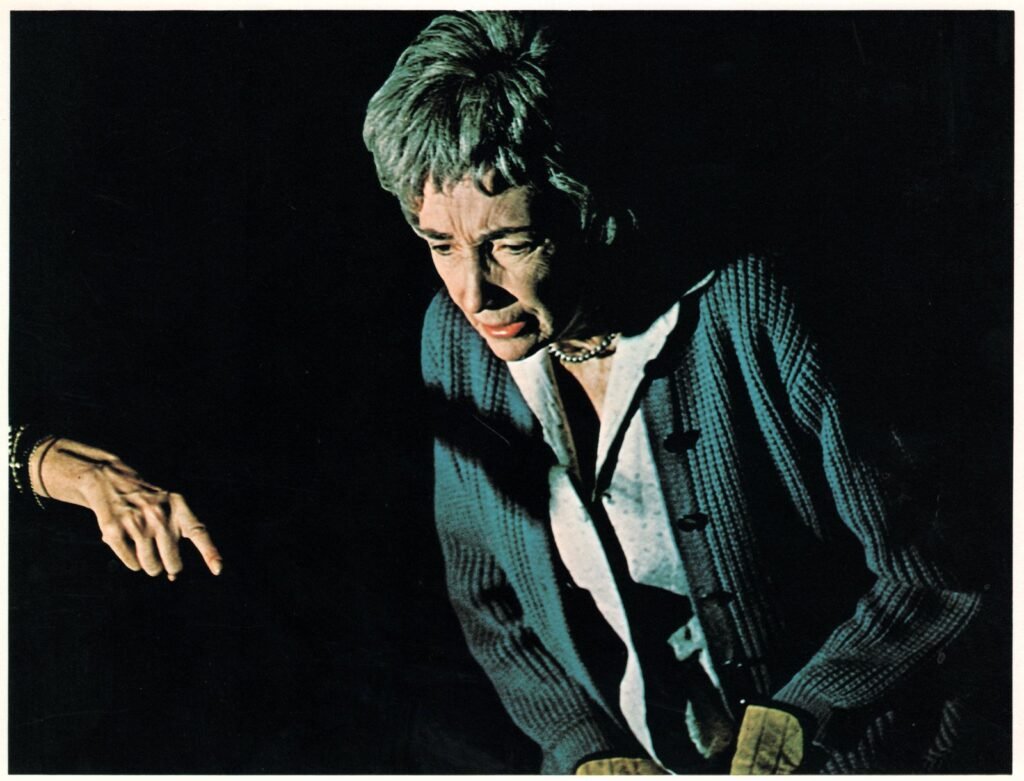
Subsequently, Marrable recalls poor Tinsley as:“A mealy-mouthed yes-lady I could barely tolerate…”
while also insisting that:“It was her devotion to alcohol that ultimately led to our parting of ways.”
Apparently she also possessed:“A vulgar manner that would make the most hardened sailor blush.”
The next unfortunate companion to enter Marrable’s orbit is Mrs. Dymock, played by the incomparable Ruth Gordon, who arrives hoping to uncover what became of her missing friend Miss Tinsley, who mysteriously vanished after entering Mrs. Marrable’s employment.
Dymock soon discovers Tinsley’s Bible among Marrable’s possessions and immediately smells a rat. Unfortunately for her, this is a very dangerous game to be playing. The story steadily unravels as every passing day becomes increasingly steeped in menace while Marrable grows more paranoid and suspicious.
Even Chloe, the local stray dog adopted by neighbouring children, is not spared as Miss Marrable embarks upon a murderous rampage designed to erase any lingering traces of suspicion surrounding her dark deeds.
The cat-and-mouse battle between Marrable and “Aunt Alice” grows steadily deadlier, complete with a sly wink toward Psycho and Norman Bates before the film finally arrives at its shocking conclusion.
Geraldine Page delivers an absolute tour de force as Claire Marrable, oozing menace, malice, and wicked charm with virtually every line of dialogue. Yet beneath all the murder and hysteria there runs a wonderful current of black humour, and one strongly suspects the cast must have collapsed into fits of laughter after many of these scenes wrapped.
Page’s performance ranks among the greatest examples of vintage camp ever committed to film. She quite obviously relished every second of the role.
Ruth Gordon — forever beloved thanks to Harold and Maude — provides superb support with a characteristically feisty and spirited performance as the titular Aunt Alice. The film succeeds wonderfully as a taut thriller but even more brilliantly as one of the blackest and most deliciously wicked comedies imaginable.
One of our enormous favourites here at The Hot Spot — a genuine gem.
Special appreciation must also be given to Ronald Stein’s gloriously schizoid musical score, which suits the film perfectly and has thankfully now become available on Spotify for public enjoyment.
This remains one of director Robert Aldrich’s most neglected achievements, alongside another cult classic of camp hysteria, What Ever Happened to Baby Jane?.
Whatever Happened to Aunt Alice? is a hugely underrated cult classic that somehow slipped quietly by without generating the acclaim it deserved. It should have been celebrated long ago as one of the greatest camp classics ever made, anchored by a towering performance from Geraldine Page, who devours the scenery with glorious abandon and absolutely deserved awards recognition for her efforts.
Robert Fuller and Rosemary Forsyth provide capable support, but this is unquestionably Geraldine Page’s film from beginning to end, with Ruth Gordon backing her magnificently throughout.
A fantastic motion picture that has stood the test of time beautifully and unquestionably deserves its place among the finest — and most entertaining — camp black comedies ever made.
Brilliantly entertaining, tense, slightly unsettling, and consistently hysterical.
A huge feather in Robert Aldrich’s cap.
It remains a complete travesty that Geraldine Page did not receive an Oscar for this performance. Perhaps, with time, the film itself may yet receive the recognition it has always deserved.