
The Hot Spot Rating
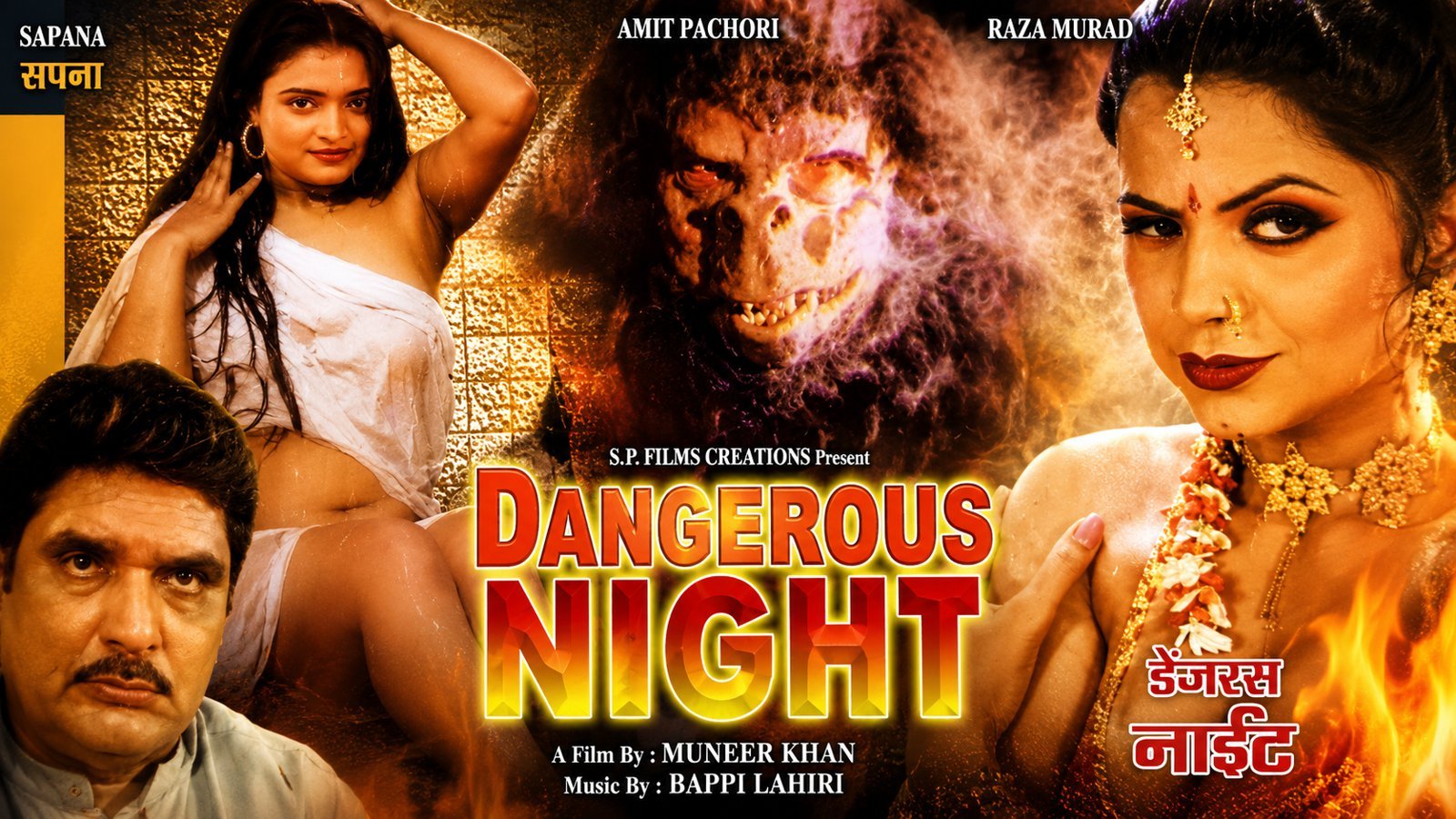
Dangerous Night (2003)
Cast: Raza Murad, Sapna, Amit Pachori, Rani Sinha, Satnam Kaur, Shakti Kapoor, Mac Mohan
Director: Muneer Khan
Synopsis: Raza Murad as a ventriloquist thakur living in a haveli. Scheming, greedy relatives. A beautiful young heiress, a dodgy Tantrik and an Ape with blood sharp, blood-soaked talons. Add Shakti Kapoor as lovestruck servant. All ingredients for a fangled Z grade horror whodunnit.
Dangerous Night contains all the ingredients of a typically convoluted, bizarre, twist-laden horror whodunnit. It is very light on logic but somehow manages to hold together by a thread until the climactic courtroom scenes, where everything is finally revealed and wrapped up in a suitably madcap conclusion.
The film opens with college boy Amit Pachori, of Adamkhor Haseena fame, demonstrating both his dancing skills and the handsome, boyish charm that established him as one of the premier leading men of the Z-grade Bollywood horror world. Alongside him is Rani Sinha, and things initially seem blissfully romantic between the pair.
Naturally, this being a low-budget Bollywood melodrama, harmony cannot last for long.
Rani wildly overreacts to one of Amit’s displays of affection, leading to a lovers’ quarrel. Within the first ten minutes, a second song arrives, featuring Pacholi being serenaded and seduced by yet another attractive college beauty. Clearly, the young man’s life is a difficult one.
Meanwhile, Rani’s father is played by Raza Murad, lord of the family Haveli and a man who spends much of the film muttering to himself while demonstrating what appears to be an advanced mastery of ventriloquism. Most of his dialogue emerges without any noticeable movement of his lips, adding an unintentionally surreal quality to proceedings.
His beautiful wife is seriously ill and wishes to see her daughter married before she passes away. Consequently, Rani is summoned home to the Haveli.
Also residing there are an uncle and aunt whose principal hobbies consist of scheming, plotting, and dreaming of inheriting the Haveli along with all the wealth and prestige that comes with it. Their thoroughly unpleasant son Jai arrives fresh from London by way of prison, and the trio quickly concoct a plan whereby Jai will marry Rani and secure control of the family fortune.
The servants have their own dramas unfolding in the background. Shakti Kapoor plays Chhabeela, who is hopelessly in love with Chhabeeli, although she remains determined to frustrate his advances at every opportunity.
One day the ailing lady of the house persuades Chhabeela to take leave and visit his parents. Reluctantly, he agrees and departs.
That very night, the film’s greatest asset finally arrives.
A remarkably impressive ape-like creature equipped with enormous talon-like claws makes its first appearance. The monster is genuinely menacing by the standards of the genre and cuts a surprisingly striking figure as it stalks through the darkness.
The lady of the house catches sight of the beast and promptly dies of fright.
Rani and Raza Murad are naturally devastated by this tragedy. Not devastated enough, however, to prevent Rani from breaking into a saucy romantic dance with Amit Pachori shortly afterwards when he arrives from college to comfort her.
Jai is considerably less enthusiastic about Pachori’s presence. Realising that his dreams of inheriting the Haveli are under threat, he arranges for some local thugs to administer a beating.
Unfortunately for them, Pachori is no pushover. Armed with heroic muscles and the confidence of a man who knows he is the leading actor, he gives as good as he gets before eventually ending up injured and hospitalised.
Thankfully, a speedy recovery follows after Rani informs him just how deeply she loves him.
Raza Murad, meanwhile, grows increasingly concerned by the appearance of the ape and seeks assistance from a local Tantrik. The holy man dispenses a lemon or two and instructs him to place them outside the Haveli to ward off monsters and evil spirits.
As anti-monster strategies go, it is certainly an economical one.
The lemons prove ineffective.
The ape returns and this time attacks Jai while he is attempting to take advantage of Rani one evening. Jai is brutally slain, his body ravaged by the creature’s lethal claws.
The police arrive, investigations begin, and slowly the mystery starts to unfold.
The film itself is pretty dreadful.
Once again, far too many songs and tediously overextended comedy sequences conspire to drain what little momentum exists. Yet somehow there remains just enough of the killer ape and just enough mystery surrounding its identity to maintain a flicker of interest.
Eventually everything culminates in a courtroom showdown featuring a fairly sizeable twist. The identity of the killer turns out to be a most unlikely suspect.
On the whole, however, the film remains pretty rotten.
What ultimately salvages it are the clawed ape and Raza Murad’s extraordinary dubbing. In fact, the dubbing is so bizarre that it gradually becomes one of the film’s strongest selling points. Every line seems to emerge from another dimension entirely, creating accidental entertainment that often exceeds anything the script intended.
Amit Pachori, Sapna, Raza Murad, Mac Mohan, Anil Nagrath, and Junior Bobby Deol are all seasoned veterans of the Z-grade cheapie, the kind of production apparently shot over a long weekend on a budget roughly equivalent to a family picnic. They sleepwalk through their roles with admirable resilience and professionalism.
Dangerous Night is hardly a film that stands out in the crowded graveyard of Bollywood horror. Still, there is an impressive killer ape with formidable claws, an enthusiastic Pacholi performance, and Sapna is almost always welcome in any film she appears in.
That is about as much praise as can honestly be offered.
It is far from good. In fact, it is often downright atrocious. Yet a hardened Bollywood horror fan will probably manage to survive the experience without being bored completely to tears.
For this genre, that constitutes remarkably high praise.