
The Hot Spot Rating
X-Ray (1981)
Cast: Barbi Benton, Jon Van Ness, Chip Lucia, John Warner Williams
Director: Boaz Davidson
Nutshell: There is a jilted killer running amok in a hospital where our Playboy centrefold is the damsel in distress.
“A thoroughly routine slasher film.”— AllMovie
“The film’s chief attraction is Barbi Benton.”— AllMovie
“One of Cannon’s more entertaining horror efforts.”— Moria Reviews
“The hospital setting provides a fresh variation on the slasher formula.”— Moria Reviews
“A fairly standard stalk-and-slash effort.”— DVD Verdict
“The mystery is reasonably engaging.”— DVD Verdict
“A fun but forgettable relic of the early 1980s.”— Hysteria Lives!
“The plot makes little sense when examined closely.”— Hysteria Lives!
“A surprisingly enjoyable little slasher.”— Oh, The Horror!
“The killer’s motivation is absurdly overblown.”— Oh, The Horror!
“Barbi Benton carries the film better than expected.”— The Bloody Pit of Horror
“A hospital full of incompetent medical staff.”— The Bloody Pit of Horror
“A textbook example of the early-’80s slasher boom.”— The Terror Trap
“More entertaining than it has any right to be.”— The Terror Trap
The film opens with a textbook 1980s slasher setup. Nineteen years earlier, on Valentine’s Day, a young brother and sister are happily playing with their elaborate train set while paying absolutely no attention to poor Harold, the local nerd and social outcast.
Harold, meanwhile, stands outside peering through the window with all the subtlety of a future stalker, gazing longingly at both the train set and the pretty blonde girl. Summoning every ounce of courage available to a pre-teen romantic, he leaves a Valentine’s card for his crush, only to have his affections cruelly mocked by the girl and her brother, who make it abundantly clear that somebody of Harold’s lowly status should know his place.
Harold does not take the rejection well.
In a fit of wounded rage, the eleven-year-old impales the girl’s brother on a coat-and-umbrella stand, leaving him screaming in agony and setting the stage for events to come.
Fast forward to the present day and the once-petite blonde has blossomed into Barbi Benton, sporting a magnificent post-Farrah Fawcett hairstyle that deserves its own billing in the opening credits. The thing is a work of art. It is coiffured, sculpted and maintained with such perfection that it somehow survives everything the film throws at it.
Barbi arrives at the local hospital for what should be a routine medical examination.
Unfortunately, it turns into the longest and most miserable day of her life.
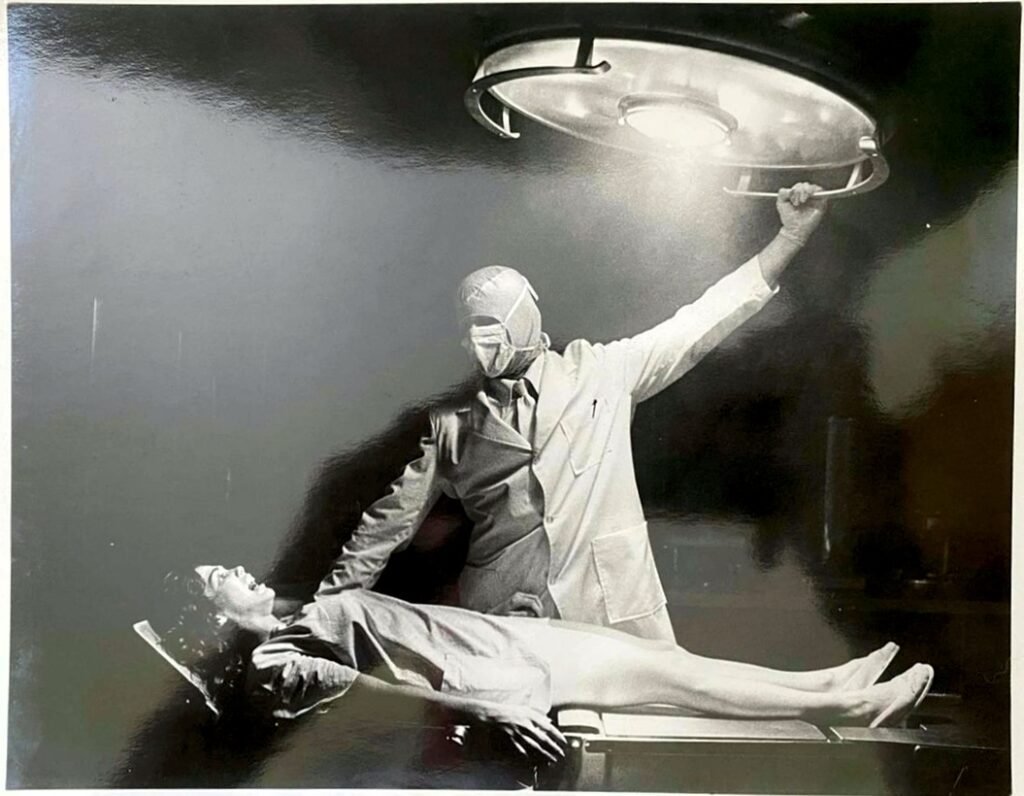
Somebody posing as a doctor—or perhaps an actual doctor, the film keeps things deliberately vague—is embarking upon a murderous rampage through the hospital. Nurses, staff and assorted bystanders begin dropping like flies as the killer dispatches them using an assortment of surgical instruments and medical procedures.
The common thread connecting the murders appears to be Barbi Benton’s medical records, which have somehow been altered and manipulated for reasons known only to the killer. When hospital staff review the falsified files, they conclude that poor Barbi is gravely ill and must remain under observation.
This proves unfortunate.
Particularly when one of the doctors appears to derive a great deal of professional satisfaction from repeatedly asking her to remove her clothing while conducting increasingly intrusive examinations. The camera, naturally, lingers over the proceedings with all the restraint one would expect from a Cannon Films production starring a former Playboy centrefold.
One quickly realises that acting ability was not necessarily the primary consideration during the casting process.
As the body count rises, Barbi gradually becomes aware that there is a killer roaming the corridors and that she is the focus of his obsession. Matters become even more alarming when she is prepared for an operation to treat a condition she doesn’t actually have. Fortunately, a sympathetic physician named Dr. Harry intervenes and helps her uncover the truth behind the switched files and bogus diagnosis.
What follows is a cat-and-mouse game through the hospital as Barbi attempts to evade a determined killer while simultaneously convincing staff that she is perfectly healthy and in no need of surgery. Since the murderer keeps altering records and eliminating anyone who gets too close to the truth, this proves easier said than done.
Eventually she finds herself largely on her own, forced to confront the mystery and survive long enough to uncover who is behind the killings.
The revelation arrives during a frantic climax intended to leave audiences gasping in shock.
Whether it actually does so is another matter.
One thing that remains genuinely impressive throughout the ordeal is Barbi Benton’s hair. During murders, chases, panic attacks and assorted hospital horrors, not a single strand appears out of place. By the end of the film, her hairstyle has demonstrated greater resilience than most of the cast.
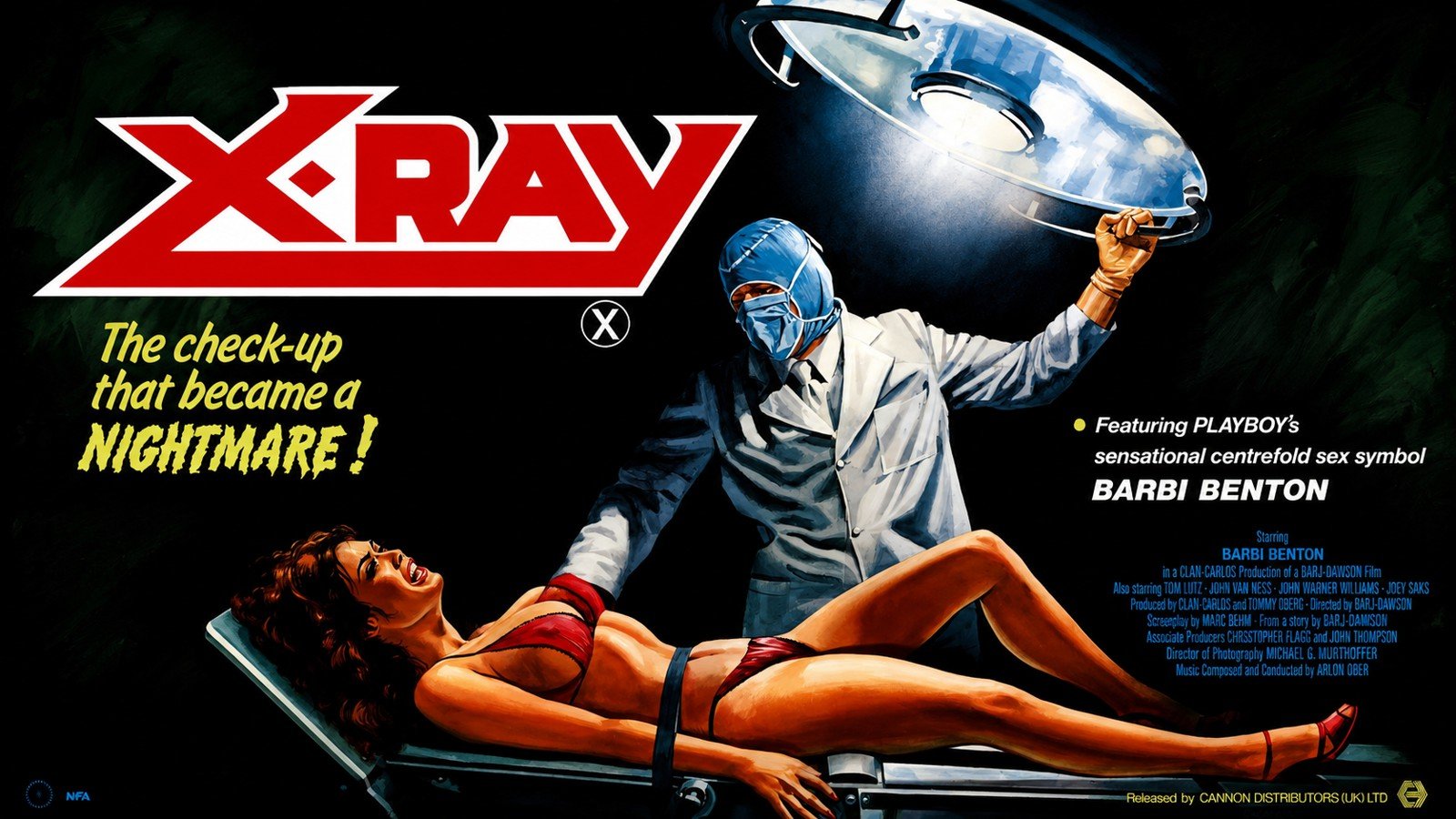
X-Ray is quintessential Cannon Films product. Like many Cannon productions from the era, the promotional artwork is vastly more impressive than the film itself. The poster is superb and undoubtedly did much of the heavy lifting when it came to attracting audiences. The combination of a striking title, lurid advertising and Barbi Benton’s Playboy fame was probably worth far more at the box office than the actual movie.
To be fair, the film is not completely unwatchable. The pacing remains reasonably brisk and events move along quickly enough to prevent total boredom from setting in. The problem is that there is very little else to recommend it.
The director attempts to manufacture suspense by presenting several possible suspects and occasionally introducing ominous chants over the soundtrack, seemingly to suggest some sort of religious or supernatural angle to the murders. These moments are more amusing than frightening and never really lead anywhere interesting.
The deaths themselves are surprisingly tame for a slasher film and most occur off-screen. The standout gore moment involves a hospital worker being dunked into a vat of unpleasant-looking green liquid before emerging covered in boils and resembling something one might reasonably describe as “Cactus Head.” It is gloriously silly and easily the film’s most memorable visual.
By the time the climax arrives, it feels less like a thrilling conclusion and more like release from purgatory.
The film is pretty rotten on the whole, lacking scares, suspense, tension and convincing performances. Yet there remains something oddly fascinating about Cannon Films at their most shameless. They seemed perfectly content to package up a mediocre product, wrap it in sensational advertising and ship it to every corner of the globe in the hope that unsuspecting audiences would part with their money.
More often than not, they succeeded.
X-Ray is hardly one of the studio’s finer hours, but it remains an entertaining reminder of an era when a good poster, a Playboy star and a ridiculous premise could still secure a theatrical release.
Watch out for the Three Crazy Ladies, though.
Their arrival is where the real madness begins.