
The Hot Spot Rating
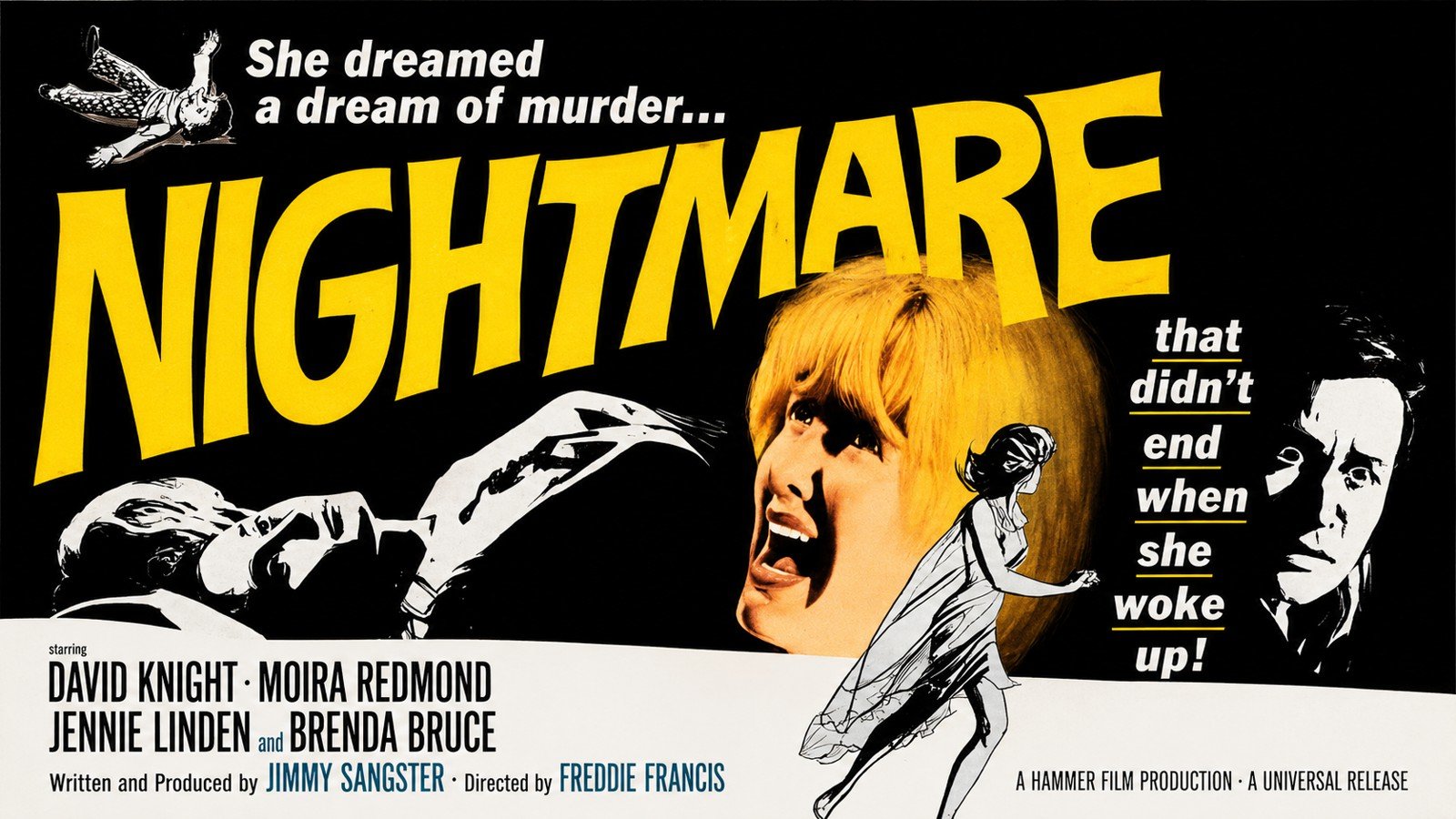
Nightmare (1964)
Cast: David Knight, Moira Redmond, Jennie Linden, Brenda Bruce, Irene Richmond
Director: Freddie Francis
Synopsis: well-crafted, acted, and thoroughly engaging thriller from the House of Hammer
“One of Hammer’s finest psychological thrillers.”— Jonathan Rigby, English Gothic
“A polished and intelligent suspense film.”— Monthly Film Bulletin
“Beautifully photographed and expertly directed.”— Monthly Film Bulletin
“A superior thriller.”— The Monthly Film Bulletin
“One of Hammer’s most underrated films.”— Marcus Hearn, The Hammer Story
“A stylish blend of Psycho and Les Diaboliques.”— DVD Drive-In
“Freddie Francis directs with considerable flair.”— DVD Drive-In
“A first-rate psychological mystery.”— AllMovie
“The black-and-white photography is superb.”— AllMovie
“One of Hammer’s classiest productions.”— Moria Reviews
“The film’s greatest strength is its atmosphere of uncertainty and paranoia.”— Moria Reviews
“A beautifully crafted thriller.”— The Digital Fix
“The twists are handled with admirable skill.”— The Digital Fix
“An elegant and surprisingly sophisticated suspense picture.”— Slant Magazine
“Hammer at its most restrained and effective.”— Slant Magazine
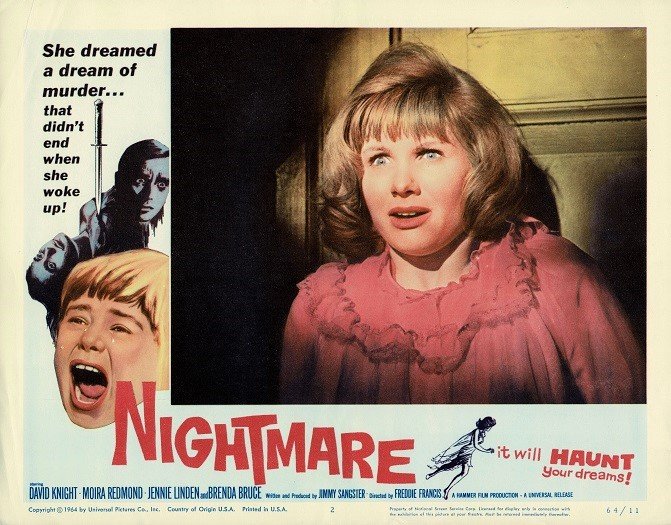
Within the first thirty seconds, a realisation dawns that this is the work of people who genuinely loved craftsmanship and cinema. The opening tracking shot, photographed in a gorgeous shimmering black and white and framed in Hammer’s own widescreen process known as “HammerScope”, is intoxicating. It immediately announces that this is not going to be some cheaply assembled thriller but something created with care and style.
The camera glides towards a forbidding Gothic building that appears to be a girls’ boarding school somewhere in the English countryside. Inside, young Janet wanders the corridors while the rest of the world sleeps.
Drawn towards a particular door, she ventures inside and discovers not so much a bedroom as a prison cell. An inmate turns towards her and greets her with a chillingly manic cackle.
“Both mad, aren’t we?”
The inmate is Janet’s mother, incarcerated for brutally stabbing her husband on Janet’s eleventh birthday. The outside world believes the woman is dead, yet she continues to appear in Janet’s recurring nightmares. Once again, Janet’s terrified screams disturb the sleep of the long-suffering girls sharing her dormitory, and before long she is moved elsewhere as her classmates have finally had enough of these nightly performances.
Seeking comfort, Janet clings to her childhood security blanket in the form of a beloved Gollywog and attempts to drown her troubles with pop music blasting from her transistor radio. Neither provides much relief. Concerned by her deteriorating condition and inability to focus on her studies, the school decides to send her home, even though term has not yet finished.
During the journey, Janet repeatedly asks about her guardian, the mysterious Mr. Baxter, but he never seems to materialise. Instead, she is met by the chauffeur John and the housekeeper Mrs. Gibbs, both of whom treat her with a mixture of patience and quiet concern, as though they understand that she is a troubled young woman.
Back at the house, Janet is introduced to Grace Maddox, a companion appointed by Mr. Baxter to keep her company. Everything initially appears perfectly normal, apart from the continued references to the elusive Mr. Baxter, who remains strangely absent. Before long, however, the nightmares return with renewed intensity. Janet becomes increasingly obsessed by the possibility that she may inherit her mother’s insanity and one day become just as violent and unstable.
The staff are attentive, the nurses seem eager to help and everyone appears determined to reassure her. Yet something feels decidedly fishy. The nightmares grow more vivid and frequent, and new images begin creeping into them: a scarred woman, a birthday cake and fragments of memories that seem determined to surface.
As matters escalate, Janet becomes increasingly unable to distinguish dream from reality. There is more than a faint whiff of conspiracy hanging in the air and the mystery slowly unfolds in a manner that remains thoroughly engaging throughout.
Visually, the film is magnificent. Director Freddie Francis and cinematographer John Wilcox create a wonderfully oppressive atmosphere using shadows, light and deep-focus compositions. HammerScope proves particularly effective, giving the film a grand cinematic feel despite its relatively intimate story. Jimmy Sangster’s screenplay keeps the audience guessing while Don Banks provides an excellent musical score that enhances the mounting sense of unease.
The role of Janet had originally been intended for Julie Christie, who left only days before filming began on her journey towards stardom. Jennie Linden inherited the role and performs admirably, supported by a sterling cast that rarely puts a foot wrong.
Eventually Mr. Baxter does make an appearance, consulting doctors regarding Janet’s fears that she is destined to follow in her mother’s footsteps. His arrival also introduces a dangerous and complicated triangle that gradually reveals itself as the film progresses.
For Janet, however, the situation has reached breaking point. Her nightmares become so vivid that reality itself begins to crumble. Convinced that madness has finally claimed her, she lashes out violently at those around her just as her mother supposedly did years before. Institutionalisation follows and it appears that Janet’s worst fears have come true.
Then, slowly but surely, the truth emerges.
What follows is one final revelation and a beautifully executed twist that catches both Janet and the audience completely off guard.
Released only a few years after Psycho and clearly emerging in the shadow of Les Diaboliques, Nightmare shares certain thematic similarities with both films while maintaining its own identity. The black-and-white photography is superb, the atmosphere is richly Gothic and the sense of creeping psychological dread is sustained throughout.
One cannot help but wonder what Julie Christie might have brought to the role had she remained with the production. Nevertheless, Jennie Linden acquits herself well and the film hardly suffers from her predecessor’s departure.
Nightmare remains one of Hammer’s most polished and underrated thrillers: beautifully photographed, expertly directed and genuinely involving from beginning to end. It may lack vampires, monsters and Gothic castles, but it demonstrates that Hammer’s talents extended well beyond traditional horror. A classy and thoroughly entertaining psychological thriller from a studio operating near the peak of its powers.