
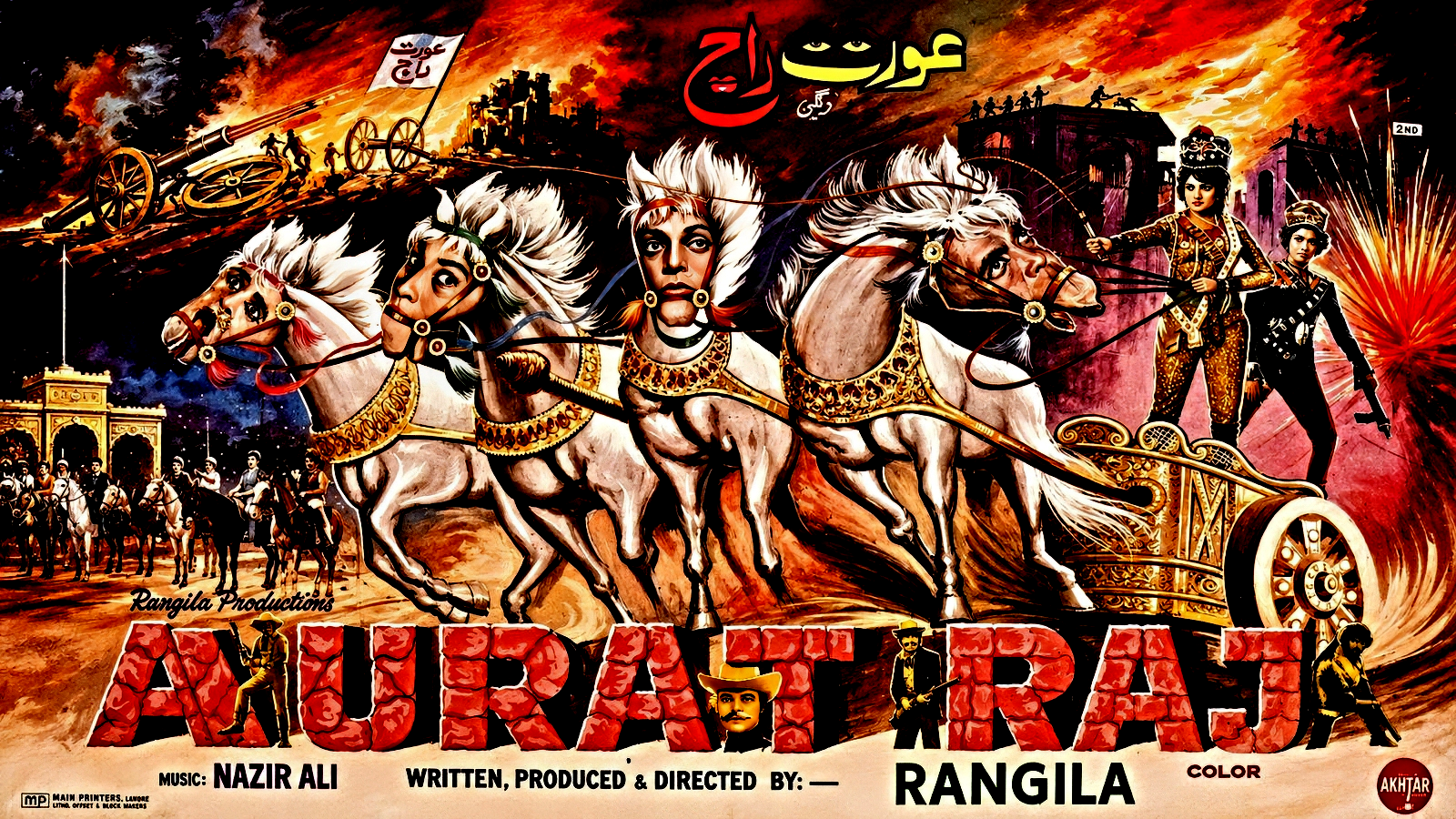
Aurat Raj (1979)
Cast: Waheed Murad, Rani, Sultan Rahi, Chakori, Naghma, Khanum, Rangila, Nanna, Badar Munir, Asif Khan, Usman Pirzada, Yasmeen Khan, Ali Ejaz, Kamal Irani, Shahnawaz, etc
Director: Rangila
Synopsis: Fabulous scathing satire on Lollywood films and Paki life - brilliant, classic!
Reviewed by Omar Ali Khan
Rangila will always remain one of Lollywood's greatest enigmas. At first glance, he appeared little more than an undersized, enormously irritating buffoon, destined forever to play the cliché-ridden comic cook or bumbling sidekick. Yet there was always far more to him than initially met the eye. Having already carved out a modest niche as a comedian, his real breakthrough came when his self-directed Dia Aur Toofan became a massive commercial success. Suddenly, Rangila was no longer a supporting comedian but a major creative force, perfectly placed to exploit an audience eager for something a little different.
By the time he decided to produce and direct Aurat Raj, based on an idea by Shaukat Thanvi, Rangila had developed into one of the industry's most original filmmakers. What he created remains one of the most remarkable and groundbreaking films in Lollywood history. Even more impressively, he disguises razor-sharp political and social satire beneath the veneer of an outrageously broad comedy farce. The result is a film that leaves audiences squirming with delight at the sheer insanity unfolding before them.
Rangila may have fallen spectacularly from grace with his much-maligned magnum opus Kubra Ashiq, but Aurat Raj stands as overwhelming evidence of his considerable talent as a director. This gloriously ridiculous farce demonstrates that he possessed a genuine gift for blending political satire, social commentary and delirious slapstick into one sinfully delicious cocktail whenever he was given a free hand.
Waheed Murad plays perhaps the most despicable, womanising, philandering husband imaginable. He delights in humiliating his long-suffering wife, Rani, treating her as little more than a servant while spending his evenings chasing glamorous women at the local dance club. Rani repeatedly pleads with him to return to his family and show some affection towards both her and their young son, but Waheed's character has absolutely no intention of changing his ways. Instead, he brazenly brings his latest conquests home, mocking and degrading his wife at every opportunity.
Eventually, Rani reaches breaking point.
Determined never again to tolerate her husband's abuse, she declares war—not merely on him, but on the entire male population, whom she holds responsible for generations of injustice towards women. Joining forces with an army of equally determined feminists, she launches a movement that rapidly snowballs into a formidable political force.
Before girl power reaches parliament, however, it first erupts onto the streets, where gangs of militant women gleefully beat the living daylights out of bewildered men.
Chaos reigns until the authorities finally restore order by announcing a general election. Whichever party wins will govern the country.
Thus emerges the Aurat Raj Party, led by the vengeful Rani and supported by an extraordinary cabinet including Naghma, Chakori, Khanum, Shehla Gill and several equally demented feminists. Opposing them is an aggressively misogynistic male party headed by Waheed Murad and his equally chauvinistic comrades.
Through a combination of determination, political cunning and no small amount of feminine charm, the women sweep to power.
Unfortunately, power proves every bit as intoxicating for women as it has always been for men.
Consumed by revenge, Rani purchases an extraordinarily expensive "Sex Bomb" capable of transforming every man in the country into a simpering, high-pitched woman while simultaneously turning women into swaggering, baritone-voiced macho men. The purchase comes at a terrible price, however. To finance it, Rani mortgages half the country to the foreign bomb manufacturers, prompting growing dissent within her own ranks and eventually leading Finance Minister Chakori to abandon the government altogether.
Once the bomb is detonated, all sanity disappears.
Hairy-chested tough guys suddenly become timid, squealing damsels, while women transform overnight into swaggering alpha males with equally deranged attitudes.
The sight of Waheed Murad performing pelvic thrusts and exuberant thumkas in full drag during "Aaj Thumke Pe Thumka Lagana Paray Ga" ranks among the funniest moments in the entire history of Pakistani cinema.
Poor Sultan Rahi, appearing as himself, suffers an even crueller fate. The undisputed king of macho Punjabi action cinema is transformed into a terrified damsel forever fleeing from the amorous advances of the marauding Chakori Phaddebaaz, desperately trying to prevent his own "izzat" from being looted.
The results are sublimely ridiculous.
The musical sequences featuring both Waheed Murad and Sultan Rahi in drag amount to a glorious parody of Lollywood's own sexism. Lingering close-ups of hips and busts, endless zoom lenses and exaggerated glamour are turned back upon the industry itself with devastating comic effect.
Indeed, Aurat Raj gleefully lampoons almost everything about Pakistani cinema and society—politics, male chauvinism, pseudo-religious customs, tradition, racism and social hypocrisy.
Nothing escapes Rangila's sights.
One particularly inspired sequence ridicules South Asia's obsession with fair skin. The endless songs celebrating goray goray gaal, gori kalaiyan and fair complexions become biting commentary on the "Fair & Lovely" mentality that has plagued the subcontinent for generations.
If there is one criticism to level at the film, it is perhaps that there is one song too many. That, however, is little more than nit-picking.
On the whole, Aurat Raj succeeds magnificently as a blistering satire on Pakistani society.
The performances deserve enormous praise. Waheed Murad and Sultan Rahi, both major stars with carefully cultivated macho screen images, deserve immense credit simply for agreeing to parody themselves so mercilessly. Waheed Murad, in particular, throws himself into the absurdity with astonishing commitment, creating one of the bravest and funniest performances of his career.
In one delightful moment, editor Rehmat Ali is fractionally late making a cut during one of the climactic musical numbers—a joyous parody of Rani's famous death dance in Anjuman—allowing viewers to glimpse Waheed Murad breaking character and laughing. Somehow, that tiny mistake fits perfectly within the wonderfully anarchic spirit of the film.
Aurat Raj is Rangila's Monty Python moment—a delirious spoof of Pakistani cinema, politics and society.
Between the laughter lies one of the sharpest pieces of political satire ever produced in Pakistan.
Writer, producer, director, actor, singer and songwriter, Rangila demonstrates extraordinary versatility, creating what remains one of the crowning achievements of his remarkable career.
Unsurprisingly, the government—already reeling from the anti-establishment impact of Maula Jatt—found Aurat Raj rather too subversive for comfort. Good satire usually has precisely that effect upon those in authority.
Some critics have labelled Aurat Raj a feminist film.
But is it?
While the film certainly highlights many injustices suffered by women, its conclusion is considerably more ambiguous. Once women seize power, they prove every bit as capable of corruption, vanity and incompetence as the men they replaced. In many ways, the film recalls those wonderfully absurd episodes of the 1960s Batman television series in which Nora Clavicle briefly seizes control of Gotham City, only to be spectacularly undone by something as ridiculous as a plague of rats.
Ultimately, Aurat Raj is less a feminist manifesto than a savage satire on power itself.
Satire is almost extinct in Pakistan today because we have become increasingly uncomfortable laughing at ourselves. The truth hurts, and Aurat Raj tells rather too much of it.
Four decades after its release, Rangila's masterpiece remains one of the boldest, funniest and most intelligent films ever produced in Pakistan. It deserves to be rediscovered by an entirely new generation.
Postscript
The last surviving 35mm print of Aurat Raj now rests safely in the United Kingdom in the care of Mondo Macabro and Bubonic Films. Sadly, the print is badly worn and far removed from its original splendour.
A silent pirate copy circulates on YouTube, while copyright complications have prevented an official restoration or release.
As long as that final print survives, however, there remains hope.
And Aurat Raj deserves that second chance more than almost any other Pakistani film.


0 Comments
Leave a Comment