
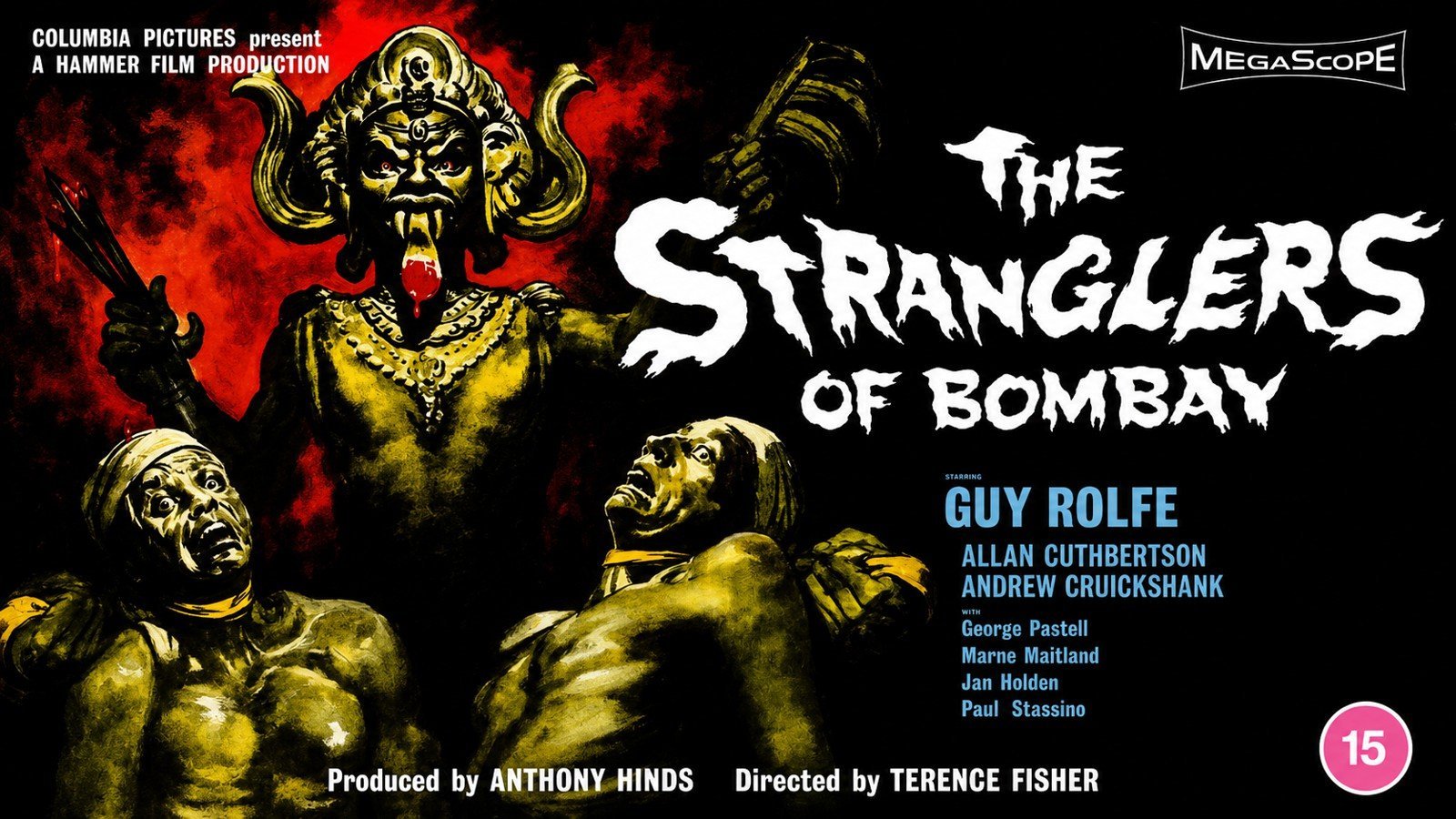
Stranglers of Bombay, The (1959)
Cast: Guy Rolfe, Andrew Cruickshank, Allan Cuthbertson, George Pastell, Jan Holden
Director: Terence Fisher
Nutshell: a strange reflection of the Indian uprising against the colonials in a highly dubious, if unintentional manner. Particularly fascinating, if somewhat awkward, is the very slanted depiction of everything Indian.
Reviewed By Omar Khan
The Stranglers of Bombay was one of those films that, in my youth, automatically became essential viewing simply because it carried the Hammer name. I remember coming away rather underwhelmed as a teenager, but with Indicator now issuing another mouth-watering collection of Hammer obscurities, the time seemed right for a more mature reassessment. The fact that Terence Fisher directed the film and that George Pastell once again appeared in his familiar guise as Hammer's resident "High Priest" provided ample justification for revisiting this 1959 black-and-white curiosity.
The film opens with a map of the Bombay region to establish the setting. The year is 1829, and the British Raj is firmly in control. Local merchants angrily petition the authorities after repeated attacks on their trading convoys have brought commerce to a virtual standstill. According to captured bandits, the culprits belong to a murderous religious cult devoted to the goddess Kali.
That same goddess is being worshipped in the opening scenes by George Pastell, Hammer's pre-eminent "evil foreign" specialist, fresh from playing an almost identical role in The Mummy. Pastell leads a fanatical band of Thuggee devotees who murder in Kali's name using their signature weapon—a silk saffron scarf expertly employed to strangle their victims.
The British authorities, led by the increasingly exasperated Guy Rolfe, are desperate to bring the killings to an end.
Unfortunately, just as Rolfe begins making genuine progress, he is replaced by a pompous bureaucratic fool possessing the stiffest upper lip imaginable and a brain apparently functioning at only minimal capacity. Rolfe continues his investigations from the sidelines while his thoroughly unsuitable superior proceeds to make matters steadily worse.
Meanwhile, the Thuggee attacks continue unabated. Convoys are looted, innocent travellers murdered, and British authority appears increasingly powerless as the cult spreads fear throughout the region.
The question soon becomes whether the colonial administration can suppress this deadly menace or whether it will ultimately prove incapable of maintaining control over the Jewel in the Crown.
Viewed purely as an adventure thriller, The Stranglers of Bombay has inevitably dated. The violence, considered reasonably strong for 1959, is largely suggested through editing, sound effects and implication rather than graphic imagery. Eyes are gouged, tongues and limbs severed and the occasional rubber appendage makes an appearance, but Terence Fisher relies more upon atmosphere than explicit gore.
The film also embraces the familiar British Raj adventure style popularised by Rudyard Kipling and countless colonial adventures of the period. At the time such portrayals passed largely without comment. Today they inevitably invite rather closer scrutiny.
Viewed through modern eyes, The Stranglers of Bombay is undeniably uncomfortable. Its depiction of Indian culture, religion and people often strays into territory that contemporary audiences will quite reasonably regard as overtly racist. Yet it also serves as an illuminating reminder of attitudes that were once commonplace within British popular culture.
Western society has changed enormously over the past half-century. Modern Britain proudly embraces figures such as Sir Mo Farah, Moeen Ali and Nadiya Hussain as national icons, reflecting a society far removed from the one that produced this film. That was not always the case. Cricketer Younis Ahmed, despite outstanding performances for Surrey, never earned a single England cap despite being fully qualified to do so. Today such treatment would rightly provoke public outrage.
Likewise, British television of the 1970s routinely presented racial stereotypes that would be unthinkable today. Programmes such as Love Thy Neighbour and Mind Your Language were immensely popular and, somewhat perversely, became enormously successful throughout South Asia, where video libraries stocked them in abundance. They now survive largely as cultural artefacts illustrating how mainstream attitudes have evolved.
Growing up, casual racial slurs such as "wog", "nig-nog" and "Sambo" were hardly uncommon in British schools. They reflected an environment in which such language had been normalised by much of the popular entertainment of the era.
Watching The Stranglers of Bombay inevitably evokes memories of that period. Beyond its uncomfortable stereotyping lies a film that also presents outright historical distortions as accepted fact. Kali has long been revered within Hinduism as a goddess associated with justice, protection and the destruction of evil rather than the bloodthirsty caricature presented here. Add to this the familiar spectacle of unmistakably British actors adopting highly questionable Indian accents while the Hertfordshire countryside cheerfully masquerades as central India, and the illusion becomes increasingly difficult to sustain.
Even setting those issues aside, the film struggles as either an adventure or a horror thriller. The climax proves strangely muted, ending on an oddly anticlimactic note in which order is supposedly restored with little sense of genuine triumph. After all the bloodshed, audiences scarcely receive the satisfying reckoning one expects, and George Pastell's villain is denied the memorably gruesome fate he so richly deserves.
When the credits finally roll, the dominant reaction is not excitement but mild bewilderment.
"Wait a minute..."
That is quickly followed by,
"Just as well it's over."
And finally,
"What a load of offensive bollocks."
Hammer produced its share of controversial films, but The Stranglers of Bombay may ultimately become one of its most discussed—not because of its qualities as entertainment, but because it offers an unusually revealing snapshot of British popular attitudes at the close of the 1950s.
As a thriller it remains curiously unsatisfying.
As a historical artefact, however, it has become unexpectedly fascinating.
Among its few genuine strengths are Terence Fisher's assured direction, a suitably dramatic score, some attractive cinematography and one absolutely sublime poster.

0 Comments
Leave a Comment