
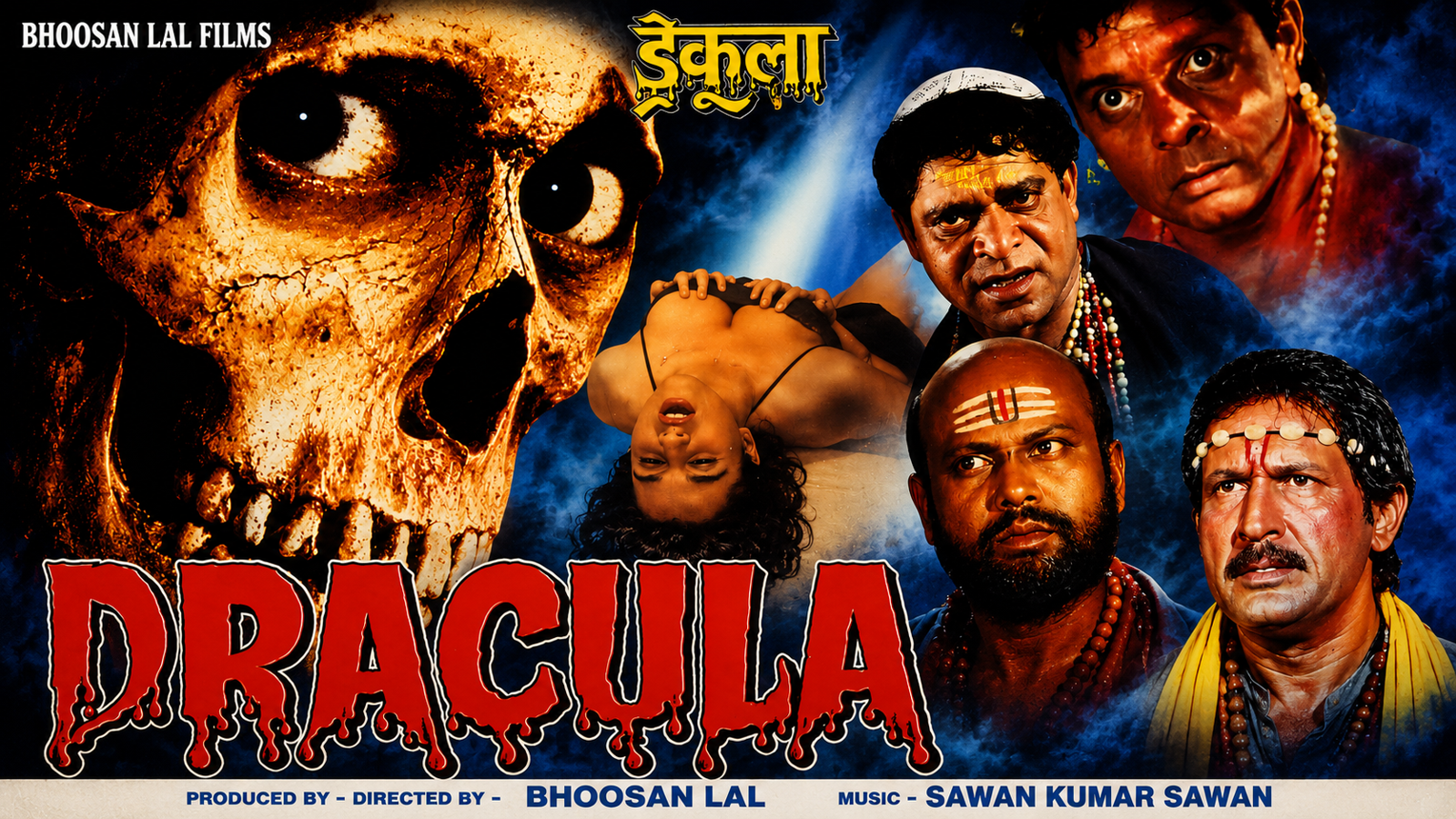
Bhooshan Lal’s Dracula (1999)
Starring: Sadashiv Amrapurkar, Ashna, Mohan Joshi, Kiran Kumar
Director: Bhooshan Lal
Nutshell: a truly colossal cinematic experience - mightier even than the spectacular Khooni Dracula. Features one of the most outstanding theme songs in history.
Review by: Omar Ali Khan
Topping Khooni Dracula was always going to be a formidable challenge. Nevertheless, writer-director Bhoosan Lal evidently felt the irresistible artistic urge to deliver his own definitive interpretation of Bram Stoker's immortal vampire tale. Thus, in 1999, Dracula emerged from the grave to greet swooning audiences.
Kiran Kumar—who has surely appeared in more Indian horror films than even Raza Murad—stars as Abdullah, a humble snake charmer who one fine day stumbles upon that mythical object every sensible man would willingly die for: the legendary Naag Mani.
For those unfamiliar with such matters, the Naag Mani is essentially a fancy bit of crystal apparently broken off some rather tacky chandelier. Once acquired, however, it supposedly functions rather like Aladdin's lamp, granting untold wealth and happiness to its fortunate owner.
Naturally, word spreads quickly.
A gang of particularly dangerous and spectacularly warped criminals escape from prison with the sole intention of relieving Abdullah of his priceless treasure. Unfortunately for everyone concerned, Abdullah dies under mysterious circumstances in a Christian graveyard before the exchange can take place, and the Naag Mani promptly vanishes without trace.
News of the missing jewel travels fast, and before long every fortune hunter within a hundred miles descends upon the area. Among them are three glamorous young women from the city, each hoping the magical jewel will transform her life forever.
There is only one slight inconvenience.
The forest contains neither hotels nor motels.
Their only option is a crumbling old haveli inhabited by a thoroughly weather-beaten Thakur who has clearly seen better days but remains delightfully hospitable, particularly when three attractive young women arrive on his doorstep requiring overnight accommodation. He welcomes them without hesitation, although a comprehensive medical examination might perhaps have been the wiser option.
Little does the poor fellow realise that his glamorous guests possess appetites extending rather beyond a comfortable night's sleep.
Unable to endure an evening without some form of carnal recreation, two of the young ladies decide that the elderly Thakur will serve admirably as entertainment.
In one of Indian horror cinema's more unexpected plot twists, the protesting old man is himself raped by the two city sirens before being unceremoniously murdered.
A refreshing reversal of the usual rape-revenge formula.
Months later, the women return accompanied by a dashing young boyfriend sporting perhaps the most terrifying hairstyle ever committed to Indian cinema—a magnificent Kevin Keegan-inspired creation that would have embarrassed both the Bay City Rollers and Ian Botham during their most follicly ambitious years.
The group heads for the graveyard where the Naag Mani supposedly disappeared.
Each attempt to recover the precious crystal is immediately interrupted by booming disco music, sinister laughter and the ghostly return of the violated Thakur, now risen from the grave seeking revenge.
Time and again scantily clad beauties wander into the cemetery only to find themselves stalked by appalling disco beats before the bloodstained spectre of the Thakur emerges, grinning maniacally and apparently frightening them to death.
Eventually, matters are brought under control by an escaped Taliban lookalike who conceals his identity beneath a conveniently acquired trident while chanting assorted mystical gibberish around the graveyard. Somehow, this proves sufficient to subdue the murderous Dracula-Thakur creature before he can unleash unprecedented mayhem.
Dracula is an absolutely atrocious film.
To its credit, however, it largely avoids the traditional rubber-mask monster approach in favour of genuine makeup effects, although plastic vampire fangs remain very much in evidence. The familiar BBC Death and Horror Sound Effects library also receives another enthusiastic airing. Those baying wolves sound suspiciously familiar.
One of the film's unquestionable highlights is Mohammad Aziz's wonderfully exuberant disco anthem "Woh Hai Dracula", which blasts across the soundtrack whenever another unfortunate soul ventures into the haunted graveyard in search of the Naag Mani.
The opening Dracula disco theme is equally irresistible and almost worth acquiring the soundtrack for on its own. "Woh Hai Dracula" is a genuinely infectious tune, lovingly composed and magnificently belted out by Aziz with remarkable conviction. It is absurdly catchy.
The thoroughly fetching VCD sleeve proudly advertises the picture as a "Sexy & Horror Film", and frankly who could argue?
Produced and directed by Bhoosan Lal—a name deserving considerably wider recognition—Dracula is worth experiencing for several reasons: its gloriously ludicrous disco soundtrack, Kevin Keegan's immortal hairstyle, the delightfully deranged performances and a screenplay that gleefully mocks every horror convention it encounters before arriving at the astonishing conclusion that Dracula was, in reality, little more than a failed disco performer.
Wonderful though it is, however, the magnificent Khooni Dracula theme song still reigns supreme.

0 Comments
Leave a Comment