
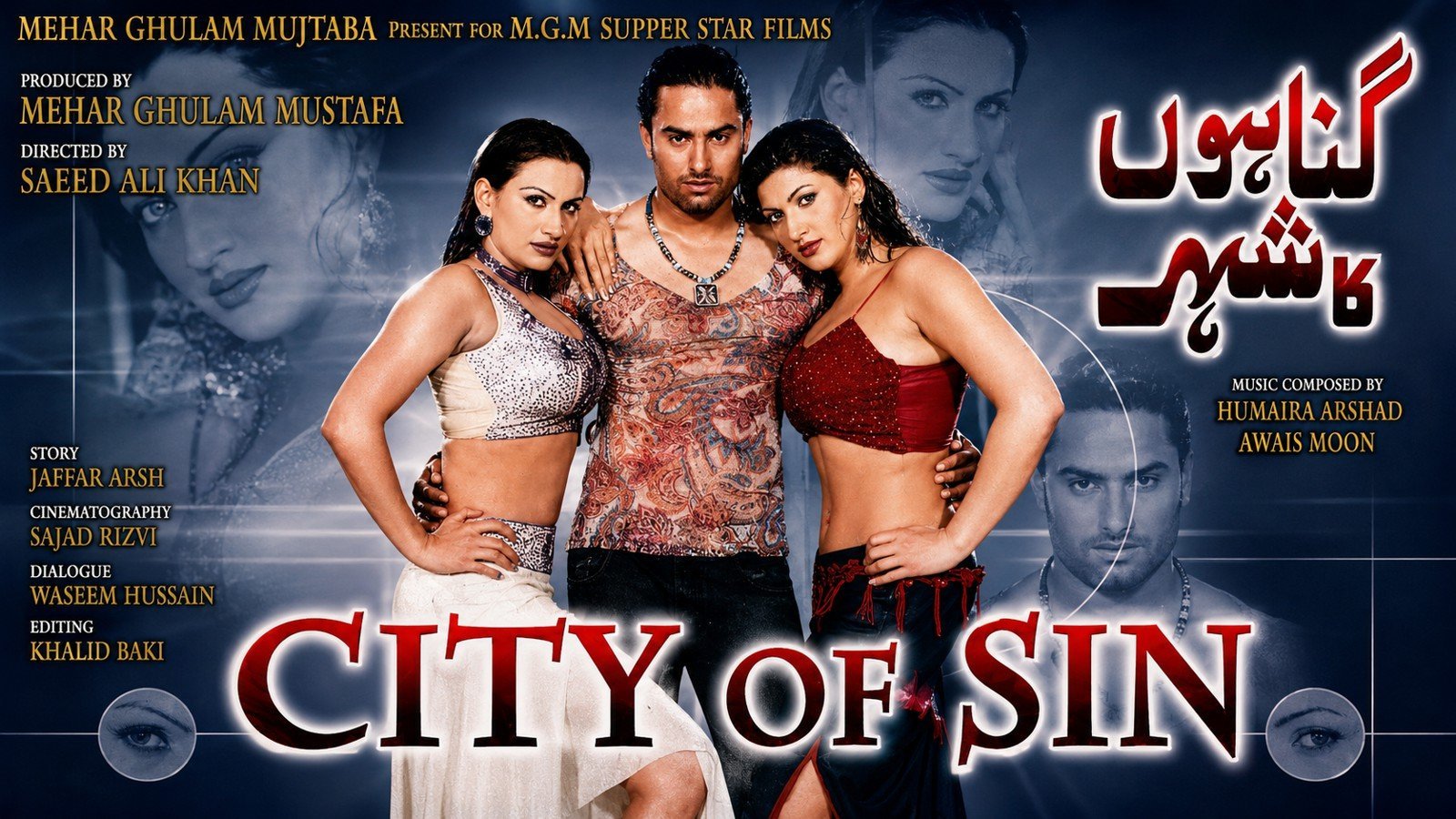
Gunahon Ki Basti (2008)
Cast: Adnan Shah, Ahmed Butt, Asha, Hina, Maria Wasti, Nida Chaudhary, Shahood Alvi, Shakeel R, Shiraz, Shiza
Director: Saeed Ali Khan
Nutshell: yet another I Spit on Your Grave variant with more “up-skirting” in a typically nauseating manner. Trash Cinema perfection.
Review by Omar Ali Khan
Just when you thought you had plumbed the very lowest depths of cinematic depravity.
Gunahon Ki Basti survives today only in a heavily truncated YouTube version, yet even in its censored form it remains among the most appalling Pakistani films I have ever encountered. Emerging during the industry's darkest years around 2008, when local cinema was in its death throes and producers increasingly relied upon sleaze simply to survive, the film is very much a product of that desperate era.
Rasheed Dogar had largely cornered this particular market before his tragic death in a fire, but veteran director Saeed Ali Khan—better known to many as "Sleaze Ali Khan"—had already spent decades refining the art of commercially successful Pashto exploitation cinema. It is Khan who presides over this particular atrocity.
The film stars Nida Chaudhary, best known not as an actress but as one of Pakistan's most notorious stage performers and mujra dancers. Her extraordinarily provocative live performances made her both hugely popular and deeply controversial, often attracting enormous audiences while simultaneously provoking endless outrage from those claiming she represented everything that was wrong with Pakistani culture.
Ironically, many of those most vocal in condemning her vulgarity were often the very people filling the theatres to watch her perform.
Her notoriety extended beyond the stage. Not long before this film, her car was sprayed with bullets following a performance in Faisalabad. Fellow performer Anjuman Shehzadi, equally famous on the stage circuit, died under mysterious circumstances in 2011. Another mujra queen, Saima Khan, survived an assassination attempt before abandoning the stage altogether.
Pakistan's stage performers have long occupied this curious contradiction. They are celebrated, exploited, condemned and idolised simultaneously.
Google has at various times reported that Pakistan and Saudi Arabia ranked among the world's most enthusiastic searchers for online pornography.
The same two countries also frequently present themselves as among the most religious societies on earth.
Go figure.
Several such stage performers eventually found their way into Pakistani cinema despite possessing little conventional acting experience beyond dancing provocatively before enthusiastic audiences. Their success depended almost entirely upon their willingness to lower necklines while simultaneously becoming convenient symbols of national moral decline.
The irony, of course, is impossible to ignore.
The very audience responsible for creating these stars is often the first to denounce them publicly for spreading obscenity.
Returning to the film itself, Nida Chaudhary arrives at a sprawling guest house deep within an isolated forest where she intends to work peacefully on her novel.
Naturally, peace is not on the agenda.
The surrounding forest is controlled by a lucrative timber-smuggling mafia operating with the enthusiastic assistance of corrupt officials and equally corrupt police officers in a country where bribery has become almost institutionalised. Matters become complicated when the authorities appoint a new Forest Ranger in the shape of former bodybuilder Ahmed Butt, an incorruptible officer whose determination rapidly begins disrupting the gang's lucrative business.
Ahmed soon turns out to be Nida's former college sweetheart.
The reunion immediately inspires a succession of spectacularly vulgar fantasy songs in which Nida lustfully drools over Ahmed's sculpted physique. Like so many films of this era, the songs substitute overt sexuality with endless pelvic thrusts, suggestive choreography and dance routines that simulate the sexual act with almost admirable ingenuity.
It is all remarkably perverse.
Curiously, Ahmed Butt himself becomes every bit as objectified as Nida Chaudhary. Considering these films were marketed overwhelmingly towards male audiences, it raises the rather intriguing possibility that there existed a substantial audience quite happy to admire the male physique, despite the official insistence that homosexuality simply did not exist within Pakistani society.
Almost every musical sequence revolves around women openly fantasising over the male body.
At the same time, these films routinely portray women themselves as creatures consumed by uncontrollable lust.
It is an extraordinarily contradictory worldview.
The plot itself scarcely exists beyond providing an excuse to string together increasingly exploitative sexual situations before descending into a catalogue of grotesque violence clearly inspired by Meir Zarchi's I Spit on Your Grave. Multiple gang rapes are depicted with thoroughly gratuitous relish before the inevitable revenge narrative takes over during the final act, as the surviving victim methodically seduces and dispatches her attackers in increasingly violent fashion.
One mildly surprising aspect is that the heroine ultimately survives and is accepted by the film's hero despite having been "dishonoured"—a comparatively progressive conclusion that does little to redeem the grotesque exploitation that precedes it.
As cinema, Gunahon Ki Basti possesses virtually no artistic merit whatsoever.
As a social document, however, it becomes unexpectedly fascinating.
Few films illustrate the extraordinary contradictions within Pakistani society quite so vividly. Women are simultaneously idolised and degraded, sexualised and condemned, celebrated and punished. Morality is preached loudly while exploitation flourishes openly.
Ahmed Butt himself deserves a degree of sympathy. He entered the film industry precisely as it was collapsing into this morass of exploitation, leaving him repeatedly cast as little more than a muscular torso rather than being afforded opportunities to demonstrate whether he possessed genuine acting ability.
For anyone interested in Pakistani cinema as a reflection of Pakistani society, films such as Gunahon Ki Basti are undeniably revealing.
As entertainment, however, it is an ineptly made endurance test that occasionally becomes unintentionally amusing before leaving a thoroughly unpleasant aftertaste.
Gunahon Ki Basti is cinematic trash of the most objectionable variety.
It is also a revealing portrait of a society wrestling uneasily with its own contradictions.


0 Comments
Leave a Comment