
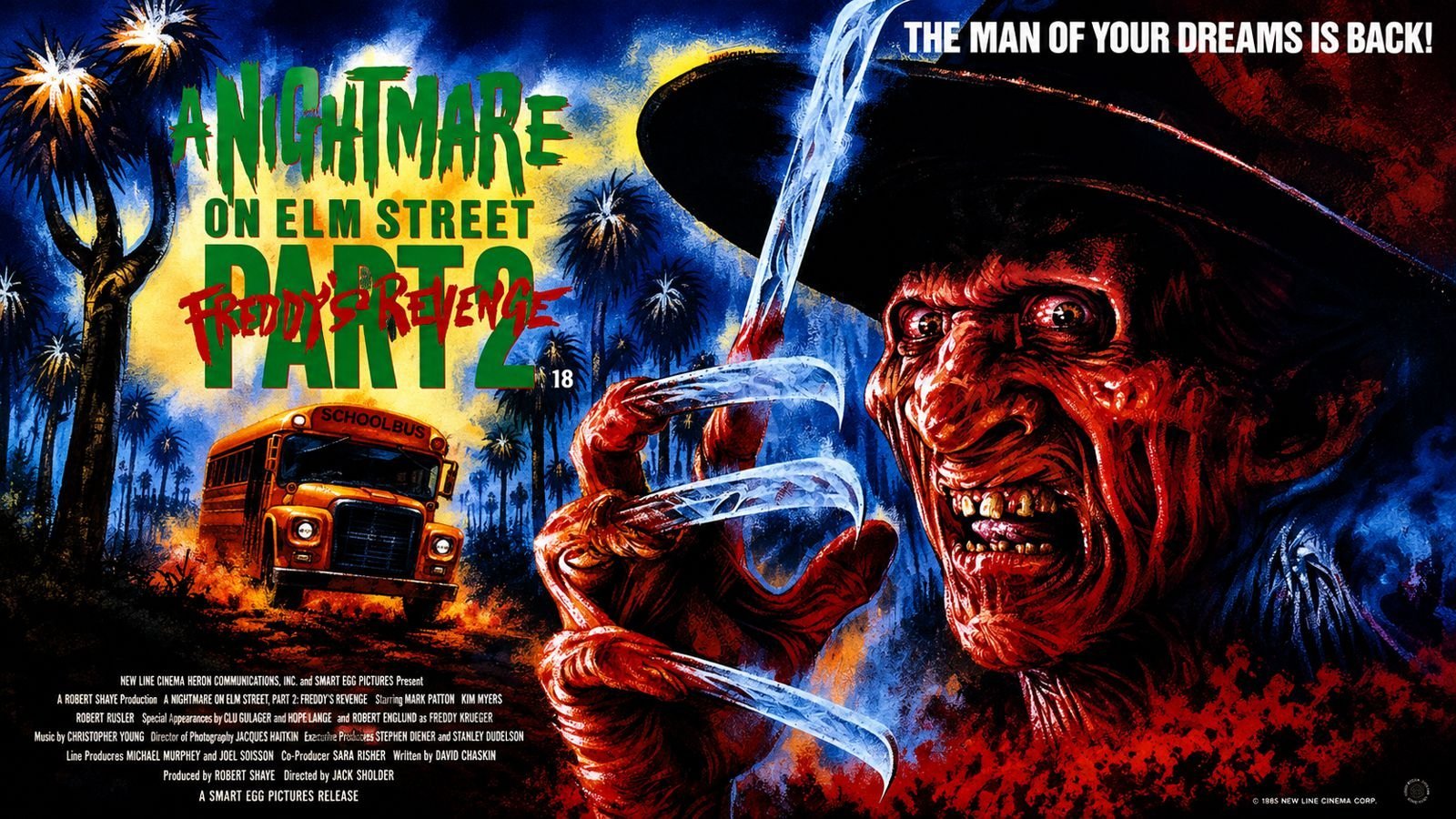
Freddy's Revenge: A Nightmare On Elm Street II (1985)
Cast: Mark Patton, Kim Meyers, Robert Englund
Director: Jack Shoulder
Nutshell: Freddy returns to wreak revenge as a gay metaphor tormenting a boy himself torn apart by his confused sexuality.
Review by: Omar Khan
A Nightmare on Elm Street 2: Freddy's Revenge is now firmly established as one of modern horror's most fascinating urban legends. The sequel to Wes Craven's horror classic has become almost as famous for its alleged gay subtext as it has for Freddy Krueger himself. Decades after the film's release, screenwriter David Chaskin openly acknowledged that he had intentionally written the screenplay with strong homoerotic undertones. Whether everyone else involved in the production realised this is another matter entirely. It appears that director Jack Sholder played the material completely straight, seemingly unaware of just how many coded references had found their way into the finished film.
On the surface, Freddy's Revenge tells the story of a teenage boy who moves into the unfortunate Elm Street house once occupied by Nancy Thompson's family. Jessie Walsh (played by Mark Patton) is soon plagued by terrifying nightmares in which Freddy Krueger attempts to possess his body and use him as the instrument through which he can continue his murderous rampage.
The film marks a significant departure from slasher convention. Instead of the traditional "final girl", the central role is occupied by a vulnerable young man who spends much of the film in varying states of undress, supposedly because of the unbearable heat generated by Freddy's growing presence within him. In doing so, Freddy's Revenge cheerfully tears up many of the unwritten rules established by earlier slasher films.
The story has frequently been interpreted as a metaphor for a young man struggling to come to terms with his sexuality. Mark Patton himself was a gay actor, and whether intentional or otherwise, his performance as Jessie lends itself remarkably well to that interpretation. Throughout the film Jessie battles an increasingly powerful force growing inside him—Freddy—desperately trying to suppress it before it ultimately breaks free and takes complete control.
Many viewers have also connected this internal struggle with the social climate of 1985, when the AIDS epidemic was still widely and cruelly referred to by many as "the gay plague", bringing fear, stigma and tragedy to thousands of young men. Whether that parallel was consciously intended remains open to debate, but it has undoubtedly become part of the conversation surrounding the film.
Several individual scenes further reinforce the film's now-famous queer subtext.
Jessie's uneasy banter with his friend about their sports coach's visits to gay leather bars quickly degenerates into playful wrestling, leaving Jessie momentarily deprived of his tracksuit bottoms in a scene that is difficult to ignore.
The film's most discussed sequence follows shortly afterwards. Jessie wanders into a leather bar populated by men dressed in full fetish attire, where he unexpectedly encounters his sports coach similarly attired. The coach later forces Jessie to run laps around the school gymnasium late at night before events take a distinctly supernatural turn. While Jessie showers, the coach is stripped naked by an unseen force, whipped across the buttocks by possessed towels and ultimately left dead, tied to the shower fittings.
Meanwhile, Jessie watches helplessly as tennis balls explode from their cans and sporting equipment erupts around the gymnasium.
Some critics have interpreted the exploding tennis balls as symbolic of Jessie's increasingly uncontrollable sexual desires. Whether this represents deliberate symbolism or simply enthusiastic over-analysis remains impossible to prove. However, David Chaskin's later admission that he intentionally embedded gay themes throughout the screenplay certainly gives such interpretations considerably more credibility than they once possessed.
Viewed purely as a horror film, however, Freddy's Revenge is considerably less successful.
There is little of the mounting dread or carefully sustained tension that made Wes Craven's original so effective. Instead, the film lumbers somewhat unevenly towards an admittedly entertaining finale in which Freddy finally succeeds in emerging physically from Jessie's body to unleash chaos upon a high-school pool party hosted by Jessie's girlfriend, Lisa (Kim Myers), whose striking resemblance to Meryl Streep has often been remarked upon.
The practical effects remain great fun, particularly when viewed in the context of the pre-CGI era, when artists such as Dick Smith, Rob Bottin and Tom Savini were redefining what cinematic horror makeup could achieve. While Freddy's Revenge never reaches those extraordinary heights, its creature effects and transformations still retain considerable charm.
Whether one accepts the queer reading or not, it is difficult to deny that Freddy's Revenge is saturated with imagery, situations and symbolism that invite such interpretation. Freddy himself can readily be viewed as the physical manifestation of the hidden desires Jessie struggles so desperately to suppress before they finally burst forth—quite literally—from within him.
Coincidence alone no longer seems an entirely satisfactory explanation.
Whatever one's interpretation, Freddy's Revenge occupies a unique place within horror cinema. It may not be among the strongest entries in the series, but it has become one of its most endlessly discussed, transforming what was once dismissed as an odd sequel into one of the most intriguing cult films of the 1980s.
0 Comments
Leave a Comment