
The Hot Spot Rating
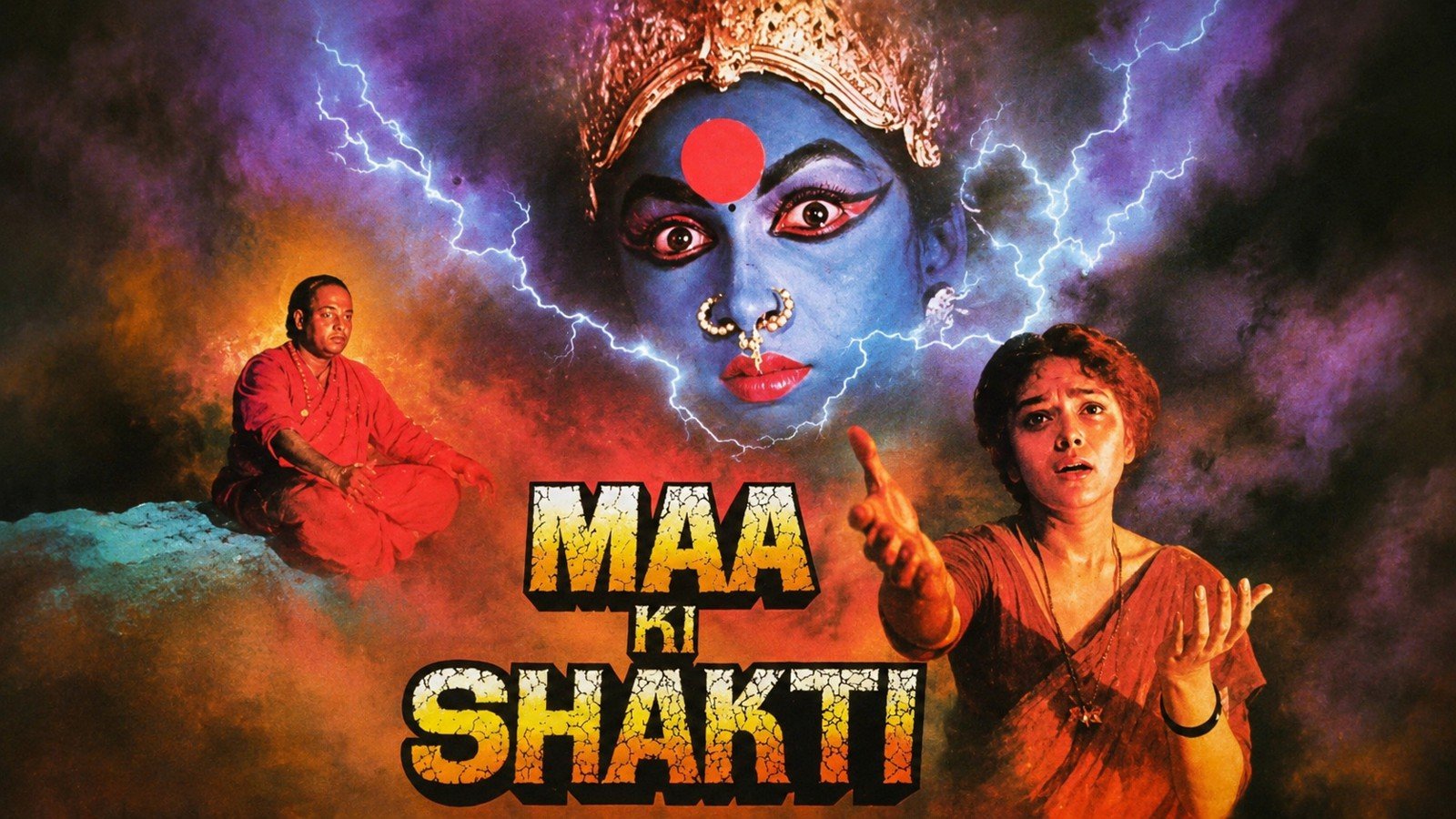
Maa ki Shakti (Ammoru) (1995)
Cast: Suresh, Saundarya, Rami Reddy
Director: Kodi Ramakrishna
Music Director: Chakravarthy & Shree
Synopsis: Successful South Indian mythology-drama-horror special effects extravaganza
This film was a major success upon its release in the mid-1990s and it is easy to understand why. Its dazzling special effects, quite extraordinary by the standards of Indian fantasy cinema at the time, proved to be the main attraction and left audiences throughout the South thoroughly spellbound.
The story itself is an elaborate mythological fairy tale steeped in local folklore and traditions.
A group of villagers decide to appease a Devi in the hope that she will protect them from misfortune. To earn divine favour they undertake a ritual fast and prepare five enormous pots of food as an offering to the gods.
Elsewhere a thoroughly unpleasant old hag is plotting her own future prosperity.
Her scheme revolves around a young doctor who is returning to the village after completing his studies. The hag intends to use her lustful daughter to ensnare the handsome young graduate and, once the wedding is safely concluded, secure all of his wealth and property for the family.
The hag’s son harbours ambitions of his own.
He dreams of becoming a great practitioner of the dark arts and has already built a modest reputation for himself as a tantrik. Unfortunately his schemes do not always proceed according to plan.
One particularly gullible college girl approaches him in the hope of obtaining advance access to examination papers. Instead she finds herself recruited into one of his dubious occult experiments with predictably disastrous consequences.
The tantrik is eventually exposed by the film’s heroine, a wide-eyed, impossibly innocent young woman who resembles a particularly sugary version of Sridevi. Naturally she soon captures the heart of the returning doctor, much to the fury of the scheming hag and her black-magic-loving offspring.
Meanwhile a mysterious woman arrives in the village.
She speaks in a strange echoing voice and possesses an unnerving calmness, as though she has spent the last century heavily medicated. Before long it becomes apparent that she is in fact a powerful Devi who has descended to assist the villagers.
The heroine, displaying a level of ingenuity rarely encountered in these films, manages to trick the Devi into promising that she will remain until her return from a brief errand.
She then promptly jumps into a well.
Thus, through a wonderfully convoluted piece of divine entrapment, the Devi finds herself obliged to remain indefinitely.
Soon she assumes the form of a magnificent miniature temple-like idol and becomes the focus of worship throughout the village, with the notable exception of the local black magic fraternity.
As romance blossoms between the doctor and the heroine, the wicked hag works tirelessly to poison the minds of the villagers and turn them against the innocent young woman.
The film proceeds at a surprisingly brisk pace despite its labyrinthine storyline. For much of its running time it resembles an old-fashioned family melodrama more than a horror film, but once the final act arrives the special effects begin to dominate proceedings and the film takes flight.
The effects work, prepared in London, remains remarkably effective because it complements the spirit of the story rather than overwhelming it. Instead of feeling like a gimmick, the visual wizardry enhances the magical atmosphere and helps bring this bizarre fantasy world vividly to life.
Equally important is the film’s complete reliance on indigenous ideas.
There are no obvious borrowings from The Exorcist, The Omen or Evil Dead. The mythology, rituals, supernatural concepts and imagery all emerge from local traditions and beliefs, giving the film a distinctive flavour that sets it apart from the endless parade of westernised horror imitators.
The production design also deserves praise. Rich blues, deep reds and dramatic lighting effects combine to create a genuinely otherworldly atmosphere, while the make-up work and visual styling add considerably to the film’s sense of fantasy.
The result is a wildly over-the-top, visually spectacular mythological adventure filled with strange rituals, eccentric characters and enough magical nonsense to satisfy even the most demanding fantasy enthusiast.
It is undoubtedly overlong and could comfortably survive the loss of at least one song, but these are minor complaints.
For all its excesses and eccentricities, this remains a fascinating, highly entertaining and uniquely Indian fantasy film whose greatest strength lies in its complete confidence in its own mythology and traditions.