
The Hot Spot Rating
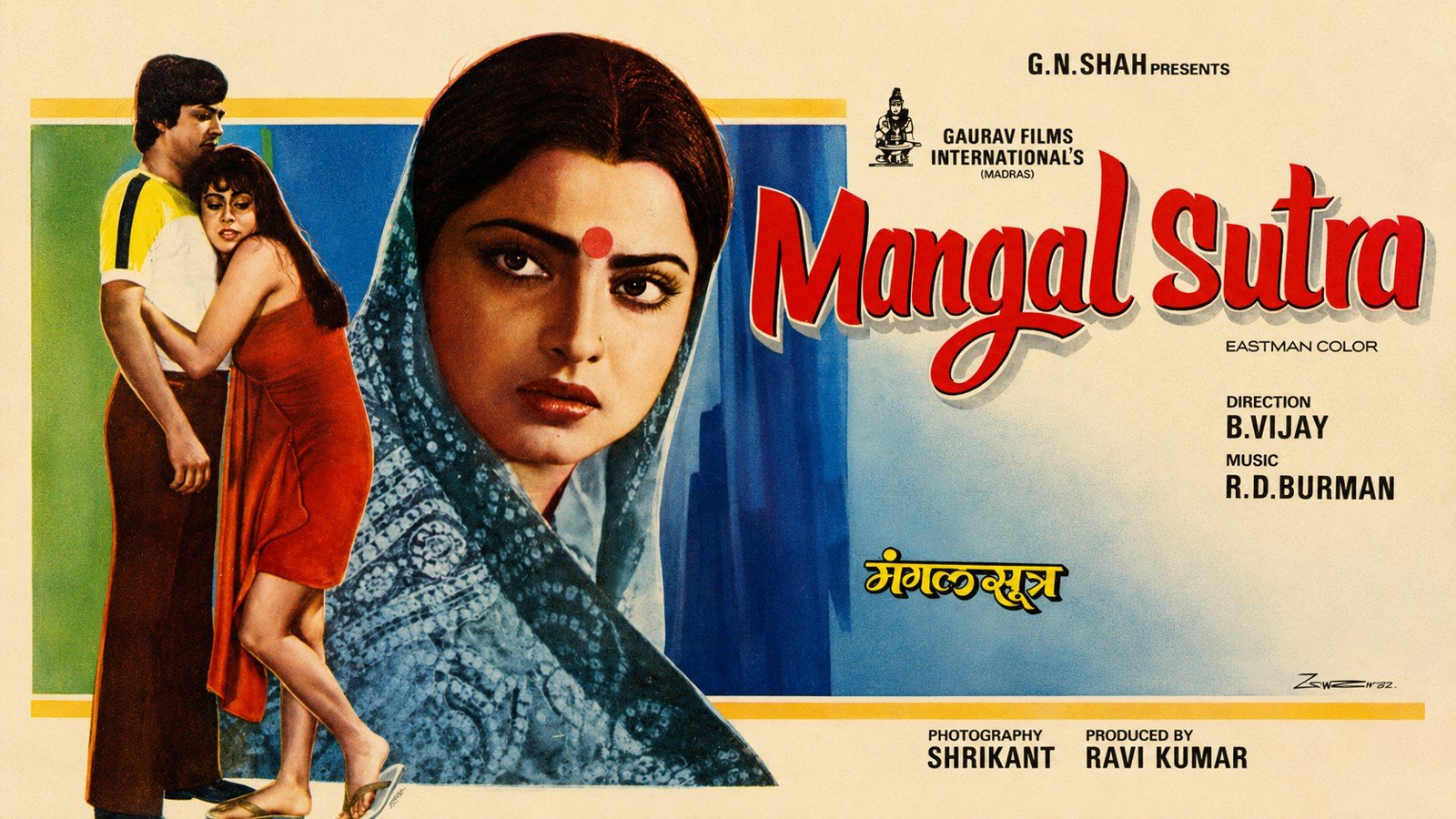
Mangalsutra (1981)
Cast: Rekha, Anant Naag, Om Shivpuri, Prema Narayan, Madan Puri, Jagdeep
Director: B. Vijay
Synopsis: South horror drama takes a leaf from The Exorcist but none of the potency
This South Indian horror-drama from Madras was one of several rapidly proliferating Exorcist-inspired productions that emerged across India during the late 1970s and early 1980s. First came the enjoyable Jadu Tona, followed by the vastly superior Gehrayee and then this effort. Mangalsutra differs slightly from the norm in that the victim of the disgruntled spirit is not the customary pubescent girl but a fully grown man.
The first third of the film is something of a trial, with romance taking precedence over everything else. We are subjected to a procession of forgettable songs whose sole purpose is to establish that Vijay (Anant Nag) and Gayatri (Rekha) are the perfect couple.
When the wedding day finally arrives, however, strange things begin to happen.
A wedding invitation bearing Rekha’s photograph is mysteriously splattered with black ink. Moments later an unearthly gust of wind sends a stack of invitation cards flying across the surrounding fields. Then, during the wedding ceremony itself, the sacred knot binding the couple suddenly catches fire while they perform the traditional saath pheras.
As omens go, these are not encouraging.
The local wildlife also appears less than enthusiastic about the marriage. A particularly aggressive bull is unleashed upon the wedding party, causing general chaos and confusion.
Despite these setbacks the ceremony is completed, although not before a mangalsutra explodes and several more alarming signs suggest that somebody, somewhere, is deeply unhappy about the union.
It soon becomes evident that the newlywed Vijay is the target.
Not long after the marriage he begins exhibiting disturbing behaviour. His eyes acquire an alarming blue tint, his voice deepens ominously and he starts glowering at people like a man who has recently discovered taxation.
The battle lines are drawn between the forces of virtue and the vengeful spirit of Kamini, played with considerable gusto by Prema Narayan.
Kamini, it transpires, was once a college acquaintance of Vijay who became somewhat obsessed with the idea of marrying him. Rejected in life, she vows revenge in death and returns from beyond the grave determined to destroy the man who spurned her affections.
Standing against these dark forces is Gayatri, the very embodiment of the idealised sati-savitri wife.
When conventional remedies fail, she takes to belting out lengthy bhajans before Lord Shiva and eventually resorts to smashing her head repeatedly against temple stones while demanding divine intervention.
Poor Shivji is left with very little room for manoeuvre.
Faced with a profusely bleeding and utterly determined Rekha, he dutifully unleashes thunderbolts, lightning flashes and eventually dispatches a cherubic heavenly messenger carrying the sacred prasad required to save Vijay.
Unfortunately Kamini proves a resourceful adversary.
Having survived near-fatal car crashes, spiritual ordeals and enough suffering to qualify for sainthood, Gayatri discovers that the precious prasad has been stolen by the vengeful ghost, who appears increasingly likely to win the battle for Vijay’s soul.
All seems lost.
Then again, as the old saying reminds us, “Bhagwan ke ghar der ho sakta hai, andher nahin.”
Thus Gayatri returns to the family shrine and demands justice from the gods with such unwavering conviction that divine assistance once again becomes unavoidable.
Whether her devotion proves sufficient to save the perpetually bewildered Vijay from Kamini’s wrath and the tantrik’s extraordinarily sharp trident is a question best left for the climax.
Unfortunately the climax itself is rather disappointing.
Ancient special effects, including a truly astonishing levitation sequence, undermine much of the tension. Kamini’s spirit spends much of the finale fleeing a magical flame apparently dispatched personally by Shivji while various superimpositions drift around the screen in a haze of primitive optical effects.
Before long it is all over.
The film ultimately struggles as a horror movie because far too much time is devoted to romance, family squabbles and comic diversions. The endless banter between the two sets of in-laws slows proceedings considerably, while the presence of Jagdeep and Narendranath ensures that whatever momentum remains is periodically brought to a grinding halt.
As if that were not punishment enough, the audience must also endure a song featuring Jagdeep alongside Jayshree and Meena.
The experiment of making a man rather than a woman the victim of possession also proves less successful than one might have hoped. Horror films have long relied upon the vulnerability of a female protagonist and Mangalsutra inadvertently demonstrates why this convention exists.
The result is not a terrible film by any means.
It contains moments of charm and occasional flashes of imagination, but it pales beside the vastly superior Gehrayee, released around roughly the same period and dealing with remarkably similar themes in a far more effective manner.
Interesting as a curiosity perhaps, but hardly essential viewing.