
Dr Jekyll and Sister Hyde arrived during a period when Hammer Film Productions, Britain’s once-mighty flagship horror factory, was floundering badly and surviving largely on borrowed time.
By the time the 1970s rolled around, the glorious golden days of the ’50s and ’60s had faded into distant memory. The ingredients that had once powered Hammer’s phenomenal success were now exhausted and increasingly redundant. Audiences had simply grown tired of endless variations on Dracula, Frankenstein, and The Mummy. Hammer seemed trapped in an eternal cycle of recycling the same monsters over and over again until viewers finally stopped turning up altogether.
The studio’s horror productions were now yielding steadily diminishing returns, and Hammer had become desperate to somehow inject fresh blood into its increasingly stale showroom of ageing horror icons.
The company remained bizarrely determined to reinvent Dracula for the modern era, despite the fact that punk rockers and social collapse now appeared far more frightening to contemporary audiences than vampires, werewolves, or mummies ever could. Hammer kept flogging its increasingly moribund Draculas and Frankensteins long after the horse had clearly died.
Where cinemas once had to turn audiences away from Hammer’s latest productions, by the dawn of the ’70s the mighty torrent had dwindled to little more than a trickle of ageing loyalists.
The company was sinking rapidly, but the bosses stubbornly continued attempting to coax life from their massively overused stockpile of horror material.
Such was the state of affairs at Hammer that what ultimately became Dr Jekyll and Sister Hyde reportedly began life as an after-dinner joke made by Brian Clemens about Dr. Jekyll transforming not into Mr. Hyde but into the voluptuous Sister Hyde instead.
Hammer boss James Carreras was immediately taken with the idea, and before long the joke had evolved into a serious production with Clemens brought onboard to write the screenplay.
Roy Ward Baker — regarded as efficient if not particularly visionary — was hired to direct, with Clemens hovering nearby exerting considerable influence over the production.
By this stage, Clemens had already built a strong reputation thanks to his stylish work on The Avengers, and Dr Jekyll and Sister Hyde offered him a perfect opportunity to transition more heavily into cinema.
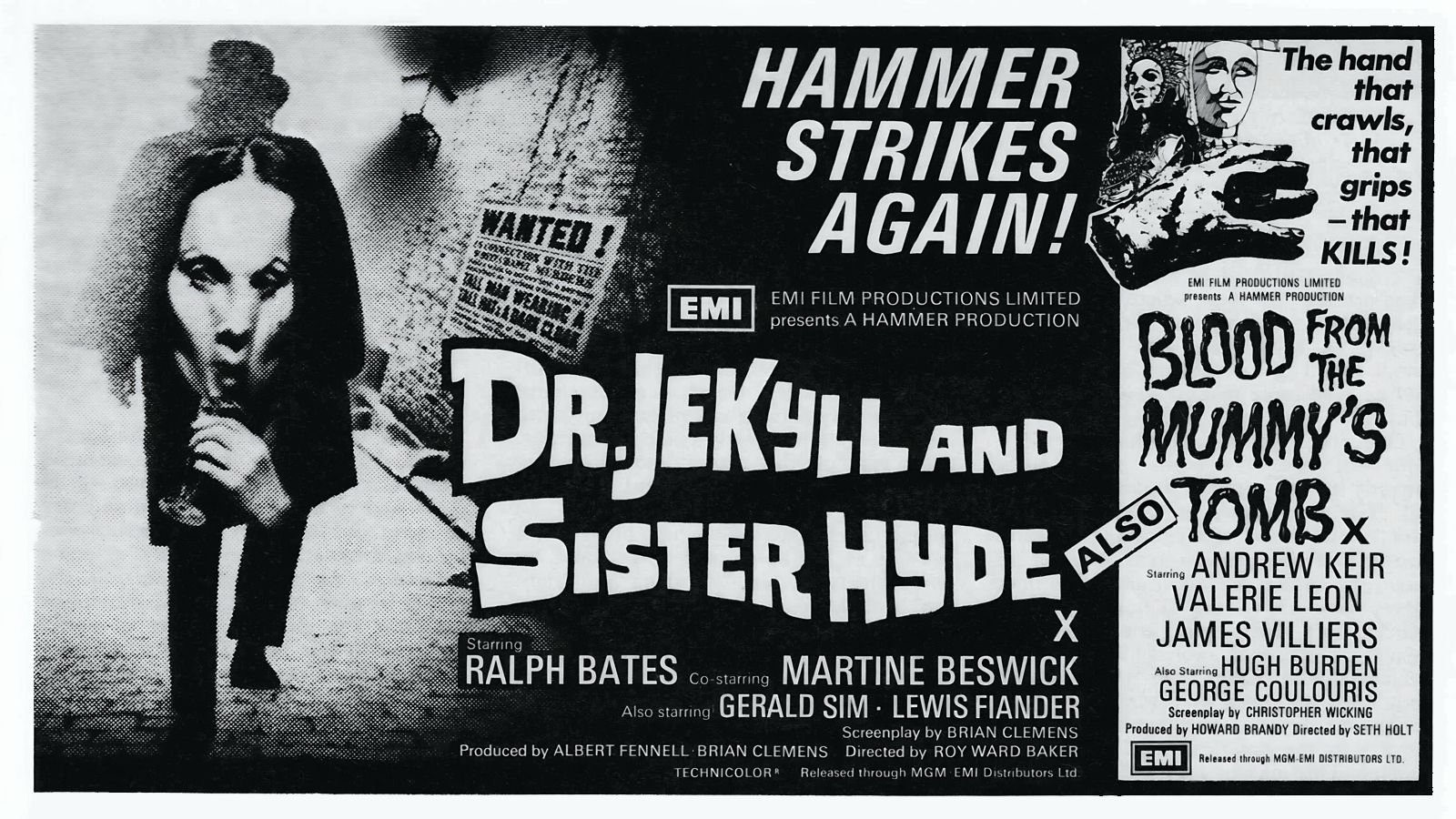
Following casting, the film entered production at Elstree Studios during early 1971 before eventually being released later that year as part of a double bill alongside Blood from the Mummy’s Tomb.
Unfortunately, audiences responded with near-total indifference to what remains one of Hammer’s more interesting latter-day productions, and the studio’s catastrophic box-office drought continued unabated.
The film also arrived during a period of major upheaval in cinematic tastes and censorship standards. The sexual revolution of the 1960s had relaxed attitudes toward nudity, while the shockwaves created by Night of the Living Dead in the aftermath of the Vietnam War ushered in a far more graphic and explicit era of screen violence.
Amidst all this cultural upheaval, even previously unstoppable British institutions like the Carry On franchise were beginning to lose steam.
The innuendo-driven sauciness of the Carry On films suddenly looked quaint and redundant once Deep Throat had pushed pornography into the mainstream in the United States, if not quite yet Britain.
Hammer responded by desperately increasing the doses of nudity, bloodshed, and pulp violence throughout the early ’70s, but by then it was already too late. Audiences had fatally associated Hammer with old-school gothic horror, while the new generation of horror cinema led by Night of the Living Dead and The Last House on the Left made the classic Hammer style appear increasingly camp and antiquated.
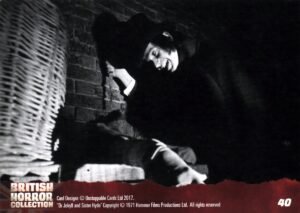
Dr Jekyll and Sister Hyde ultimately evolved from a joke into a screenplay and finally into a surprisingly intriguing film. Clemens clearly recognised Hammer’s increasing desperation and wisely attempted to steer the classic Strange Case of Dr Jekyll and Mr Hyde material in a fresher and more subversive direction — and to a large extent he succeeds.
The film still retains all the familiar Hammer trademarks:
- swirling pea-soup fog
- bawdy taverns
- flirtatious barmaids
- gloomy Victorian England
- suspicious alleyways
- sinister laboratories
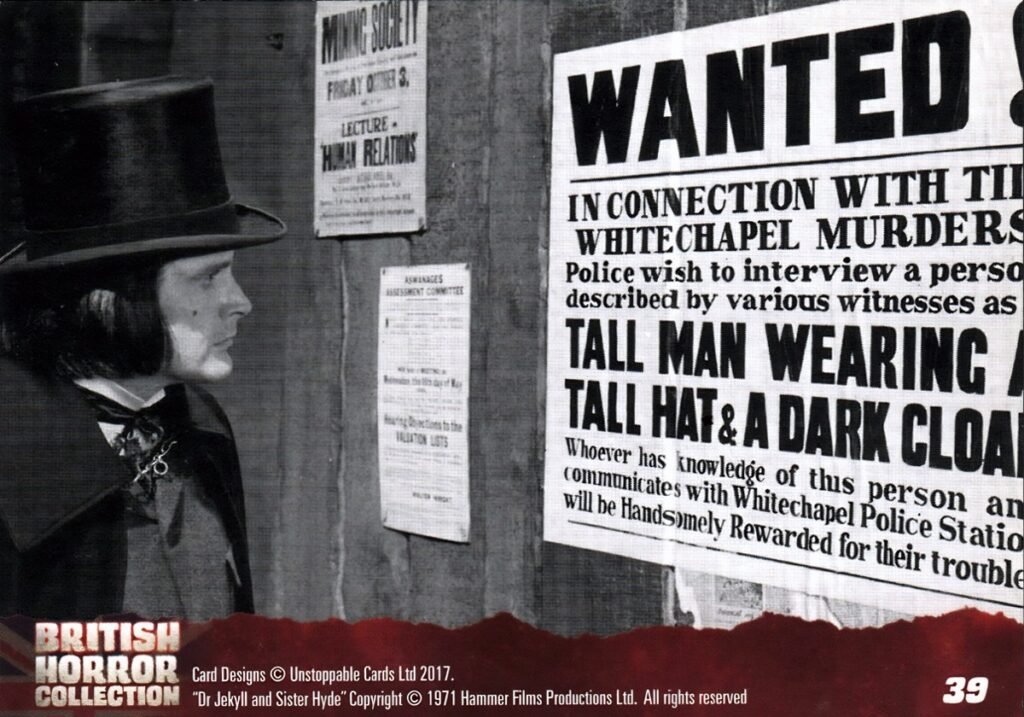
This time, however, Clemens cleverly incorporates elements of the infamous Jack the Ripper murders into the storyline, using the Whitechapel killings as a grisly backdrop while also weaving in the infamous Burke and Hare body-snatching mythology to create his own peculiar twist on the Robert Louis Stevenson template.
The story opens with Ralph Bates prowling the streets of London searching for female corpses from which he may extract hormonal tissue for use in his increasingly demented experiments — all of which he insists are intended to cure terrible diseases.
His ambition is matched only by his obsessive zeal inside his private laboratory.
Living upstairs are the Spencer family, including young Susan, who develops a thoroughly schoolgirl crush upon the handsome but mysterious Dr. Jekyll. Susan becomes almost comically obsessed with the doctor, virtually stalking him in hopes of winning his affection, while Jekyll remains hopelessly buried in his scientific work.
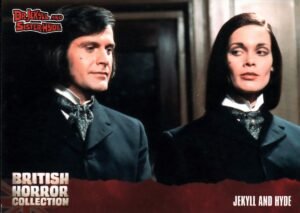
Naturally, the doctor receives the shock of his life when his experimental elixir produces catastrophic side effects, transforming him into a voluptuous beauty with an entirely separate personality.
When neighbours begin spotting this mysterious woman, Jekyll hurriedly explains that she is merely his visiting “sister.”
Meanwhile, Susan continues scratching persistently at Jekyll’s door like an infatuated teenager completely incapable of taking a hint.
As the film progresses, Jekyll’s transformations into the seductive Sister Hyde become increasingly frequent while Hyde’s personality steadily gains dominance.
There is also a welcome streak of delicious humour running throughout the script, particularly during a marvellous scene in which Jekyll forgets he has reverted back into male form and continues shamelessly flirting with a rather startled neighbour.
The doctor must continue sourcing fresh bodies to sustain his experiments, while Sister Hyde prowls the foggy London streets searching for fresh victims and conveniently diverting suspicion away from Dr. Jekyll’s apparent involvement in the Whitechapel murders.
Eventually, however, the struggle between brother and sister for control of their shared body escalates toward horrifying consequences, while poor innocent Susan becomes hopelessly entangled within the nightmare unfolding around her.
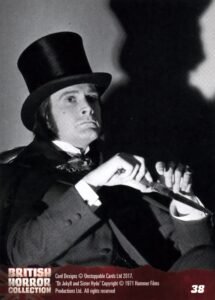
The film admittedly lacks some of the grandeur and visual elegance of Hammer’s vintage classics, which is hardly surprising considering the tightening budgets and rapidly worsening financial situation facing the studio by this stage.
Nevertheless, the production remains surprisingly handsome. The cleverly rearranged sets successfully evoke Victorian London’s narrow fog-bound alleyways, while Hammer’s trademark pubs overflowing with shameless floozies and bawdy humour remain gloriously intact.
Jekyll’s laboratory, admittedly, appears somewhat underwhelming compared to the magnificent gothic labs inhabited by Peter Cushing’s Baron Frankenstein in The Curse of Frankenstein.
One cannot help wondering whether the film might have benefited from Clemens himself directing, especially given the stylish flair he demonstrated with The Avengers. Roy Ward Baker was generally known more for efficiency and reliability than visual imagination.
To be fair, however, Baker does a perfectly respectable job throughout, and the first transformation sequence is genuinely clever and impressively handled considering the limitations involved.
Clemens’ subversive humour is felt strongly throughout the screenplay, while Ralph Bates — whom Hammer clearly hoped to groom as their next horror star — performs very effectively as Dr. Jekyll.
Ultimately, though, it is Martine Beswick who steals the picture entirely as the murderous and irresistibly seductive Sister Hyde.
The supporting cast is filled with dependable British character actors, while the set design and production values remain solid throughout.
Sadly, the film’s box-office performance proved disastrous. Released in London’s New Victoria Cinema during October 1971 alongside Blood from the Mummy’s Tomb, the double bill reportedly generated a pitiful opening-week gross of just £2,376 — another brutal nail in Hammer’s increasingly crowded coffin.
Audience perceptions of Hammer Horror had changed irreversibly, and the rejection was swift and merciless.
In retrospect, however, while hardly top-tier Hammer vintage, Dr Jekyll and Sister Hyde remains one of the more interesting productions from the studio’s declining years. At the very least, it demonstrates a genuine attempt to shake up the formula while injecting a healthy dose of sly humour and sexual subversion into the material.
For horror fans — and especially Hammer devotees — the film remains essential viewing and is unlikely to disappoint most genre enthusiasts.