
The Hot Spot Rating
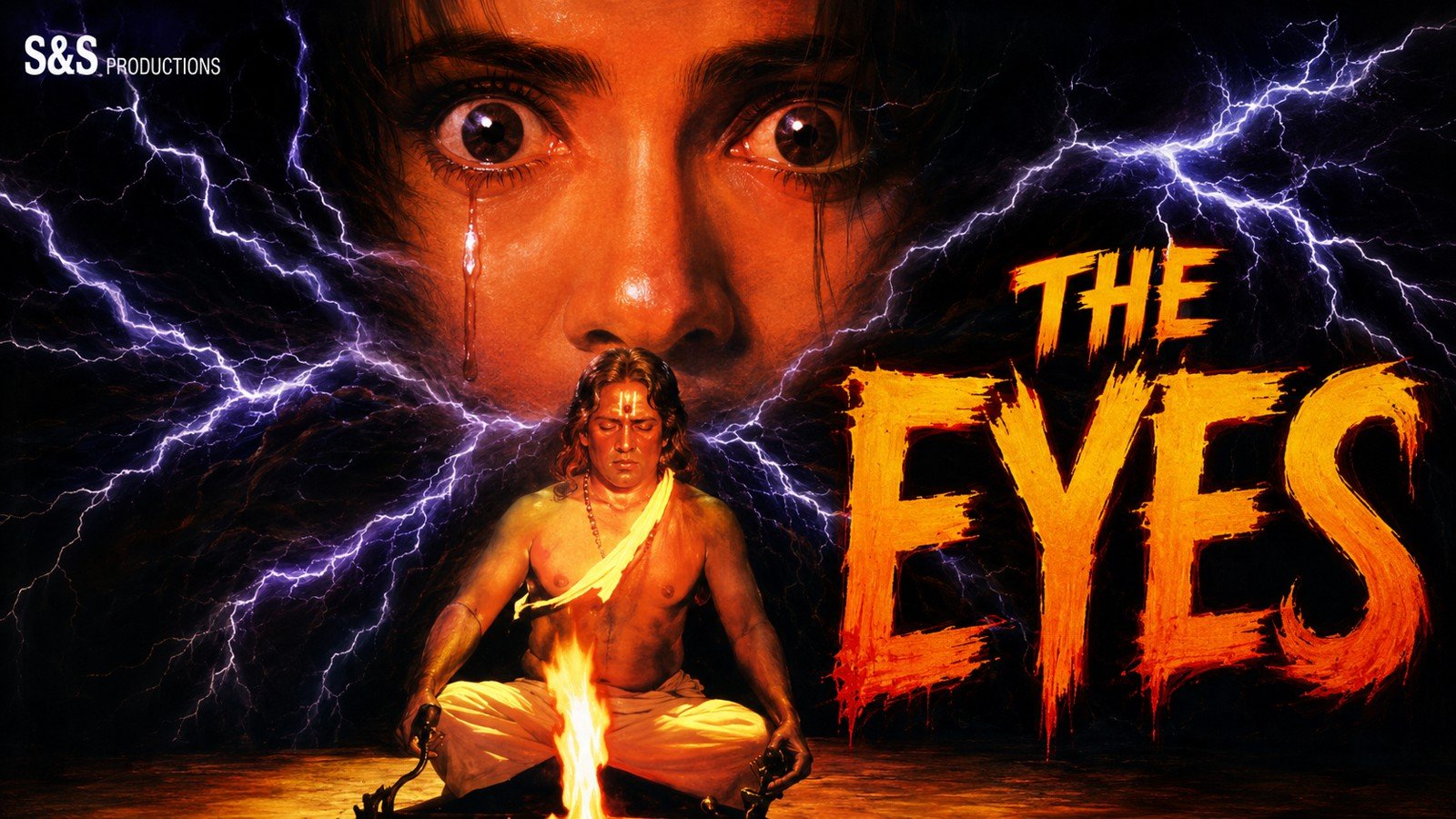
Eyes, The (1998)
Starring: Vikram, Vanivishwanath,Devan, Pradap Chandran
Director: George Kithu
Synopsis: University study trip goes horribly wrong as ghastly ghost is unleashed
A South Indian movie dubbed rather awkwardly into Hindi begins with a group of university students preparing for an archaeological expedition to the ancestral lands of one of their classmates. The purpose of the trip is supposedly to study a local tribal community, gather evidence, and produce some sort of anthropological report.
Accompanying the students are two male lecturers—one of whom appears to be a full-time alcoholic—and a female professor. Together they pile into a van and set off towards their destination while swaying merrily to the obnoxious sounds of Daler Mehndi blasting from the soundtrack.
Along the way, the audience is periodically treated to shots of dense jungle accompanied by standard horror-movie music just to remind us that some malevolent force is lurking nearby. What this evil presence actually is remains unclear for the time being, but the film is determined that we should know something unpleasant is waiting in the wings.
The group eventually settles into a Purani Haveli belonging to a student named Hari, whose family once owned the property. Before leaving home, Hari’s grandmother insists on sending him off with an extraordinarily gaudy amulet designed to protect him from evil forces, particularly those inhabiting the vicinity of the Haveli.
Old granny clearly knows something we don’t.
Initially everything goes swimmingly. The students appear to be having a wonderful time while we sit patiently waiting for disaster to strike.
Meanwhile, the aspiring anthropologists begin studying local tribal customs, though exactly what educational value these observations possess is somewhat questionable. One day, while rummaging through the darker corners of the Purani Haveli, two of the least intellectually gifted students—admittedly a highly competitive category as they all appear remarkably slow and suspiciously overage for university students—discover a collection of old artefacts along with several paintings depicting a stunning beauty.
One of the paintings appears unfinished, and the students insist that Hari complete it, since he happens to be a talented artist.
At the same time, the soundtrack begins warning us that this is a very bad idea indeed.
The second major mistake made by the students occurs during a stroll through the jungle. There they discover a large tree with a massive nail protruding from it like a six-inch dagger. Naturally, rather than leaving it alone, they spend several minutes tugging and pulling until the nail finally comes loose.
Immediately an eerie wind erupts from nowhere.
Never a good sign.
Things deteriorate further when screams suddenly erupt from the girls’ room. The painting recovered from the Haveli basement has inexplicably burst into flames. Moments later it levitates, flies out of the nearest window, and disappears into the jungle.
The amateur anthropologists had not anticipated ghostly airborne artwork and are understandably rattled by these developments.
A day or two later, the obligatory Bollywood ghost beauty begins making regular appearances. Draped in a flowing white sari and accompanied by a Lata Mangeshkar clone wailing mysteriously in the background, she wanders around looking suitably spectral. Like countless Bollywood ghosts before her, she possesses the ability to assume the appearance of other people and has an irritating tendency to vanish whenever anyone gets close enough to ask sensible questions.
Clearly we are dealing with a restless spirit consumed by vengeance.
One sleepless evening, one of the students decides to go wandering alone through the jungle in the dead of night, which seems a perfectly reasonable thing to do under the circumstances. Sure enough, he encounters the alluring beauty in white.
She lures him to a suitably romantic location where a passionate embrace rapidly transforms into a deadly encounter as she suddenly becomes a vampire and sinks her fangs into him.
Or at least that’s what we’re told happens.
The scene itself is surprisingly unfrightening despite the heroic efforts of the music director, who attacks the soundtrack with all the subtlety of a man trying to wake the dead through sheer volume alone.
Several equally uninspiring death scenes follow, after which the film pauses for a lengthy dose of comedy courtesy of a police inspector and his profoundly dim-witted sidekick constable.
One night Hari and one of the professors catch the ghost in the act of feeding upon another victim. They manage to interrupt the attack and save the unfortunate student. The ghost responds by performing a spin worthy of Wonder Woman before vanishing into thin air.
At this point the group correctly concludes that conventional law enforcement is unlikely to solve their problem.
What they require is spiritual assistance.
Enter Swami Ji.
Respected by all and sporting a magnificent mane of wild grey hair, the holy man arrives dispensing mystical wisdom, cryptic warnings, powders, potions, and assorted spiritual mumbo-jumbo. Remarkably, much of it seems to work.
The film then serves up several desperate attempts at special effects as Neeli the ghost tries to scare him away with gale-force winds, walls of flame, and various supernatural tricks. Each time the Swami calmly counters her attacks using his own arsenal of powders and magical remedies.
Clearly this is not a man to be trifled with.
Eventually matters build towards the inevitable showdown between good and evil, pitting Neeli’s murderous spirit against the righteous powers of Swami Ji and his glorious locks.
It all feels a little like Father Merrin’s confrontation with Pazuzu in The Exorcist—if The Exorcist had been dubbed badly and produced on the budget of a family picnic.
The problem is that the entire enterprise feels painfully stale.
There is no novel twist, no fresh perspective, and no attempt to do anything remotely new with a storyline that Bollywood had already recycled countless times. Wandering white-sari-clad ghosts bent on revenge have been haunting Hindi cinema since the industry’s earliest flirtations with horror.
This is essentially the same story all over again.
The first half is particularly excruciating, crawling along at a glacial pace until Neeli finally begins putting her vampire fangs to work—fangs which, incidentally, we never actually get to see.
There is also a shocking lack of gore. The film’s sole concession to bloodshed arrives when Neeli sheds tears of blood, another tired trick lifted from a very worn-out playbook.
The audience must wait until the final reel for the big payoff, which arrives in the form of a thoroughly laughable transformation sequence where Neeli becomes a six-hundred-year-old hag complete with warts and all.
Cheap, badly acted, poorly shot, and painfully sluggish, the film is partially redeemed by the Swami Ji character, whose enthusiastic performance injects a little life into proceedings as the story stumbles towards its conclusion.
This is certainly not the worst Bollywood horror film ever made, but it desperately lacks decent gore and spends far too much time talking when it should be getting on with the business of horror. In this day and age, a white-sari ghost simply doesn’t cut it, even if she occasionally moonlights as a bloodthirsty vampire.
Cheap.
Tacky.
Not frightening for even a fleeting moment.
Very much in keeping with the grand Bollywood horror tradition.