
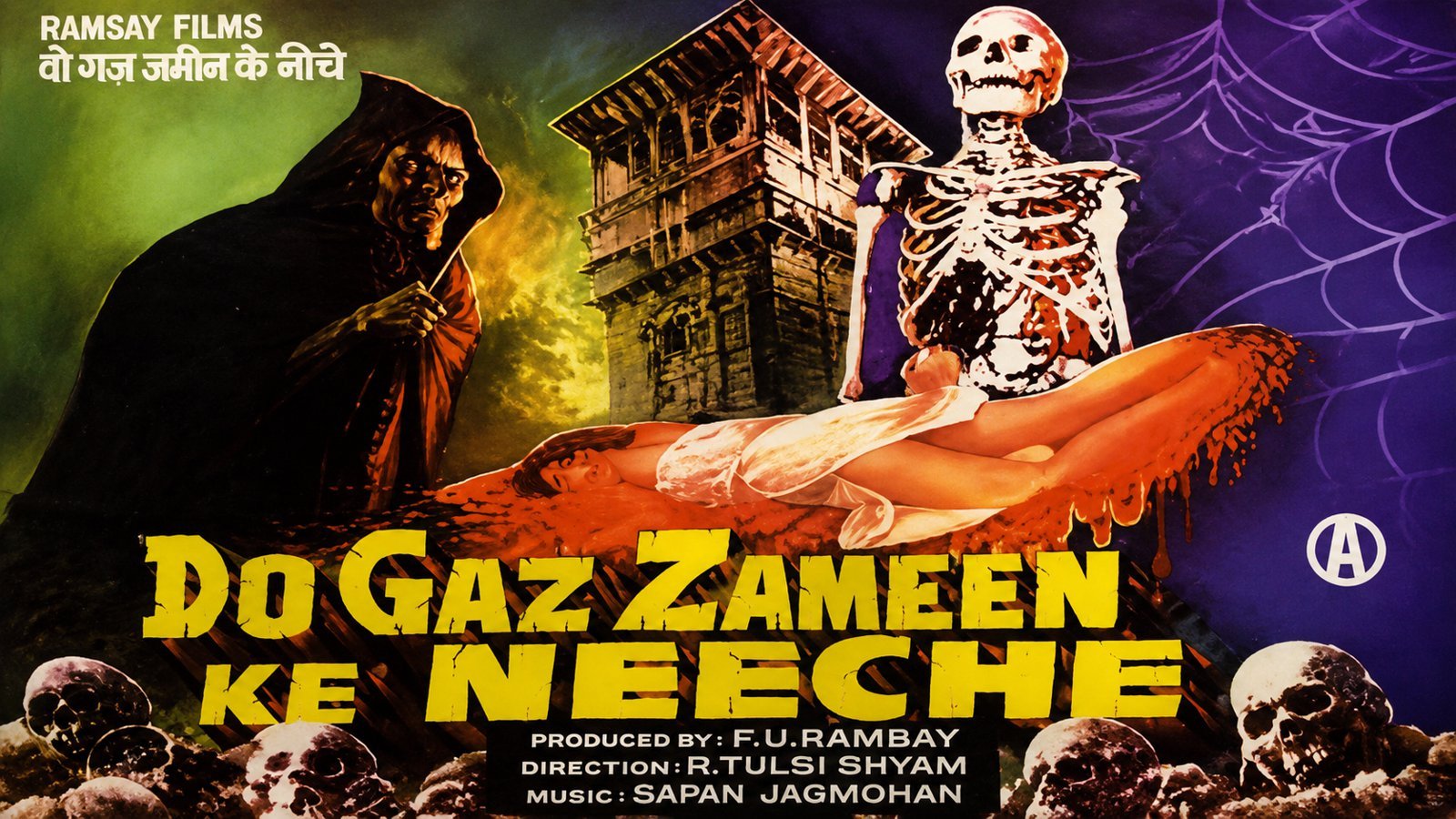
The Hot Spot Rating
Do Gaz Zameen ke Neeche (1972)
Cast: Surendra Kumar, Shobha, Imtiaz Khan, Satyen Kappu, Helen
Directors: Tulsi Ramsay & Shyam Ramsay
Synopsis: Groundbreaking Ramsay horror flick opened up the floodgates!
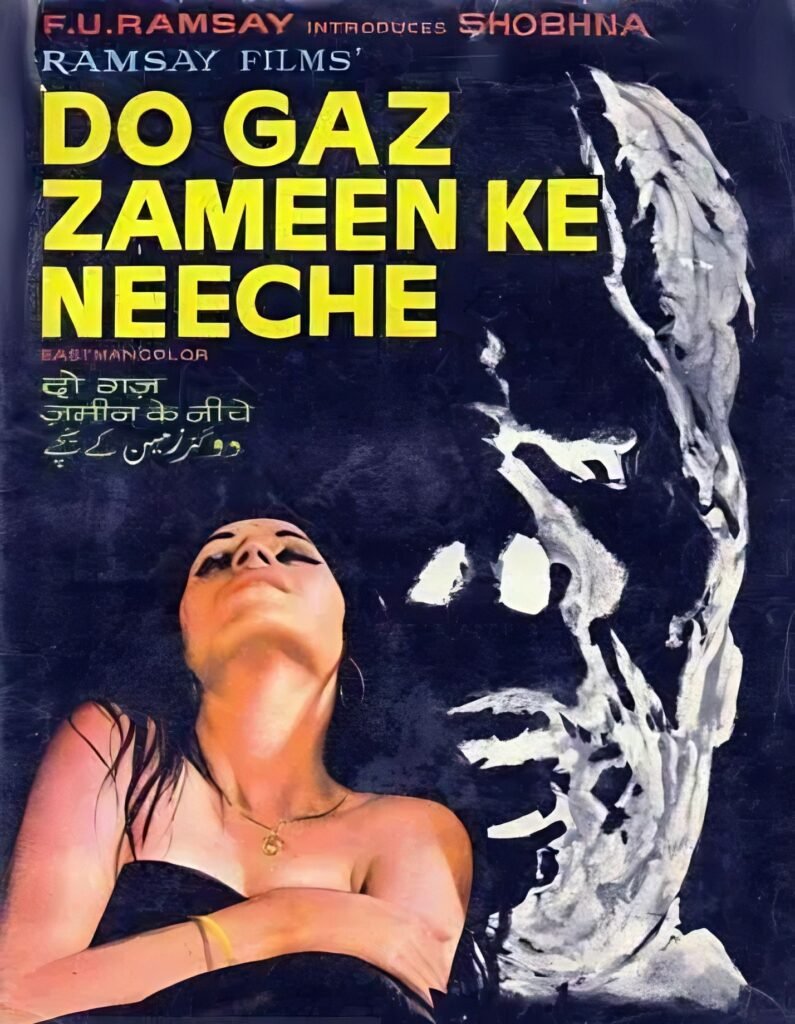
This early 70s effort by the Ramsay family is considered a major breakthrough in South Asian horror. Not only did it score a huge box-office bullseye, but it also paved the way for a new wave of horror that veered away from the genteel white sari-clad ghosts of yesteryear towards the blood-curdling, post-Hammer style that would become the hallmark of local terror in the years to come.
The Ramsays had long been ardent admirers of the macabre and especially of the films turned out by Hammer Studios in England. It doesn’t take long watching a Ramsay film to begin to appreciate just how profound that influence was.
Do Gaz Zameen Ke Neeche is perhaps not quite what one has come to expect from a typical Ramsay feature. There is no hidden Taekhana harbouring a dark secret and a slumbering hairy monster. There is no Purani Haveli being ravaged by the spells of an evil Tantrik. In fact, there are no creatures at all—hairy, fanged, rubber-faced or otherwise—which makes a refreshing change from the atypical “hairy monster” epics that would dominate the 80s and 90s.
The film begins with Raja, a hugely wealthy aristocrat-cum-scientist, mourning the death of his recently departed wife, with whom he was evidently madly in love. His moping session is interrupted by the sounds of desperate shrieking and he turns to see a nubile young thing being pursued through the woods by a pack of good-for-nothing anti-social elements. He rushes to the rescue and saves the damsel in distress, a helpless if somewhat overage college girl named Anju (she later explains that she has failed her exams four times in succession), who is every bit as vulnerable as she is voluptuous.
Our aristocratic scientist offers the distressed beauty shelter for the night as darkness has fallen and she has nowhere to go.
Later that evening the nymph-like Anju quietly slips into Raja’s bed and, when he awakens in some confusion, explains that she was simply too frightened to sleep on her own. It does not take long for the pair to succumb to their mutual lust and, the following morning, upon finding Anju weeping over her indiscretion, Raja nobly promises to do the right thing and marry her.
All is well initially, but before long a slimy uncle turns up and begins using Anju as a convenient means of draining Raja’s wealth. It soon becomes evident that uncle and niece are working hand in glove and that Anju is far removed from the meek and innocent waif she originally pretended to be.
Bit by bit she reveals herself to be one of the most scheming and manipulative villains imaginable, prepared to stop at absolutely nothing to get what she wants. If cold-blooded murder happens to be the most convenient route to her ambitions, then so be it.
She recruits her lover, Imtiaz Khan, to pose as a doctor after poisoning Raja into a state of semi-paralysis and together they carefully plot the poor scientist’s destruction. Eventually, in a chilling and particularly effective sequence, the scheming lovers dispose of the suffering Raja and dump his corpse into a freshly dug grave—Do Gaz Zameen Ke Neeche.
The slimy uncle, Anju and Imtiaz subsequently begin falling out over the division of the spoils and complications arise when unpleasant things start going bump in the night. Matters become considerably worse when a zombified Raja is spotted prowling around the vicinity.
Upon checking the grave, everyone’s worst fears are confirmed when the corpse inside turns out not to be Raja at all, but rather the unfortunate fellow recruited to help bury him.
Under increasing pressure, the relationship between Anju and Imtiaz begins to fracture and they soon find themselves at one another’s throats. Then the terror escalates dramatically as the rotting cadaver of Raja begins making its presence felt in increasingly traumatic fashion.
The film succeeds largely because it grips the viewer through its intriguing tale of deception, greed and murder. Raja, the hapless and hopelessly trusting scientist, is played with appropriate geekishness by Surendra Kumar, though his nerdish demeanour proves somewhat deceptive. Shobha is a revelation as the deliciously wicked Anju—seductive and coy whenever required, yet utterly ruthless and cold-blooded when pursuing her ambitions.
Imtiaz Khan is equally effective as the manipulated lover hopelessly ensnared in the web spun by the black widow Anju.
Unlike many later Ramsay productions, there is none of the seedy overt titillation that would become a regular feature of their work. Nevertheless, there is enough masala on display to satisfy local expectations, which remained rather Victorian by modern standards. We are treated to scenes where Shobha joins Imtiaz in the bathtub—albeit fully clothed while he is not—the sort of sequence that was considered positively scandalous in those comparatively innocent days.
On the whole, Do Gaz Zameen Ke Neeche is a satisfyingly gripping thriller featuring a tightly woven plot and numerous chilling moments without ever becoming an outright horror film in the conventional sense.
Fortunately there are no painful comic diversions courtesy of Jagdeep or Narendranath and the film is immeasurably better for their absence. There is also very little gore on display and it may seem curious that the film is regarded as such a groundbreaking work given that it is not really “Full Horror”, as local parlance would have it, despite its heavy macabre overtones.
What made it so important was that it represented something refreshingly different at the time—a welcome departure from the pseudo-horror films populated by ghostly white sari-clad ladies wandering through misty wildernesses while lamenting their fate to the strains of Lata Mangeshkar.
Perhaps the greatest influence of Do Gaz Zameen Ke Neeche was not the film itself but the success it achieved. Its massive popularity kick-started the Ramsay horror production line that would become the backbone of Bollywood horror for the next two decades.
It is a thoroughly enjoyable effort from the Ramsays and, somewhat ironically, one that occasionally suggests they may never have quite surpassed it despite all the hairy monsters, evil Tantriks, haunted Havelis and Taekhanas that were still to come.