
The Hot Spot Rating
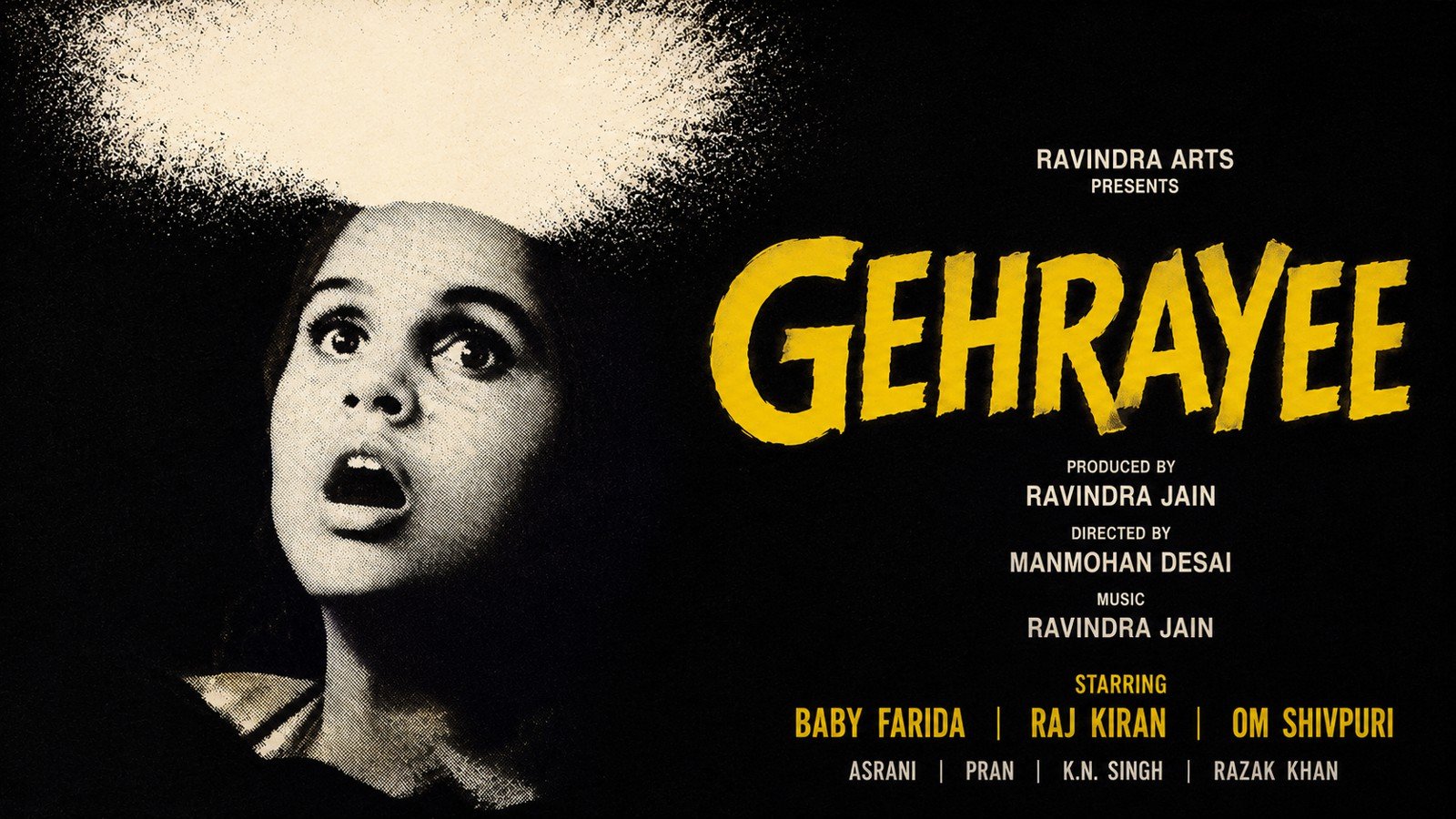
Gehrayee (1980)
Starring: Amrish Puri, Padmini Kolhapure, Anant Naag, Shriram Lagoo, Indrani Miukherjee
Director: Arunavikas
Synopsis: stylish, taut and well acted possession chiller is gripping and understated
This unheralded little production from the early 80s is quite possibly one of the finest horror films ever to emerge from Bollywood. The film focuses on a small, middle-class, well-educated South Indian family struggling to come to terms with financial difficulties and tightening the household belt in order to provide the children with a decent education and the elders with a comfortable retirement.
At the head of the family is Dr Lagoo, who is fortunate enough to have inherited a large tract of land from his father. At the beginning of the film, a solemn Lagoo arrives at his ancestral property where he is greeted by an adoring servant who is overjoyed to welcome the Chhota Sahib back to the land he has devoted his life to tending.
The servant proudly shows him the fields and trees that he has lovingly cultivated over the years. Lagoo then stuns the old man by informing him that he has sold the land to a soap manufacturing company and that within weeks the beloved fields and orchards will be levelled and replaced by a monstrous structure of concrete and steel.
Baswa, the servant, is horrified.
Later that night he launches into a furious tirade against what he sees as nothing less than the rape of his mother—the land itself. He is outraged by the very notion that a man could “sell his own mother” for financial gain and works himself into a frenzy over the impending arrival of the factory. Seething with anger, he vows to devote himself to overturning this terrible injustice.
Lagoo departs the following morning, unaware of the devastating impact his decision has had upon Baswa and many of the people whose lives revolve around the land.
Several years pass.
Lagoo now lives happily in Bangalore with his typically traditional goodie-two-shoes wife, his son Anant Nag and his young school-going daughter Uma, played by Padmini Kolhapure. They appear to be a respectable and contented family with few serious worries. The son has bright prospects and a steady girlfriend, while the daughter is cheerful, intelligent and consistently tops her class.
Lagoo runs both his business and his household in much the same fashion—with an iron fist and little enthusiasm for democratic discussion. His wife is the archetypal long-suffering eastern woman, steeped in religious belief and traditional customs. Lagoo, by contrast, has no time whatsoever for what he considers superstitious mumbo-jumbo.
Gradually, however, a change begins to take place in young Uma.
The bright, cheerful girl becomes withdrawn, moody and increasingly sullen. Her school performance deteriorates dramatically and she begins complaining of headaches, sore eyes and constant fatigue.
The first half-hour of the film is a masterclass in slow-building tension. The audience braces for something dreadful to happen but the film refuses to rush matters.
Then Uma suffers her first fit.
Suddenly she appears to adopt an entirely different personality and begins speaking in a strange masculine voice, recounting bizarre tales of injustice and betrayal.
The parents are baffled.
Medical experts provide no answers. While the father remains determined to find a scientific explanation, Uma’s mother increasingly turns towards religion, spiritualism and traditional healers.
The resulting conflict begins tearing the family apart.
Then comes the bombshell.
During one of her trances, Uma accuses her father of being both a murderer and a lecherous womaniser who not only deprived Baswa of his beloved land but also seduced his wife, leaving her pregnant and disgraced. Unable to bear the shame, Baswa’s wife subsequently threw herself into a village well.
As these accusations emerge, the family begins to crumble under the strain of both Uma’s deteriorating condition and the dark secrets that are suddenly dragged into the open.
Anant Nag and his mother seek spiritual help but initially find themselves exploited by charlatans. One uses the family’s desperation to extract money, while another, played with great gusto by Amrish Puri, attempts to use Uma as a vessel through which to reincarnate his own evil Devi.
Fortunately, it proves to be third time lucky.
A humble family servant eventually introduces them to a saintly priest who appears genuinely capable of understanding what is happening.
When Uma finally seems cured, Anant travels to the ancestral lands seeking answers. There he learns that Baswa has long been dead. Yet in a chilling final revelation, Baswa’s tormented spirit returns to explain exactly why it chose to unleash such devastation upon Lagoo’s family.
What makes Gehrayee so remarkable is its restraint.
This is perhaps the only Bollywood possession film that manages to tell its story without resorting to spinning heads, levitation, projectile vomiting, flying furniture and all the other gimmicks normally associated with the genre.
While comparisons with The Exorcist are inevitable given that a young schoolgirl becomes the target of a malevolent spirit, the similarities largely end there.
Gehrayee avoids cheap horror tricks and instead relies on a compelling narrative, excellent performances and a mounting sense of dread. There are no insufferable comedians such as Jagdeep, Rajendranath or Satish Shah to derail proceedings, nor are there any elaborate special effects or gore sequences.
Instead the film places its faith entirely in atmosphere and character.
Padmini Kolhapure is magnificent as Uma. She may never have been a conventional beauty, but what she lacked in bombshell glamour she more than compensated for with natural charm, spontaneity and warmth. Following Jaya Bhaduri’s retirement, Padmini helped fill that void of wholesome, relatable screen presence and here she delivers one of the finest performances by a child actor in Indian cinema.
Remarkably, she was only around twelve years old at the time.
Her portrayal of a young girl slowly succumbing to possession is completely natural. Never self-conscious, never overwrought and never theatrical for the sake of effect, she anchors the entire film with a performance of remarkable maturity.
Dr Lagoo is equally effective, wisely avoiding the excessive hamming that would begin to affect some of his later performances. Anant Nag, who had already made a name for himself through Benegal’s Ankur, performs admirably, while Indrani Mukherjee is excellent as the increasingly desperate mother. Rita Bhaduri also leaves a strong impression despite limited screen time.
Full marks must go to the director for resisting the temptation to rely upon the cheap gimmickry that is so often inseparable from the genre.
Gehrayee is a stylish, intelligent and superbly acted film that operates successfully on several different levels. It can be viewed as a story about a young girl struggling through puberty, a family collapsing beneath the weight of hidden sins, a conflict between modern science and traditional belief, an examination of authoritarian patriarchy, or simply as a ghost story about a vengeful spirit seeking justice.
Whatever angle one chooses, the film succeeds.
Gehrayee is not merely a fine Bollywood horror film.
It is an exceptional one.