
The Hot Spot Rating
Blood Beach (1980)
Cast: David Huffman, John Saxon, Mariana Hill, Burt Young
Director: Jeffrey Bloom
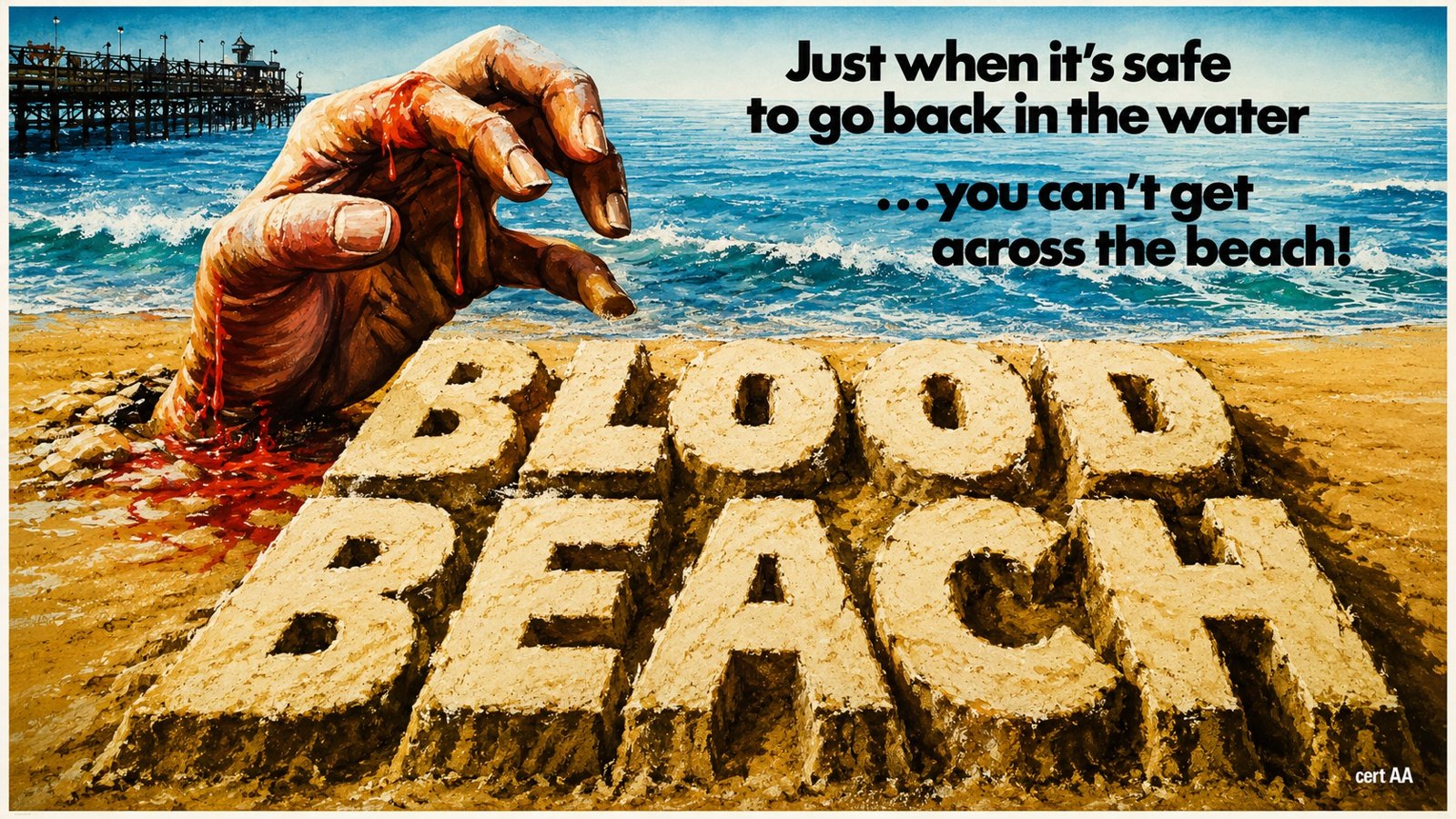
Nutshell: Just when you thought it was safe to get back in the water…..you can’t get across the Beach!”

“A cut or two above the recent run of low-budget horror films.”— Tom Buckley, The New York Times
“An attractive and professional cast, a rarity in the genre.”— Tom Buckley, The New York Times
“Undermined by plodding direction and a talky and incoherent script.”— Tom Buckley, The New York Times
“Short on action, suspense and even the gore that the title promises.”— Tom Buckley, The New York Times
“The potential for campy fun… is defeated.”— AllMovie retrospective review
“A completely straight, plodding detective story.”— AllMovie
“Unfortunately, the film never rises to the level of its advertising.”— TV Guide
“Gore-less and bizarre.”— Scott Weinberg, eFilmCritic
“A great high concept.”— Cinematic Diversions
“The poster, premise and cast are far better than the actual movie.”— We Have Issues
“The film’s smartest moment comes from its awesomely ridiculous tagline.”— We Have Issues
“Blood Beach fights its audience.”— Cinematic Diversions
“We are here for monster under the beach action.”— Cinematic Diversions
“I should have loved Blood Beach.”— Cinematic Diversions
“The movie seemed to work hard to avoid entertaining me.”— Cinematic Diversions
The early 1980s represented a boom period for low-budget horror movies, and Blood Beach arrived just as the trend was beginning to run out of steam after years of total, wall-to-wall saturation.
I still remember a trip to New York City at the end of 1980 when there must have been a dozen horror films playing simultaneously. For a horror fan it felt like Christmas had arrived early. Maniac, Motel Hell, Terror Train, Mother’s Day, He Knows You’re Alone and Humanoids from the Deep were just some of the titles showing during the week I visited. Everywhere you looked there seemed to be another lurid poster promising murder, mayhem and assorted unpleasantness.
I also remember first noticing Blood Beach playing at a fleapit theatre on Tremont Street in Boston, right at the edge of the city’s notorious Combat Zone, an area known less for combat than for its sleazy adult entertainment and seedier attractions. Somehow it seemed the perfect place for a film called Blood Beach to be showing.
By this stage, however, the horror bubble was beginning to burst. The masked slasher craze that had seemed so fresh and exciting in the wake of Halloween was rapidly becoming exhausted. Every week brought another imitation, another killer, another body count and another poster featuring a knife. Audiences were starting to lose interest and the genre was drifting into stagnation. It would take Wes Craven’s magnificent A Nightmare on Elm Street to inject fresh blood into the business a few years later. Until then, there was an endless conveyor belt of largely forgettable horror fodder being churned out on tiny budgets with increasingly diminishing returns.
Blood Beach certainly wasn’t blessed with star power, but it did possess one thing capable of attracting attention: a wonderfully ridiculous premise and a superb tagline.
“Just when you thought it was safe to get back in the water, you can’t make it across the beach!”
The shameless riff on Jaws 2 was enough to raise a smile and probably sold more tickets than anything actually contained within the film itself.
The story takes place in a run-down seaside resort somewhere near Los Angeles, a place that has clearly seen better days. This is less Amity Island and more the bargain-bin version of Amity, a faded and dilapidated beachfront community where the rot has well and truly set in and tourists are conspicuous by their absence.
Nevertheless, strange things are afoot.
In broad daylight, a woman walking her dog suddenly vanishes beneath the sand, dragged underground by some unseen force. Our hero, a harbour patrol officer, happens to be nearby enjoying a swim when he hears the unfortunate woman’s screams, but by the time he reaches the scene there is nothing to see.
The victim’s daughter, Kat, arrives from the city to discover what became of her mother, and before long the death toll begins mounting at an alarming rate. The grieving dog is abruptly relieved of his sorrow when the earth rises up and removes his head in spectacular fashion. A young woman is attacked while her friends innocently build sandcastles nearby. A particularly sleazy individual suffers a fate involving the loss of certain anatomical equipment no man wishes to part with. Others simply disappear beneath the sand altogether.
The police remain completely baffled as the body count climbs and the mysterious underground menace continues its feeding frenzy.
No horror film worth its salt would be complete without a local prophet of doom, and Blood Beach provides one in the form of the wonderfully eccentric Trolley Lady. Wandering the beachfront pushing her shopping cart and issuing dire warnings, she fulfils much the same function as Crazy Ralph in the Friday the 13th films. Naturally, nobody pays the slightest attention to her.
As panic spreads, theories begin to emerge that some kind of amphibious creature has taken up residence beneath the beach and is feeding on unsuspecting sunbathers. The authorities dismiss such suggestions as nonsense despite being completely unable to explain the mounting carnage.
One of the film’s major attractions, at least for me, was the presence of Mariana Hill. Most people would probably respond with “Mariana who?” but for us she was already a familiar face and a firm favourite. Long before Blood Beach, she had enchanted viewers as Cleo Patrick, King Tut’s glamorous assistant in the classic 1960s Batman television series. We were hopelessly smitten with her in that role. The only other film in which I’d seen her play a significant part was the delightfully deranged The Baby, but as far as I was concerned her place in cult cinema history had already been secured decades earlier.
Here she plays Kat, daughter of the beach’s first victim and former flame of the local harbour patrol hunk. Unfortunately, not even the presence of Cleo Patrick herself can do much to elevate the material.
To be fair, Blood Beach remains mildly entertaining B-movie hokum and just about manages to keep viewers engaged in the hope that an outrageous monster-movie finale is lurking around the corner. Sadly, that payoff never really materialises. The film plods along in a rather pedestrian fashion, generating little suspense and even less excitement. The promised subterranean terror remains largely unseen and by the time the end credits roll one feels slightly cheated, as though the filmmakers forgot to include the monster they spent ninety minutes teasing.
In the end, the most memorable aspects of Blood Beach are its magnificent poster and that wonderful tagline. Everything else tends to evaporate from the memory almost immediately.
Still, there is an important lesson here.
Beware of horror movies with brilliant posters, because all too often the poster turns out to be the best thing about them.