
The Hot Spot Rating
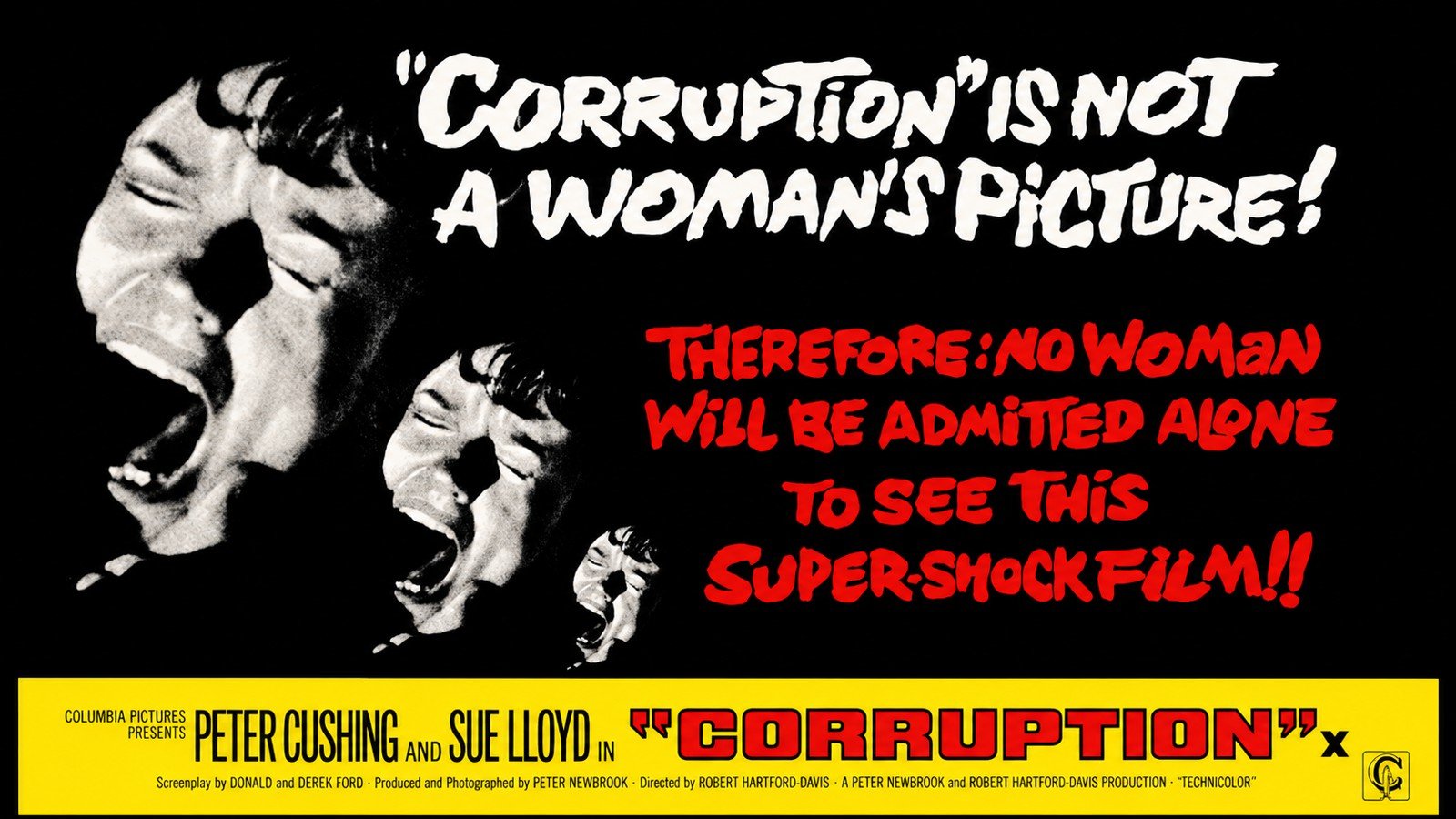
Corruption (1968)
Cast: Peter Cushing, Sue Lloyd, Noel Trevarthen, Kate O’Mara.
Director: Robert Hartford-Davis
Synopsis: Fabulously lurid, trash-art take on Franju’s Eyes Without a face. Wonderfully warped and entertaining. Memorable and worthy camp classic with a nasty edge.
“One of Peter Cushing’s most unusual and controversial performances.”
— The Aurum Film Encyclopedia: Horror
“A bizarre but fascinating entry in British horror cinema.”— The Encyclopedia of Horror Movies
“A sleazy but compelling mixture of horror and Swinging London excess.”— Video Watchdog
“Peter Cushing gives one of the strongest performances of his career.”— DVD Drive-In
“A genuinely disturbing film despite its exploitation trappings.”— DVD Drive-In
“A grotesque variation on Eyes Without a Face.”— The British Horror Film by Steve Chibnall & Brian McFarlane
“A surprisingly nasty shocker.”— Monthly Film Bulletin
“Perhaps the most unpleasant film Peter Cushing ever made.”— Jonathan Rigby, English Gothic
“One of the key examples of British horror’s transition from Gothic fantasy to modern horror.”— Jonathan Rigby, English Gothic
“A fascinating time capsule of Swinging London.”— Mondo Digital
“The film’s lurid violence caused considerable controversy on release.”— BFI Screenonline
“A repellent mixture of sex and violence.”— The Monthly Film Bulletin
“Nauseating.”— The Daily Telegraph
“An unpleasant exercise in bad taste.”— The Standard
Had Austin Powers been conceived as a nasty horror film, it would probably have looked a great deal like 1968’s lurid shocker Corruption, a film that captures London at the height of the Carnaby Street era, complete with psychedelic fashions, swinging parties and Hare Krishnas wandering around Oxford Street.
Peter Cushing stars as Sir John Rowan, a brilliant and highly sought-after plastic surgeon whose pioneering work with laser technology has recently earned him a knighthood from the Queen. Successful, wealthy and respected, Rowan appears to have everything a man could want, including a stunning model girlfriend named Lynn.
Following a gruelling five-hour operation, Rowan is exhausted and desperate for rest. Unfortunately, Lynn reminds him that he has promised to accompany her to a fashionable party overflowing with wine, beautiful people, dancing and assorted Swinging Sixties excesses.
Reluctantly, he agrees.
The resulting party sequence feels as though it has been transported directly from an Austin Powers movie. There is even a bizarre fashion-photo shoot that bears an uncanny resemblance to scenes later used in International Man of Mystery. The difference, of course, is that Austin Powers is trying to make you laugh.
Corruption most certainly is not.
Cushing sticks out like a sore thumb amidst the youthful hedonism and before long tensions flare into a scuffle with disastrous consequences. One of the heat lamps used during the photo shoot crashes onto Lynn, horribly burning and disfiguring her face.
The effects are surprisingly unpleasant.
Lynn’s world immediately collapses. Once a successful model, she now finds herself unable to face the outside world and increasingly consumed by despair. Rowan, wracked with guilt, throws himself into his experimental laser research.
Like the great Baron Frankenstein before him, he becomes obsessed with achieving the impossible.
Developing a serum derived from human pituitary glands and combining it with his laser treatments, Rowan achieves what appears to be a miracle. Lynn’s beauty is restored.
For a while.
Anyone familiar with horror films such as The Wasp Woman, Countess Dracula, Frankenstein or Rejuvenator already knows what comes next. The effects prove temporary and before long the deterioration begins again.
This time, however, Lynn has no intention of surrendering to despair.
If fresh pituitary glands are required to maintain her beauty, then fresh pituitary glands she shall have.
The only problem is that somebody has to acquire them.
And so begins Rowan’s increasingly desperate descent into murder.
Corruption plays like a trashy, psychedelic, pop-art cousin to George Franju’s masterpiece Eyes Without a Face. It borrows similar themes of beauty, obsession and surgical horror but filters them through a haze of free love, psychedelic colour and late-1960s excess.
The score deserves special mention.
It often sounds like a free-form jazz experiment that somehow escaped from another movie entirely. At times it recalls Lalo Schifrin’s rejected score for The Exorcist, had it been performed by a particularly enthusiastic lounge band.
One cannot help imagining William Friedkin hurling those tapes out the window all over again.
Had The Exorcist retained that sort of score, it would probably have died a very swift death.
In Corruption, however, the strange music somehow works. The discordant jazz constantly accompanies scenes of violence and murder, creating a bizarre atmosphere that is simultaneously unsettling and oddly amusing.
The result is a warped fusion of horror film and psychedelic nightmare.
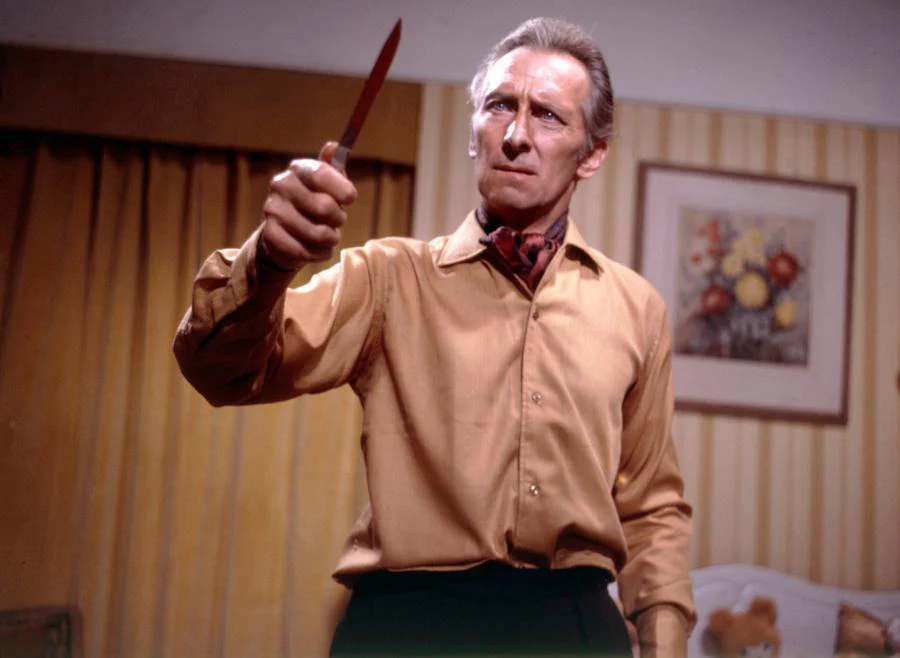
Many of Peter Cushing’s devoted admirers were reportedly horrified by the film upon release. Audiences accustomed to Hammer’s comparatively restrained Gothic horrors suddenly found themselves confronted with severed heads, topless women, graphic violence and the sight of Peter Cushing himself stabbing victims in scenes photographed through fish-eye lenses.
This was not the Peter Cushing they had grown up with.
To his credit, Cushing defended the project, stating that he had been attracted to the screenplay and was growing tired of endlessly portraying characters trapped in bygone centuries. He later remarked that ownership of the production changed hands during filming and that the finished movie differed considerably from the original script he had signed on to make.
The film was heavily criticised upon release and quickly disappeared from cinemas. For many years it remained frustratingly difficult to see, surviving primarily through a highly sought-after Japanese Laserdisc.
Thankfully, Grindhouse Releasing eventually rescued it from obscurity with a magnificent Blu-ray edition that showcases the film’s vibrant colours in all their glory. The reds in particular are absolutely eye-popping.
Time has also been kinder to the film than many expected.
What once seemed merely tasteless now feels like a fascinating artefact of its era. Its reputation has steadily grown and it has acquired a devoted cult following.
Indeed, one of the film’s greatest pleasures today is as a snapshot of Swinging London. The fashions, music, attitudes and locations provide a wonderfully entertaining time capsule of a rapidly changing Britain.
Cushing is excellent throughout as Sir John Rowan and receives strong support from Sue Lloyd, who delivers a suitably unhinged performance as Lynn. Kate O’Mara is strikingly beautiful as Lynn’s sister, while sharp-eyed viewers may also spot a young Billy Murray, later famous as Johnny Allen in EastEnders.
My own first encounter with Corruption came during a late-night television screening in England during the early 1970s. The climactic sequence burned itself permanently into memory and remains every bit as striking today.
Revisiting the film years later, the finale remains undeniably spectacular, although one occasionally wonders what a modern remake might achieve in the hands of a genuinely visual director.
Still, perhaps that would miss the point.
Corruption remains a one-of-a-kind curiosity: a trashy, nasty, psychedelic reimagining of classic horror themes filtered through the freewheeling excesses of the late 1960s.
Funny in places, disturbing in others, endlessly bizarre and gloriously camp throughout, it remains a unique and thoroughly entertaining horror oddity.
A scream from beginning to end.