
The Hot Spot Rating
Title: Dogs (1976)
Cast: David McCallum, Linda Gray, Sandra McCabe, George Wyner, Eric Server
Director: Burt Brinckerhoff
Nutshell: Every pet owner’s worst nightmare. Frighteningly inept
“This efficiently made little film generates a fair amount of tension and is reasonably diverting.”— Kevin Thomas, Los Angeles Times
“One of the better efforts in the genre.”— Kevin Thomas, Los Angeles Times
“Every dog attack scene was photographed the same way.”— Gene Siskel, Chicago Tribune
“I didn’t buy it.”— Gene Siskel, Chicago Tribune
“The film is bad and it’s not real.”— Gene Siskel, Chicago Tribune
“A surprisingly good little horror chiller despite its premise.”— Rotten Tomatoes user review
“Atmospheric and tense.”— Rotten Tomatoes user review
“A thick hunk of American cheddar.”— Cool Ass Cinema retrospective
“The lovable family mutt is running in packs & are on the rampage.”— The EOFFTV Review / retrospective commentary
“Not as fun as it sounds.”— The EOFFTV Review
“The attacks are shot poorly.”
— The EOFFTV Review
“A somewhat sub-par addition to the much beloved Nature-Run-Amok genre.”— HorrorNews.net
“Maramduke and Benji just aren’t all that intimidating.”— Mana Pop
“The filmmakers do their best… but they can’t cover up the fact that these dogs are clearly friendly and having a good time.”— Letterboxd review by sieckman
“These dogs are too cute to be killers.”— Letterboxd review by sieckman
“This movie was all bark and no bite.”— Letterboxd review by Patrick
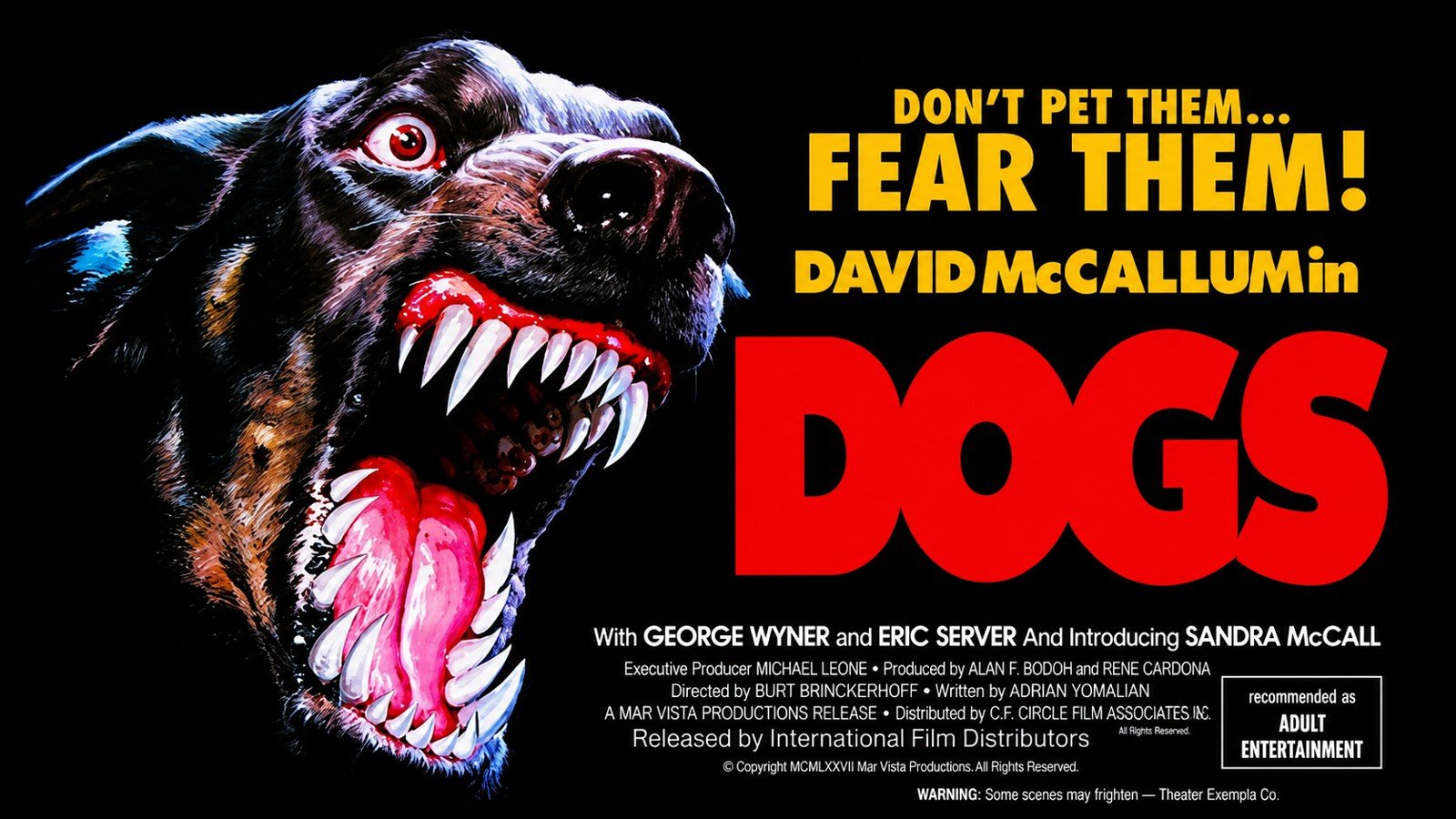
The poster for Dogs has occupied pride of place in my bedroom for as long as I can remember. Every horror poster enthusiast has their personal favourites and I have been fortunate enough to surround myself with some wonderful examples over the years. Terror Train, Maniac, Phantasm, The Evil of Frankenstein, The Devil Within Her and Up from the Depths all adorn the walls and rank amongst my most treasured possessions.
Unfortunately, experience has taught me a valuable lesson.
Some of the worst horror films ever made possess the greatest poster artwork.
I eventually got around to watching Up from the Depths, which did little to challenge that theory, and for years I feared Dogs might suffer a similar fate. Nevertheless, curiosity finally got the better of me and I pulled the DVD from a growing pile of films that had been purchased but never actually watched.
Beyond the magnificent poster, the film offered a few additional attractions. There was David McCallum, forever remembered as Ilya Kuryakin from The Man from U.N.C.L.E., and Linda Gray, eternally Sue Ellen Ewing from Dallas. Seeing her in something other than a bottle-fuelled family feud seemed reason enough to give the film a chance.
The story unfolds in rural California at a prestigious university boasting some of the finest research facilities and faculty members in the country. During an annual banquet welcoming a new member of staff, reports begin emerging from local ranchers that livestock are being slaughtered by some unknown predator.
David McCallum, playing the university’s head of biology, investigates the attacks but is unable to determine precisely what is responsible.
As more animals are discovered mutilated, McCallum begins to suspect a pack of dogs. He warns the local authorities, but the mayor refuses to cancel an upcoming dog show involving numerous townsfolk and their beloved pets.
Needless to say, this proves to be a questionable decision.
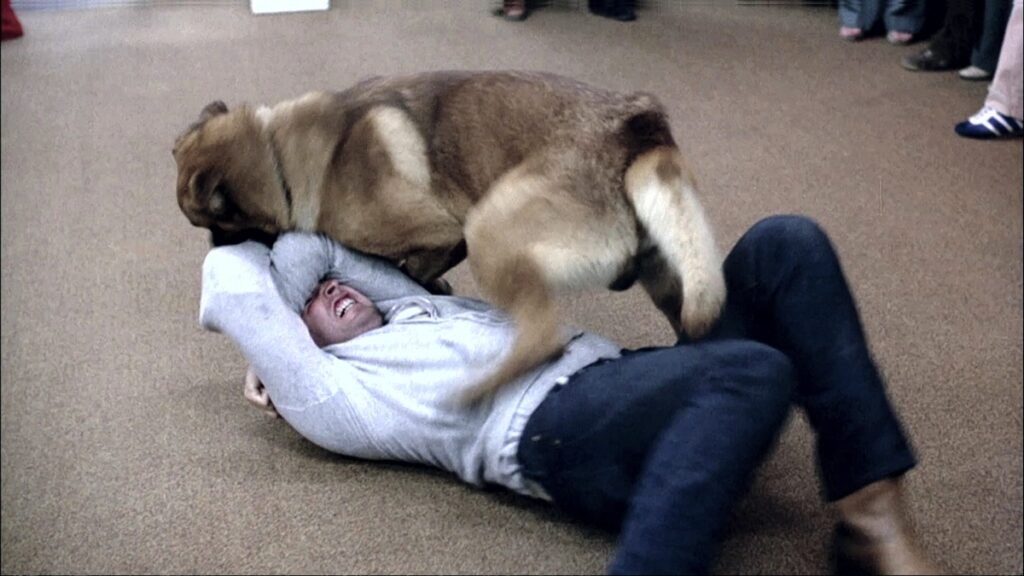
Soon the cute little mutts begin growling ominously and turning against their owners. The sequence is clearly intended to evoke memories of Hitchcock’s The Birds, but whereas Hitchcock had flocks of screeching predators attacking terrified children, Dogs gives us poodles and other assorted household pets chasing grown adults around a field.
The intended result is terror.
The actual result is unintentional comedy.
The body count gradually rises, but most attacks occur at night and are filmed in such a manner that little is actually visible. We occasionally glimpse a silhouette, a flash of teeth or a vague canine outline disappearing into darkness. Most of the gore is reserved for the aftermath, with victims discovered already mutilated.
Even then, the effects remain remarkably tame.
At no point do the dogs appear genuinely threatening. The film constantly flirts with Night of the Lepus territory, asking audiences to fear creatures that most people instinctively want to take home and cuddle.
The effort may be sincere.
The result is not convincing.
The opening scene perfectly illustrates the problem. The camera is used as a dog’s point of view as people stroke and interact with it. The sequence is intended to place viewers in the mind of a canine predator but instead feels awkward and artificial.
In many ways, it serves as an accurate preview of the film to follow.
Linda Gray appears briefly as one of the gossiping faculty wives and spends much of her screen time behaving exactly as one would expect Sue Ellen Ewing to behave if she had wandered accidentally onto another set. She eventually falls victim to the marauding mutts, as do various other cast members.
Despite the steadily increasing body count, there is virtually no atmosphere, suspense or tension. The attack scenes are poorly staged and rarely generate anything approaching excitement.
David McCallum does his best with the material, but there is little an actor can do when trapped inside a script this lifeless. The remainder of the cast perform their duties adequately enough, though “adequate” is about as enthusiastic a compliment as one can muster.
The film is so sluggish and uninvolving that it requires considerable willpower not to start checking one’s phone, scratching the family dog, making a sandwich or simply giving up altogether.
After a succession of uninspired attack scenes, the film eventually shuffles towards an underwhelming conclusion before delivering a final sting that appears to suggest an entire franchise of homicidal household pets.
Today: dogs.
Tomorrow: cats.
Then perhaps goldfish, canaries and hamsters.
The possibilities seem endless.
Ultimately, Dogs has almost nothing going for it beyond its breathtaking poster artwork. If anything, it provides further evidence for the long-held theory that terrible horror films often compensate with magnificent advertising campaigns designed to separate horror fans from their money.
The production values are threadbare, the screenplay is weak and the director displays virtually no ability to generate suspense or fear from the material. Much of the film resembles a particularly cheap television production from the 1970s.
There have been numerous killer-dog films over the years. The Pack, Cujo, Man’s Best Friend and even Zoltan: Hound of Dracula all contain moments of genuine entertainment and tension.
Compared with Dogs, they look like masterpieces.
A beautiful poster.
A dreadful movie.
With Dogs, your safest option may be to cross the street and walk away briskly.