
The Hot Spot Rating
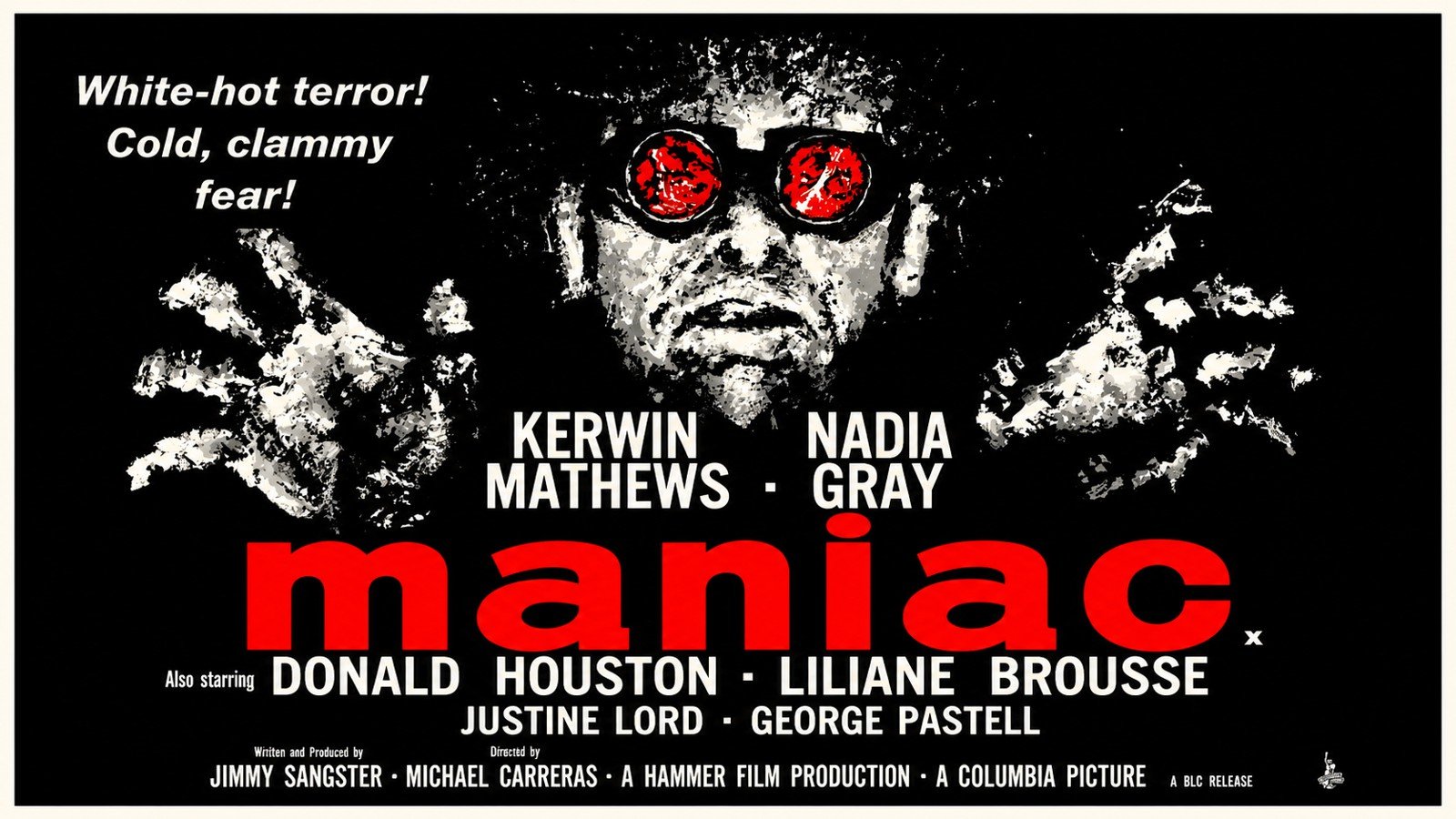
Title: Maniac (1963)
Cast: Kerwin Mathews, Nadia Gray, Donald Houston, Liliane Brousse, Justin Lord, George Pastell
Director: Michael Carreras
Nutshell: twisting tale of conniving minds, lust, double cross and murder with picturesque Southern France as the scene.
“One of Hammer’s most handsome thrillers.”— The Hammer Story by Marcus Hearn & Alan Barnes
“A stylish and surprisingly adult psychological thriller.”— Jonathan Rigby, English Gothic
“Beautifully photographed in the South of France.”— Monthly Film Bulletin
“The French locations add immeasurably to the film’s appeal.”— The Hammer Story
“A gripping suspense thriller.”— Kine Weekly
“Keeps the audience guessing right up to the end.”— Kine Weekly
“One of Hammer’s better non-horror productions.”— The Aurum Film Encyclopedia: Horror
A fascinating blend of Psycho and Les Diaboliques influences.”— The British Horror Film by Steve Chibnall & Brian McFarlane
“An elegant thriller with a distinctly continental flavour.”— Video Watchdog
“The widescreen photography is superb.”— DVD Drive-In
“A highly enjoyable and underrated Hammer thriller.”— DVD Drive-In
“A remarkably polished suspense film.”— Moria Reviews
“An ingenious but somewhat far-fetched thriller.”— The Monthly Film Bulletin
“A competent suspense drama.”— Variety
“Stylish but not entirely convincing.”— The New York Times (international release review)
Maniac emerged as part of Hammer’s new wave of psychological thrillers during the 1960s, a cycle driven as much by financial opportunity as artistic inspiration. The phenomenal success of Psycho and Les Diaboliques had demonstrated that modestly budgeted thrillers could generate enormous profits in an era increasingly dominated by expensive Technicolor spectacles.
Hammer was hardly alone in spotting the trend.
Studios everywhere began scrambling to produce their own twist-laden shockers in the hope of capturing some of Hitchcock’s magic. William Castle delivered the delightful Homicidal in 1961, Roman Polanski unleashed Repulsion a few years later, while audiences were also treated to films such as Berserk!, Pyro, Fanatic, Hysteria and countless others.
The dollar was the driving force and producers rushed their thrillers into cinemas hoping lightning might strike twice.
Maniac was photographed in what was then marketed as “Megascope”, essentially a widescreen format designed to give even relatively modest productions a grander appearance. The film is set amidst the vineyards and countryside of southern France, and the location photography is genuinely impressive.
Beautifully photographed and expertly lit, the film often looks far more expensive than it really was. The picturesque landscapes and handsome compositions lend an unexpected touch of class to what is otherwise a fairly economical production.
Modern audiences are particularly fortunate that Indicator have included Maniac among their excellent Hammer/Columbia releases. Their Blu-ray presentation is superb and likely the finest the film has ever looked. Scanned in high definition from original elements, the transfer is rich, detailed and filmic. Naturally there is visible grain, but that is exactly as it should be for a production of this vintage and in no way detracts from the viewing experience.
The story begins with a genuinely unpleasant incident involving a paedophile who assaults a young girl. Her father responds with understandable fury and administers a horrifying measure of vigilante justice involving a blowtorch. Unfortunately, it is the father rather than the paedophile who ultimately finds himself confined to an asylum following the attack.
Several years later, the daughter has grown into a striking young woman. Into her life wanders a smooth-talking American drifter and opportunist who quickly begins charming his way through the local female population.
His attentions initially focus upon the daughter, but he proves remarkably flexible in matters of romance and is equally willing to pursue her glamorous stepmother if the opportunity presents itself. Indeed, one soon suspects he would happily pursue both simultaneously if circumstances allowed.
The daughter is understandably appalled by her stepmother’s behaviour, particularly given that her husband remains alive and confined to an institution. The stepmother, however, appears unconcerned by such details and throws herself enthusiastically into her new romance.
Before long, the story heads precisely where seasoned thriller fans expect it to go.
A plot is devised.
The frustrated wife desperately wants rid of her institutionalised husband so that she can begin a new life with her younger lover. Unfortunately, divorce proves difficult when the husband in question remains stubbornly alive.
Every month she visits him at the asylum and returns looking defeated and miserable.
Eventually an arrangement is reached involving husband, wife and lover.
If they assist in engineering his escape, he promises to disappear forever, freeing them to live happily ever after somewhere far away. He even promises to send for his daughter once he is safely settled.
To the opportunistic American, it sounds like an excellent deal. He keeps the attractive wife, inherits her successful business, enjoys room and board and possibly leaves the door open for further adventures involving the daughter should the opportunity arise.
What could possibly go wrong?
Naturally, everything.
The “maniac” escapes but quickly abandons his promises. Bodies begin appearing in inconvenient places. One accomplice ends up dead and mysteriously returns despite efforts to dispose of the corpse in a river, evoking memories of Les Diaboliques.
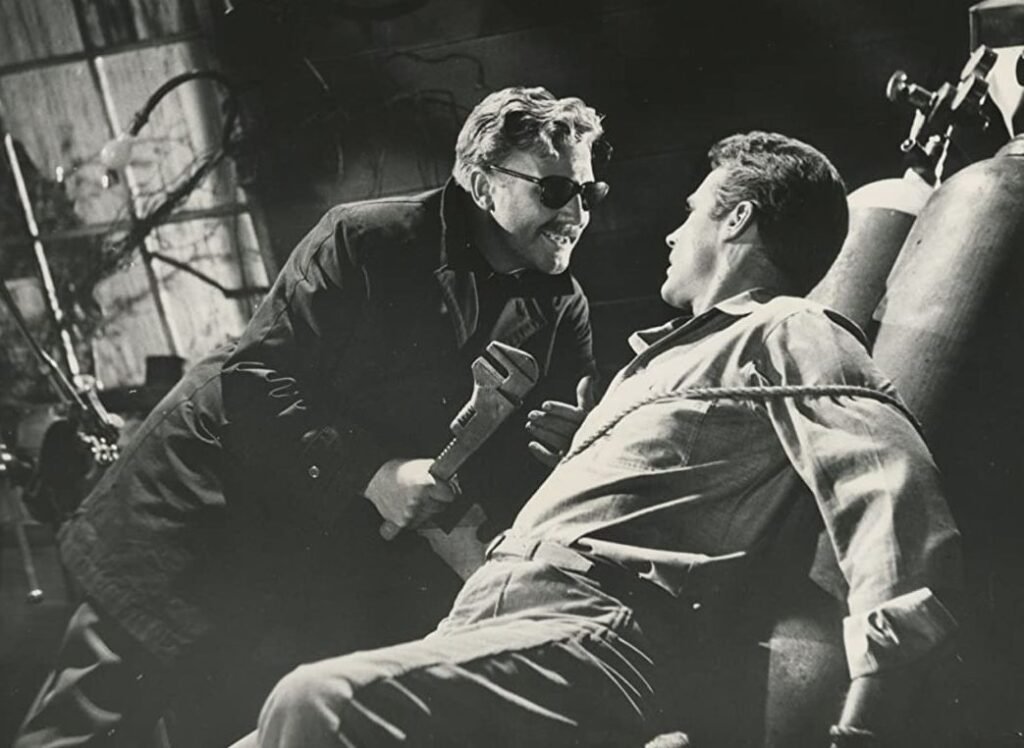
Before long the escaped husband reappears seeking revenge on the American who dared to take up residence with his wife. Once again the infamous blowtorch is brought into service and the film heads towards a climax involving charred flesh, murder, deception and multiple twists.
As events spiral out of control against a stunning French backdrop, the question becomes whether the schemers can escape the consequences of their actions or whether yet another surprise remains waiting around the corner.
The film is consistently attractive to look at and benefits from a cast that takes the material seriously. The performances are generally strong, including that of the deeply unlikeable American lead, whose opportunistic behaviour makes him difficult to root for but impossible to ignore.
Maniac never outstays its welcome and moves briskly towards its conclusion. The score occasionally feels rather intrusive and ill-suited to the material, but otherwise the film hangs together remarkably well.
It never approaches the psychological brilliance of Psycho, nor does it possess the seedy, oppressive atmosphere that makes Les Diaboliques such a masterpiece. Nevertheless, it remains an entertaining and well-crafted variation on the same basic formula.
Ironically, the film’s greatest weakness may be its title.
There is, in truth, very little evidence of an actual maniac anywhere in the story. The central antagonist is many things — ruthless, calculating, selfish and murderous — but genuinely insane he is not. Audiences expecting a deranged psychopath may feel somewhat short-changed.
Still, for admirers of Hammer’s rich and often fascinating history, Maniac remains essential viewing. It is a polished, professionally made thriller featuring excellent photography, strong performances and enough twists to keep the viewer engaged throughout.
Indicator’s Blu-ray release only strengthens the recommendation.
A solid and entertaining Hammer thriller, beautifully presented and well worth seeking out.