
The Hot Spot Rating
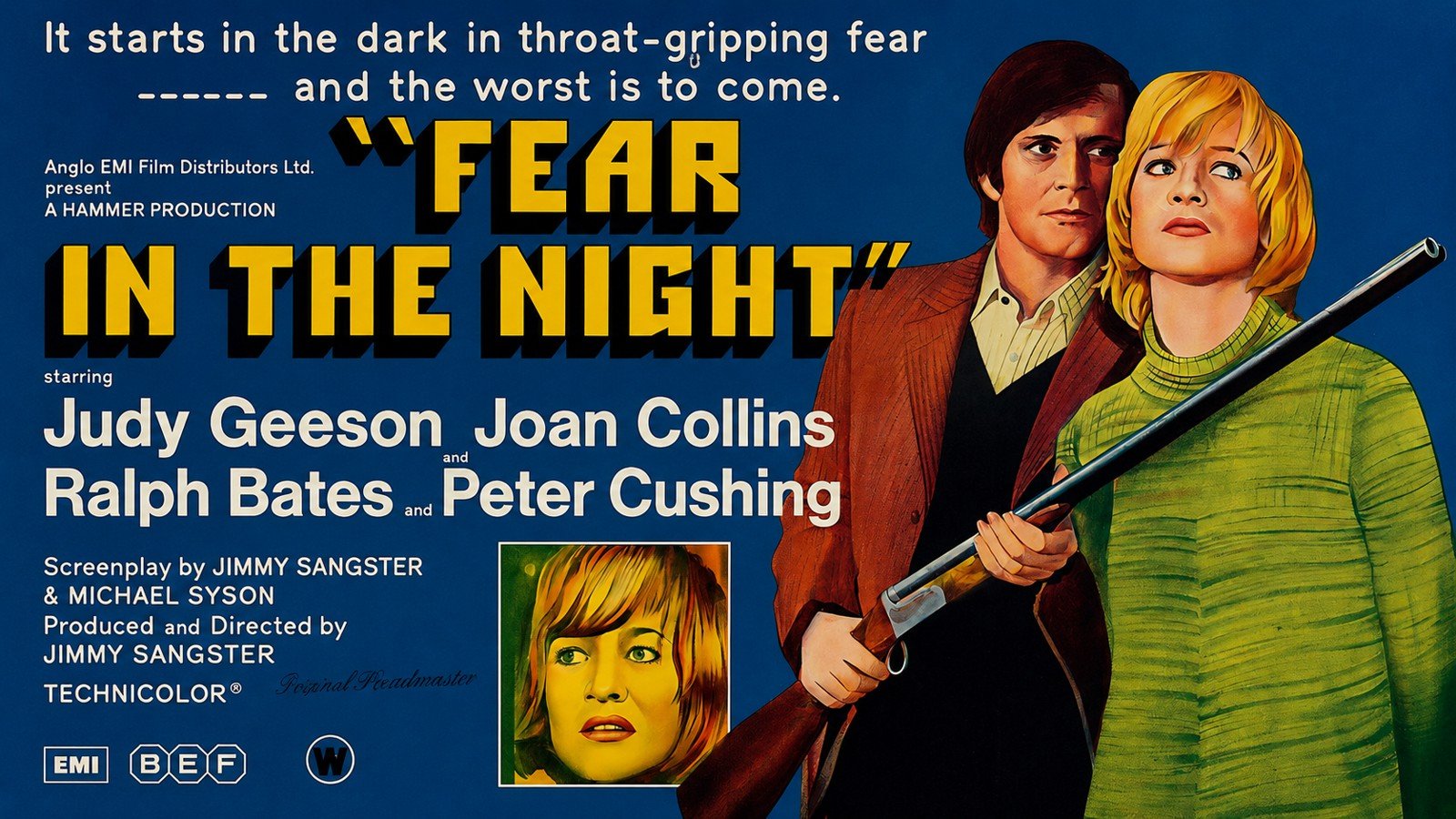
Fear in The Night (1972)
Cast: Judy Geeson, Joan Collins, Ralph Bates, Peter Cushing
Director: Jimmy Sangster
Nutshell: Hammer attempting new directions in the 1970s with mixed results.
“One of those neatly constructed but slightly mechanical psycho-thrillers…”— Time Out
“Hammer fans will soon recognise the plot as a thinly disguised reworking of Taste of Fear.”— Time Out
“Those who did see it found it satisfying, if a shade modest.”— Graeme Clark, The Spinning Image
A brave attempt by Hammer to go in a new direction…”— Popcorn Pictures
“Entertaining enough if you want to stick it out.”— Popcorn Pictures
“It will never be regarded as one of Hammer’s better films.”— Popcorn Pictures
“One of the most predictable scripts I’ve encountered in some time.”— Dave Sindelar, Fantastic Movie Musings and Ramblings
“The film never again recovers from the icy, morbid impression of its opening.”— John Kenneth Muir, Horror Films of the 1970s
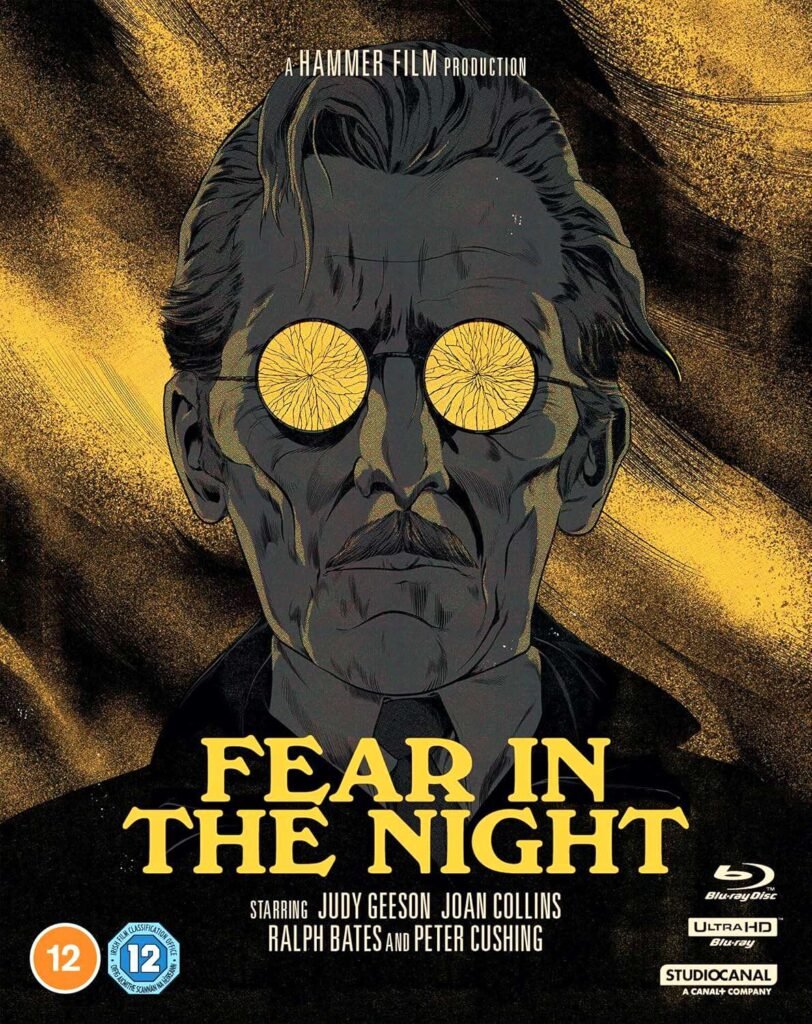
Fear in the Night is a Hammer production based on a script Jimmy Sangster had originally written years earlier under the title Brainstorm. The story concerns a young newlywed woman recovering from a nervous breakdown who is preparing to begin a new chapter of her life with her husband, recently appointed to a teaching position at an old-fashioned public school on the outskirts of South London.
On the eve of their departure, Peggy (Judy Geeson) is suddenly attacked and strangled by a mysterious figure sporting a prosthetic arm. She loses consciousness and, upon awakening, is determined to report the assault to the police. Unfortunately, those around her are far less convinced. Given her recent mental health struggles, they suspect the incident may have existed only in her imagination.
With uncertainty hanging over everything, Peggy accompanies her husband to his new post and settles into their school residence. Before long, however, the mysterious assailant returns and attacks her once again. Once more, nobody believes her account of events.
The following day Peggy explores the school grounds and experiences one of the film’s more effective sequences. Empty corridors seem strangely alive with the sounds of lessons in progress, children laughing and teachers talking, creating a faintly unsettling atmosphere. She meets the headmaster, played by Peter Cushing, and is shown around the grounds, but before long the mysterious figure with the artificial arm makes yet another appearance.
The film’s biggest problem arrives shortly afterwards in the form of Joan Collins.
The moment Collins appears as the cold, aloof and thoroughly disagreeable wife of the headmaster, much of the mystery evaporates. Joan Collins is many wonderful things, but she is rarely cast as the sweet, kindly neighbour. Matters become even more suspicious when she is paired with the elderly and distinctly unglamorous Peter Cushing. Any viewer even vaguely familiar with British psychological thrillers of the era will likely put two and two together almost immediately. From that point onwards, the plot becomes painfully easy to unravel.
The scenes set within the strangely deserted school remain eerie and reasonably effective throughout. The notion of an apparently bustling institution that feels oddly empty creates a nice atmosphere, but elsewhere the film struggles to generate much tension.
Of the cast, Collins undoubtedly emerges with the most memorable role. Playing a cold, calculating and manipulative bitch was something she could do almost effortlessly throughout her career, and the role fits her like a glove. According to Jimmy Sangster himself, she was not exactly the easiest person to work with either, which perhaps makes the casting even more appropriate.
Peter Cushing, meanwhile, remains the consummate professional. By this point in his life he had reportedly never fully recovered from the loss of his beloved wife, and there are moments where that familiar sparkle seems just a little diminished. Nevertheless, his performance is typically polished, restrained and faultless.
Hammer’s psychological thrillers often borrowed heavily from the shadows cast by Les Diaboliques and Psycho, repeatedly attempting to reinterpret or repackage elements of those masterpieces. Fear in the Night follows the same path, though beyond its public-school setting and psychological uncertainties, it never really approaches the brilliance of either Hitchcock or Franju.
In truth, the film often feels more like an above-average episode of a 1970s television thriller written by Brian Clemens on autopilot than a major Hammer production. The mystery is not especially intriguing, and most viewers will begin unravelling it very early in the proceedings.
Is Peggy imagining everything? Does the school really exist as she perceives it? Is the man with the prosthetic arm real, or merely a manifestation of her fragile state of mind? Could Joan Collins possibly be playing a warm-hearted village wife devoted to her elderly headmaster husband? These are the questions the film asks, though the answers become apparent rather sooner than they should.
By 1972 Hammer was already in serious decline. The glory days of The Curse of Frankenstein, Dracula and The Mummy felt increasingly distant. The studio was desperately searching for a new direction, and in the aftermath of Psycho, psychological thrillers with twist endings appeared to offer a possible path forward. Hammer produced several respectable efforts in this vein, but none generated significant excitement at the box office.
The problem was that audiences had changed. Night of the Living Dead had arrived and horror was moving in a far grittier and more modern direction. Hammer increasingly looked old-fashioned, and no amount of psychological intrigue could entirely disguise that fact.
Fear in the Night remains a reasonably engaging effort from Jimmy Sangster, but it suffers badly from predictability and a lack of cinematic flair. Even the stalking and attack sequences feel surprisingly flat and routine, staged with very little imagination or visual invention.
Today the film survives largely as one of Hammer’s lesser-known curiosities. Thankfully, StudioCanal’s Blu-ray release as part of their Hammer box set finally allows it to be seen in superb condition. The transfer is sharp, detailed and likely looks better than it did for many audiences upon its original release.
While Fear in the Night is far from top-tier Hammer, it remains worthwhile for enthusiasts of the studio and serves as an interesting snapshot of a company desperately trying to reinvent itself during a period of enormous change. The StudioCanal box set itself is highly recommended and does a splendid job of preserving some of Hammer’s more neglected titles for modern audiences.