
The Hot Spot Rating
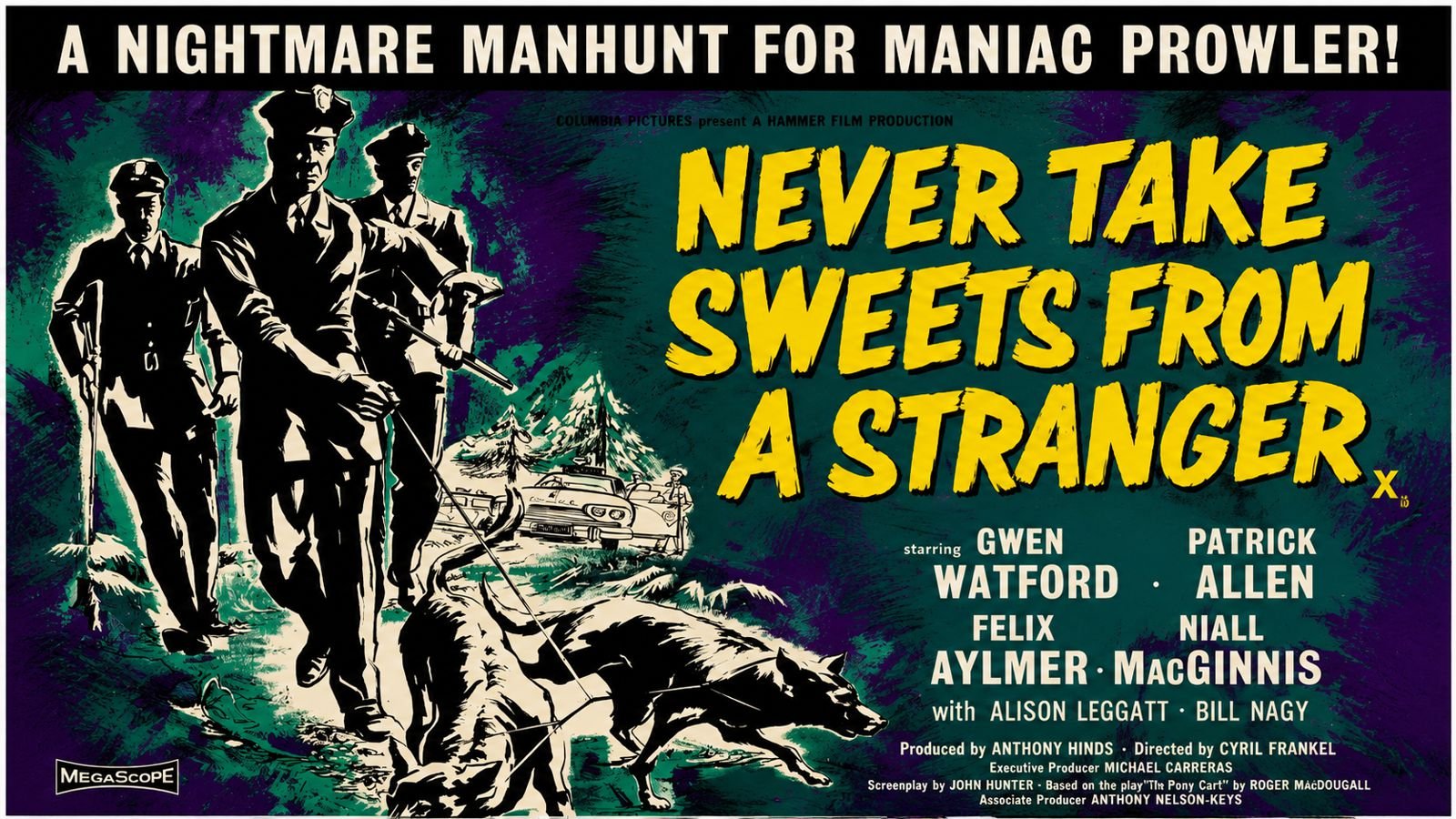
Title: Never Take Candy from A Stranger (1960)
Cast: Gwen Watford, Felix Aylmer,
Director: Cyril Frankel
Nutshell: A shocking departure for Hammer into taboo territory but crafted with admirable restraint and maturity. Way ahead of its time.
“One of Hammer’s most serious and socially conscious productions.”— The Hammer Story by Marcus Hearn & Alan Barnes
“Remarkably courageous for its time.”— Jonathan Rigby, English Gothic
“A disturbing and powerful drama.”— Monthly Film Bulletin
“Handled with restraint and intelligence.”— Monthly Film Bulletin
“One of the most mature films Hammer ever produced.”— Video Watchdog
“A genuinely unsettling picture.”— DVD Drive-In
“An extraordinary subject for a British film of 1960.”— BFI Screenonline
“A brave film that tackled an almost taboo subject.”— BFI Screenonline
“More frightening than many of Hammer’s horror films.”— Moria Reviews
“The true horror lies in the respectability of the predator.”— Moria Reviews
“An unusually thoughtful and intelligent Hammer production.”— Hammer and Beyond: The British Horror Film
“A powerful indictment of privilege and social influence.”— The British Horror Film by Steve Chibnall & Brian McFarlane
“One of Hammer’s hidden masterpieces.”“A neglected classic.”
“Years ahead of its time.”“A film whose themes remain disturbingly relevant.”
A very unusual Hammer production, and one that demonstrates just how versatile the studio could be when it chose to step outside its familiar Gothic territory.
Although Never Take Candy from a Stranger is every bit as disturbing and horrifying as many of Hammer’s more famous horror films, it is not really a horror movie at all. Instead, it tackles a deeply troubling social issue and does so years before it became acceptable for such subjects to be discussed openly.
The film’s subject matter remains uncomfortable today and must have been even more so at the time of its release. To Hammer’s credit, the material is handled with considerable sensitivity and restraint, avoiding sensationalism while never diminishing the seriousness of the issue.
The story follows a family who have recently emigrated to Canada. Gwen Watford and her husband have secured promising new jobs and arrive with hopes of building a better life. Accompanying them are their young daughter and Watford’s mother-in-law.
Initially everything appears idyllic.
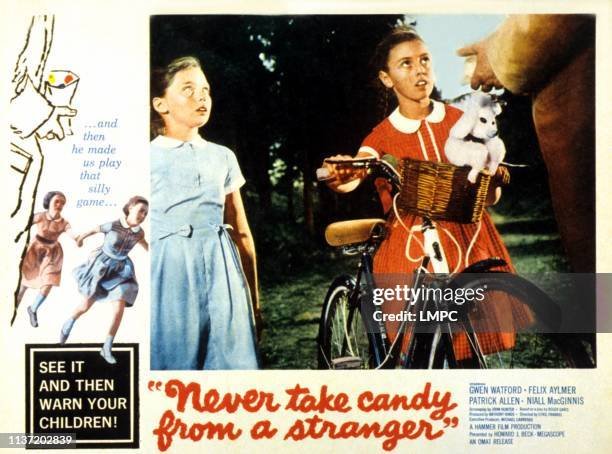
The film opens with the young girl and a newly acquired friend enjoying themselves on a swing. However, looming over the children is the imposing home of the wealthy and influential local Elderberry family.
Watching the girls through binoculars from an upstairs window is the elderly Mr. Elderberry, a man old enough to be their great-grandfather and a man whose interest in the children is immediately and unmistakably disturbing.
It quickly becomes apparent that something is badly wrong.
When the girl returns home and is questioned about where she has been, she innocently explains that she and her friend visited the Elderberry residence where the old man had asked them to dance for him after removing their clothes.
The revelation leaves her parents stunned.
Faced with such allegations, they have little choice but to involve the authorities despite repeated warnings from local residents about the immense influence and power wielded by the Elderberry family within the community.
The matter eventually reaches the courtroom.
What follows is one of the film’s most frustrating and infuriating aspects. Through a combination of wealth, status and influence, the defence succeeds in undermining the accusations and discrediting those making them. Despite evidence of previous misconduct and a troubling history of similar behaviour, the elderly predator once again escapes meaningful consequences.
The performances throughout are of a remarkably high standard.
The young actress delivers an especially impressive performance, and director Cyril Frankel demonstrates exactly why he had developed such a strong reputation for working with children. The scenes involving the younger cast members feel natural, convincing and emotionally authentic.
Veteran actor Felix Aylmer is equally effective as the elderly predator. There is something deeply unsettling about his performance. At times he seems almost to stalk the children with the same slow, unnatural movements that Christopher Lee’s creature displayed in The Curse of Frankenstein. The effect is quietly terrifying precisely because it is so restrained.
Gwen Watford is excellent throughout, conveying both maternal protectiveness and growing frustration as the family encounters resistance at every turn.
What makes the film particularly powerful is its intelligence.
This is not simply a drama about one criminal act. Along the way the screenplay explores issues of social class, privilege, justice, influence, community pressure and the willingness of respectable society to look the other way when confronted with uncomfortable truths.
The film remains gripping from beginning to end because the threat feels entirely real.
There are no monsters.
No supernatural forces.
No Gothic castles.
Only ordinary people confronting an evil that exists within respectable society itself.
Hammer had every reason to be proud of this production. Far from being a cheap exploitation picture, Never Take Candy from a Stranger is a thoughtful, serious and mature piece of filmmaking that addresses a difficult subject with remarkable courage for its time.
It is not always an easy watch and certainly not a film one would describe as entertaining in the conventional sense. Nevertheless, it remains an important, powerful and highly effective drama whose themes remain sadly relevant today.
Finally, as has become almost expected, Indicator’s Blu-ray release is exemplary. The company continues to build an enviable reputation for presenting neglected British films with care and respect, and this release is no exception.
A brave, intelligent and deeply unsettling film that deserves to be remembered among Hammer’s finest achievements.