
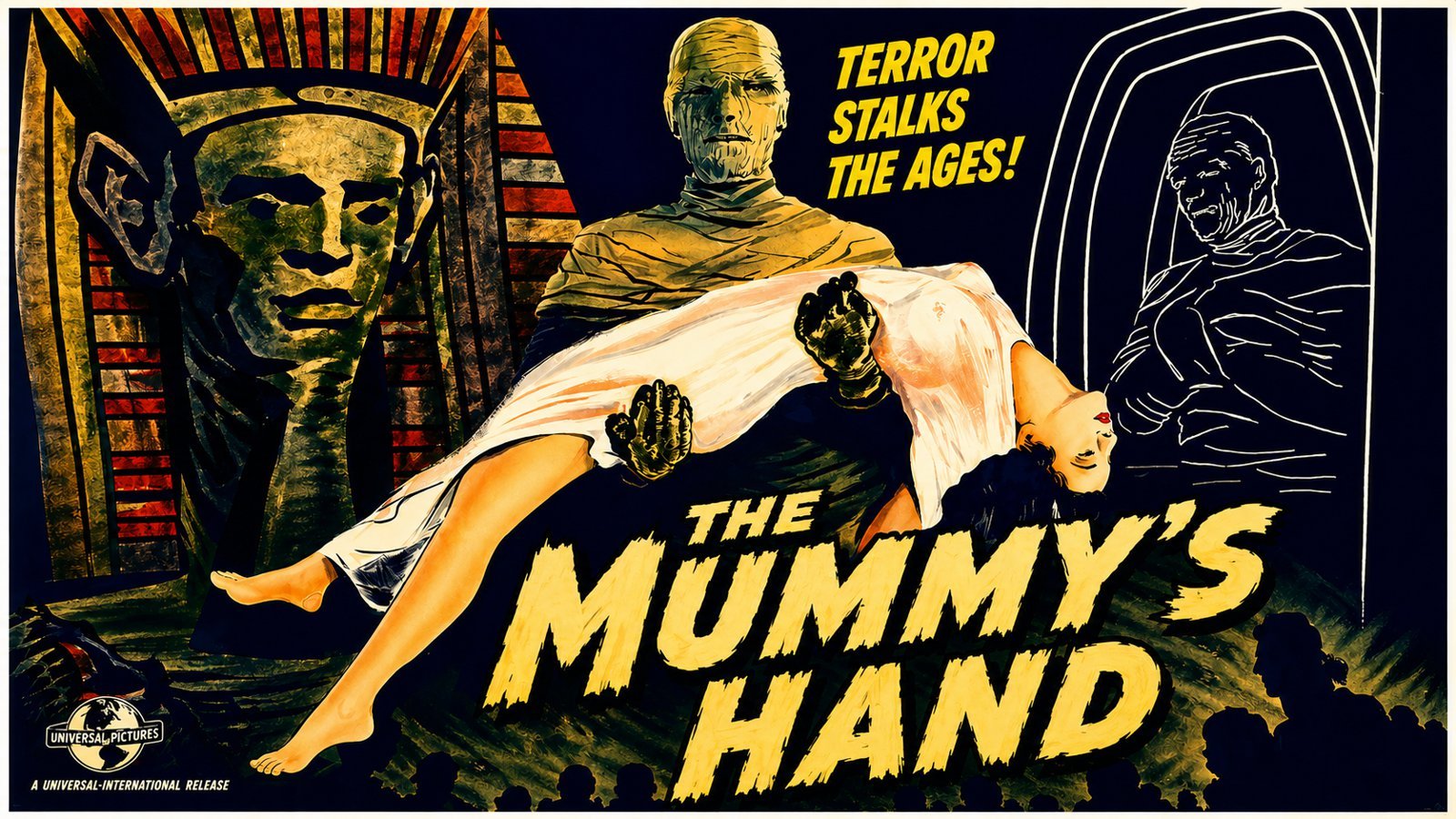
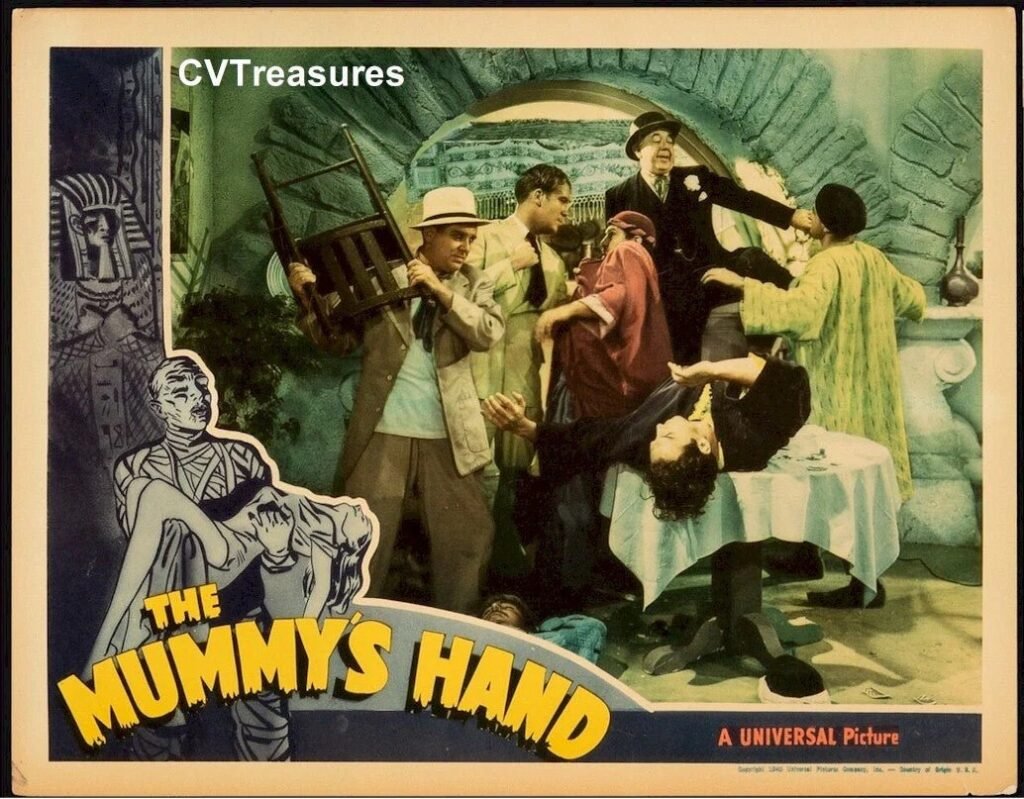
Following the enormous success of the original Boris Karloff classic, The Mummy’s Hand arrived in 1940 carrying a considerable burden of expectation.
The film opens with an extended prologue recounting the tragic tale of Kharis and Princess Ananka. Long ago, Kharis attempted to revive his beloved princess using the sacred Taana leaves, only to be captured and condemned to a fate worse than death. Mummified alive and buried alongside the forbidden leaves, he is doomed to spend eternity awaiting the moment when he can exact vengeance upon anyone foolish enough to violate the resting place of his princess.
The ancient High Priest explains the story to his successor and carefully instructs him in the preparation of the sacred Taana leaf potion. Most importantly, he issues a stern warning:
Never administer more than nine leaves at one time.
Should that limit be exceeded, Kharis will become a monster beyond imagination.
The old priest soon passes away, but his successor vows to continue guarding the sacred secret and protecting the tomb from meddling outsiders.
Some years later, archaeologist Steve Banning arrives in Cairo eager to make his mark upon the world. Accompanying him is a wisecracking sidekick from Brooklyn whose primary purpose appears to be providing comic relief.
Unfortunately, the comic relief wears out its welcome almost immediately.
What may have seemed amusing on paper quickly becomes tiresome in practice, and the endless stream of wisecracks often feels more like an obstacle than an asset.
Nevertheless, Banning and company eventually discover clues leading them towards the legendary tomb. Despite repeated warnings from local inhabitants about ancient curses and dire consequences, the expedition presses forward with the usual confidence displayed by movie archaeologists.
The locals urge caution.
The Westerners laugh.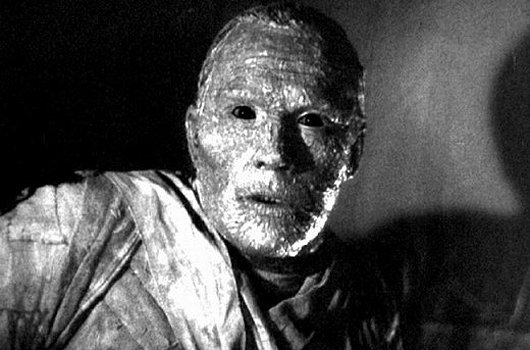
One suspects the audience already knows who is about to be proven correct.
When Kharis is finally revived using the sacred Taana leaves, the film is already more than halfway over. Better late than never, however.
Tom Tyler cuts an imposing figure beneath the bandages and makes for a reasonably effective Mummy. Hobbling through the shadows under the command of the High Priest, he follows the scent of the Taana leaf potion much like a supernatural bloodhound.
The priest develops a simple but effective strategy. He secretly plants traces of the potion upon intended victims and then directs Kharis to seek them out and eliminate them.
Soon the death toll begins mounting around the excavation site.
One by one members of the expedition fall victim to the ancient guardian, and panic gradually takes hold as the survivors realise they are being stalked by an unseen force.
Matters become even more serious when Kharis abducts Banning’s girlfriend Marta and delivers her to the High Priest. His intention is to embalm her and grant her a form of immortality similar to the miserable existence endured by Kharis himself.
The race is now on. Can Steve rescue Marta before it is too late? Can the Mummy be stopped? And how does one destroy a creature seemingly immune to bullets and ordinary weapons?
Sadly, the answer proves rather disappointing.
After spending most of the film establishing Kharis as an unstoppable menace, the finale dispatches him with astonishing ease. Considering the havoc he has caused, one is left with the impression that a determined scout armed with a box of matches might have solved the problem much earlier.
The film’s strongest moments occur whenever the Mummy is actually on screen. Close-ups of Kharis are particularly effective, especially when his eyes appear as dark, empty sockets that lend him an eerie and inhuman appearance.
Unfortunately, these moments are relatively scarce.
Much of the running time is devoted to broad comedy, exposition and lengthy stretches where very little happens. The production also lacks the visual elegance and atmosphere associated with Universal’s finest horror films. The sets are functional rather than impressive, and the film often feels far smaller in scale than its ambitious premise would suggest.
The biggest problem may be that the film never quite decides what it wants to be.
At times it strives for horror.
At other moments it plays like a family adventure.
The two approaches never sit comfortably together and the result is a film that succeeds fully as neither.
There are one or two effective Mummy sequences and Tom Tyler’s performance under the bandages deserves credit, but beyond that there is surprisingly little that lingers in the memory.
Ironically, the most memorable aspect of the entire production may be the ease with which Kharis is ultimately defeated, earning him a place amongst the least resilient Mummies in cinema history.
While The Mummy’s Hand certainly has its admirers and would go on to launch Universal’s long-running Kharis series, it remains a considerable disappointment when viewed on its own merits.
Uneven, uninspired and lacking the atmosphere of its predecessor, it ultimately feels like a missed opportunity wrapped in bandages.