
The Hot Spot Rating
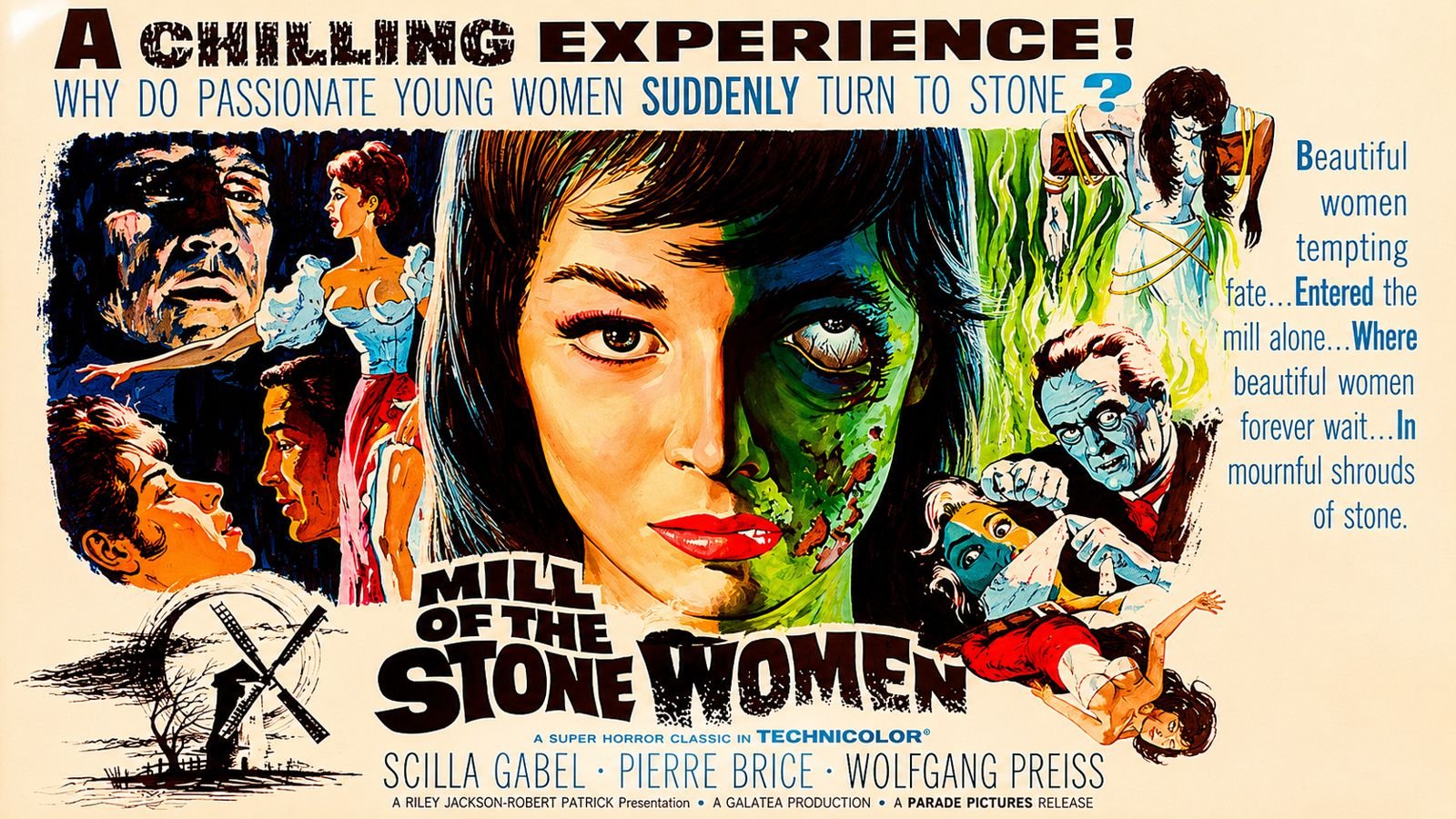
Mill of the Stone Women (1960)
Cast: Pierre Brice, Scilla Gabel, Wolfgang Preiss, Liana Orfei, Herbert Boehme
Director: Giorgio Ferroni
Synopsis: Creepy, Macabre and sinister tale reminscent of The House of Wax
“An engaging period piece revolving around a huge windmill and its waxwork gallery.”— Classic Horror Film Board / Euro Gothic discussion
“Greatly helped by vivid color cinematography.”— Classic Horror Film Board
“Good fun and stylishly executed.”— Classic Horror Film Board
“There is some really beautiful use of color… primarily in the lighting.”— Classic Horror Film Board retrospective
“The colors and shadows add a great deal not just to the appearance of the film but to the atmosphere as well.”— Classic Horror Film Board retrospective
“A nice, atmospheric horror film… very worthy. And very pretty.”— Classic Horror Film Board retrospective
“The location sets are truly atmospheric.”— IMDb user review
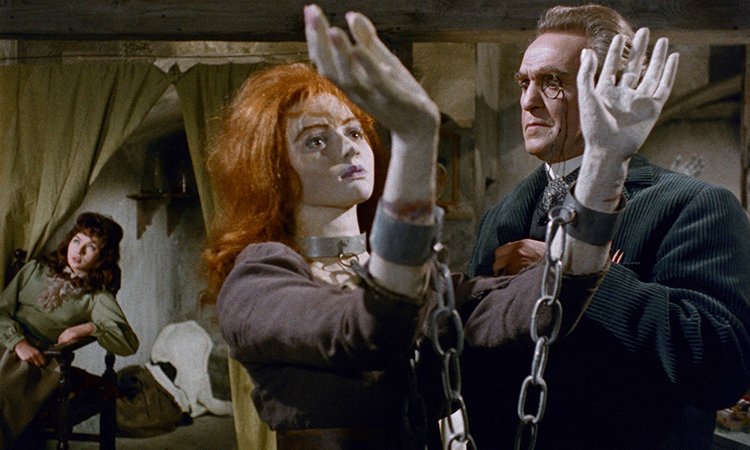
In the early 1900s, the young and mild-mannered Dr. Hans Van Arnhim arrives in a small town on the outskirts of Amsterdam to begin work studying a famous local landmark — an old windmill containing a macabre carousel of female figures depicting notorious killers from history.
Upon arriving at Dr. Vaal’s windmill residence, Hans is greeted by a mysterious maid. While waiting for the doctor, he witnesses a strange and unsettling sight. From behind the heavy curtains emerges a fragile, trembling greyhound, almost whimpering in some strange distress. Above the frightened creature stands a beautiful and mysterious young woman, her face barely visible through the shadows.
Hans is immediately intrigued.
Curiosity gets the better of him, and after asking questions at the local inn, he learns that Dr. Vaal has a daughter named Elfie who, for reasons nobody seems to understand, never leaves the windmill.
Drawn by the mystery surrounding her and captivated by her extraordinary beauty, Hans returns to the windmill, where the drop-dead gorgeous Elfie is indeed waiting for him — and with rather obvious romantic intentions. Hans can hardly believe his good fortune and eagerly returns to see her again the following night.
However, there is something deeply unsettling beneath Elfie’s delicate beauty. She appears strangely rejuvenated during their meetings but becomes increasingly possessive, especially after discovering that Hans’s true affections belong to his childhood sweetheart and that he eventually intends to return to her.
Rejected and heartbroken, Elfie vows revenge.
Gradually, the horrifying truth hidden beneath her flawless exterior begins to emerge — a secret too ghastly and hideously macabre to imagine.
The Franco-Italian production, released in 1960, clearly follows in the footsteps of two earlier horror classics: House of Wax and Eyes Without a Face. The influence of both films is unmistakable, with similar themes of obsession, preservation, beauty and madness running throughout. Yet despite the similarities, Mill of the Stone Women never feels like a cheap imitation. Instead, it creates its own wonderfully eerie identity.
It is a thoroughly entertaining, beautifully atmospheric and deliciously macabre slice of Gothic horror, filled with wonderfully chilling moments and drenched in a thick fog of creeping evil.
Much of the film’s sinister atmosphere comes from its haunting score, which at times recalls the unsettling carnival-like themes used so effectively in Eyes Without a Face. The centrepiece of the film, however, is undoubtedly the carousel itself.
It is worth watching the movie for this creation alone.
The grotesque “wax” figures of doomed women and killers from the past lurch forward, twisting and contorting hideously as they move along their jittering mechanical track. The whole contraption feels wonderfully nightmarish — part fairground attraction, part chamber of horrors.
Later, the film delivers a gloriously gruesome sequence involving a fresh corpse entering rigor mortis before being injected and carved into its “prescribed shape”. It is deliciously grisly stuff, complete with wonderfully nasty sound effects as bones crack and bodies are reshaped for their horrifying purpose.
Mill of the Stone Women is a gripping and hugely enjoyable example of Grand Guignol horror, very much in the tradition of the classics that inspired it. However, its greatest achievement is that it succeeds entirely on its own merits. Not once does it feel like a second-rate copy of the films it resembles. If anything, it proudly earns a place alongside them.
After lying in relative obscurity for far too long, the film was thankfully resurrected through Mondo Macabro’s excellent DVD release, presenting it in a beautiful anamorphic transfer with multiple audio options and an impressive collection of promotional artwork and advertising material.
A forgotten Gothic gem finally given the treatment it deserves.
And indeed, Mill of the Stone Women gives the phrase “drop dead gorgeous” a whole new meaning.