
The Hot Spot Rating
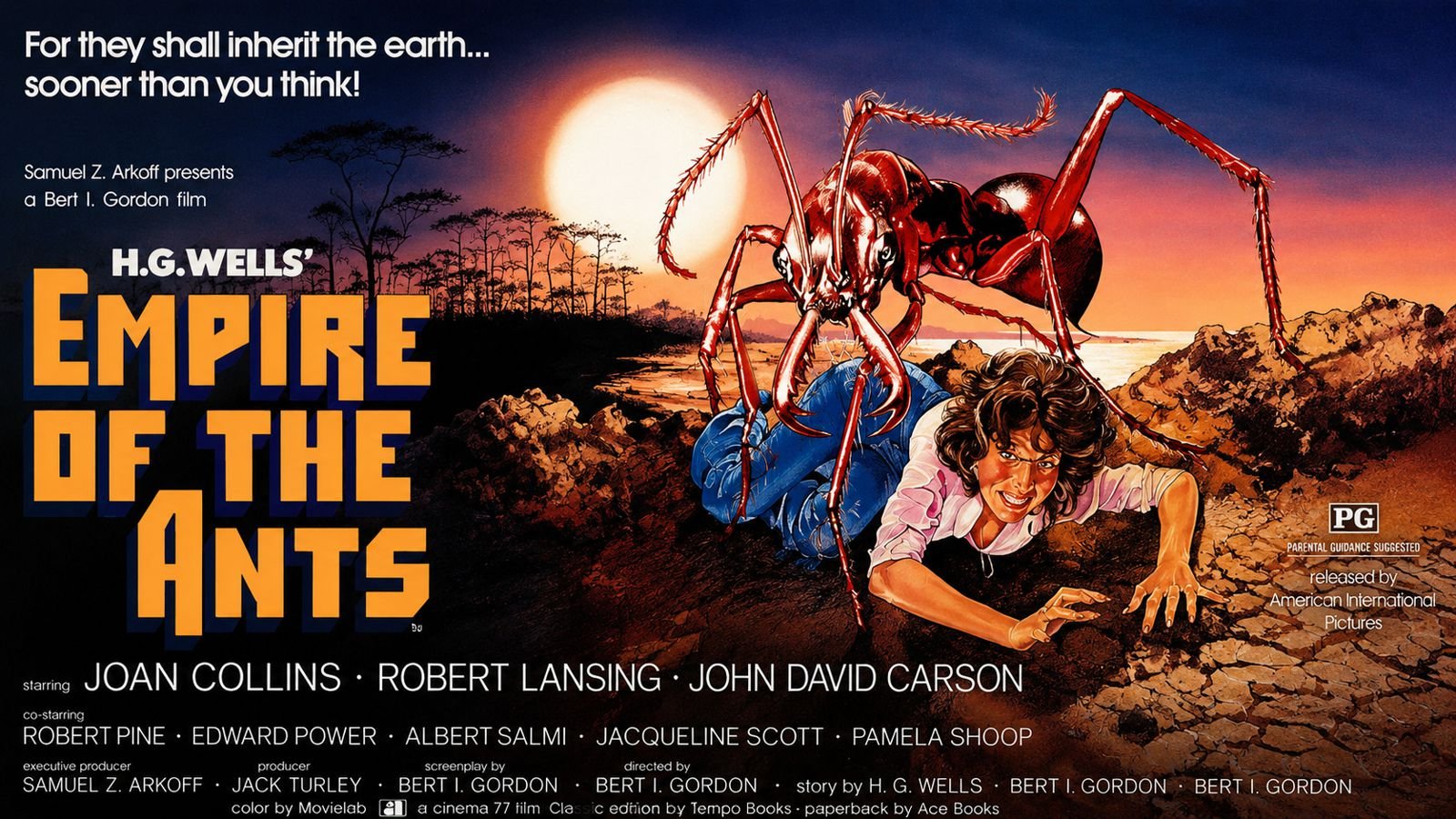
Empire of the Ants (1977)
Cast: Joan Collins, Robert Lansing, John Carson,
Director: Bert. I Gordon
Nutshell: A saucy con artists
“Cheesy drive-in fare that’s fun throughout its entire 89-minute run time.”— Cinema Sentries
“Trashy… even anachronistic, Empire of the Ants is undeniably watchable.”— The Digital Bits
“A thick hunk of American cheddar.”— Cool Ass Cinema
“Joan Collins… delivers a performance that more than adds this film to the considerable pile of her camp classics.”— Moria Reviews
“A shoddy 1970s Animals Amok film about giant ants.”— Moria Reviews
“Utterly ludicrous in every respect.”— The EOFFTV Review
“A cheesy giant ant film based loosely, and I mean very loosely, on a 1905 H.G. Wells short story.”— Monster Shack
“The giant ants in Empire of the Ants do not look at all like giant ants.”— Eric D. Snider
“It’s all drastically boring.”— Time Out
“Periodic moments of good special effects are separated by reels of dramatic banality.”— Variety
“The Empire of the Ants is edgy, insipid worthlessness that dares to claim it derives from H.G. Wells.”— Rex Reed, New York Daily News
Footage of ants of all shapes and sizes diligently going about their daily duties, accompanied by a wonderfully serious deadpan voiceover, gets the ball rolling in H.G. Wells’ Empire of the Ants. The narration warns viewers that humanity has failed to take ants seriously enough, failed to respect them, and failed to understand that in the not-so-distant future these tiny creatures may very well become “the next dominant force of the planet.”
A chilling warning indeed.
This is followed by footage of some suitably suspicious “official” types heading out to sea with a boat loaded full of toxic waste. They proceed to dispose of it in the traditional environmentally responsible fashion — by chucking barrel after barrel straight into the ocean beside a stretch of undeveloped land.
This same barren wasteland has been earmarked by Joan Collins as “Dreamland Shores,” a luxurious five-star estate destined to become the envy of the world. She has organised a promotional tour of this future paradise, gathering together a motley collection of potential buyers eager to witness the miracle of modern property development.
At present, however, Dreamland Shores consists mainly of empty fields decorated with ambitious signs promising a “future 18-hole golf course,” a “future swimming complex,” a “future state-of-the-art gymnasium,” along with future shops, restaurants, cinemas, casinos and basically every future luxury imaginable.
One day it may indeed become paradise.
At the moment, unfortunately, it resembles a swampy dump being promoted by a wildly egocentric woman who appears intent on relieving her customers of their savings before possibly disappearing into the sunset.
Sadly for Ms Collins, her assembled guests appear less like wealthy investors and more like freeloaders who heard rumours of free sandwiches and cheap wine.
Nevertheless, the show must go on.
The group heads off through this barren landscape of “future magnificence,” but it isn’t long before strange and ominous sounds begin echoing nearby. Nobody pays much attention, although we viewers already know something is terribly wrong. We have witnessed ordinary ants feasting on a mysterious mercury-like substance leaking from those toxic barrels so generously donated to nature by mankind.
Soon the strange sounds grow closer and closer.
Then comes the genius of Ant-Vision.
Whenever the ants are preparing to strike, the camera switches to the insects’ point of view, splitting the image into numerous tiny fragments just as an ant supposedly sees the world. It is a wonderfully ridiculous touch, and the moment Ant-Cam appears, viewers know that somebody’s chances of survival have decreased dramatically.
The first victims are a middle-aged couple who discover that the impressive piping system supposedly installed throughout Dreamland Shores is nothing more than a few plastic pipes shoved into the ground for appearances. Unfortunately, before they can expose Joan Collins’ magnificent real-estate empire for what it really is, the ants arrive.
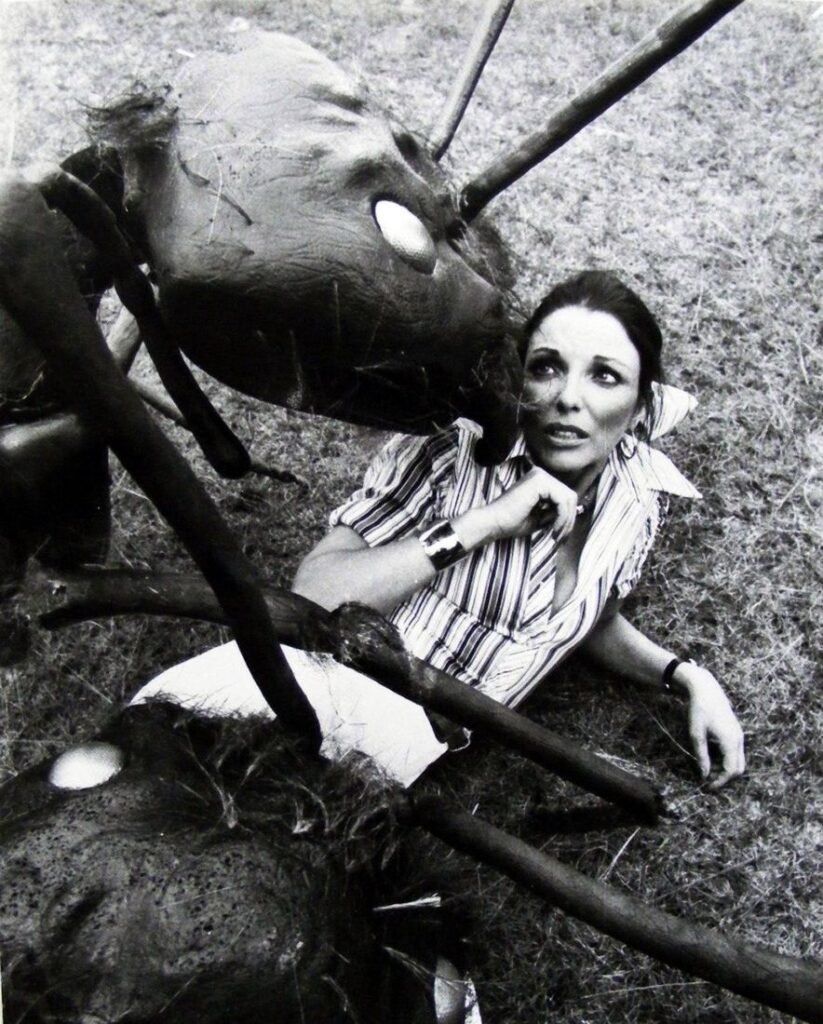
Having gorged themselves on atomic waste, the little insects have mutated into gigantic monsters towering over their human prey. The eight-foot ants launch their attack, and within moments the unfortunate couple becomes an afternoon snack.
The ants themselves are furry, twitchy and oddly adorable, somewhat reminiscent of the giant killer rabbits from Night of the Lepus. You might almost consider keeping one as a pet if only it would stop screaming for two seconds.
Naturally, there is much shouting of “Oh my God!” and “Get the hell out of here!” as the survivors run around desperately trying to avoid becoming teatime treats for the increasingly ambitious ant population.
Things begin looking extremely bleak. The survivors are surrounded, panic sets in, and then comes the sinister revelation that the ants may not simply be interested in eating people. There appears to be a larger plan unfolding. Rather than randomly devouring humans, the ants seem to be herding them.
What exactly do these horrible creatures have planned?
Who will survive?
And what will be left of them?
The film eventually takes a wonderfully bizarre turn involving a nearby sugar factory producing “enough sugar to feed an army,” more mysterious official types, and a discovery that suggests the ants may have advanced far beyond simple monster movie behaviour.
Suddenly that ominous opening narration begins to make sense.
Maybe, just maybe, one day the ants really will have their revenge.
The film waddles along at a pace just fast enough to prevent viewers from abandoning ship entirely, helped enormously by the presence of the wonderful Joan Collins doing what Joan Collins has done better than almost anybody throughout her career — playing Alexis Colby-Carrington.
The names change, the films change, the decades change, but Joan remains gloriously Joan.
Here she is gifted a particularly juicy variation of the role. During the first half she is cold, confident, ruthless Alexis. During the second half she transforms into screaming, hysterical, considerably less confident Alexis.
It is perhaps a shame that Collins became so strongly associated with this particular character type because one wonders what other sides of her we might have seen. Still, when someone plays the cold, glamorous schemer this magnificently, perhaps resistance is futile.
Much of the film is spent imagining what spectacularly horrible fate should eventually befall Ms Collins’ character before remembering that the special effects budget probably cannot provide the level of gruesome satisfaction required.
The supporting cast of assorted victims and future ant food are exactly what one expects from this type of creature feature and serve their purpose perfectly well.
The simple fact remains that any film featuring Joan Collins, giant mutant ants, delicious 1970s sexism, environmental hysteria, and gloriously ropey special effects cannot possibly be dismissed entirely.
This ridiculously preposterous slice of eco-horror madness, supposedly inspired by H.G. Wells, is certainly more entertaining than many far more expensive productions and remains streets ahead of Irwin Allen’s spectacular disaster The Swarm, the legendary turkey that crashed and burned around the same period.
It was the 1970s.
The Summer of Sam was terrifying America, I Feel Love was changing music forever…
…and thankfully ants were still just ants.